About Theristicus melanopis (Gmelin, 1789)
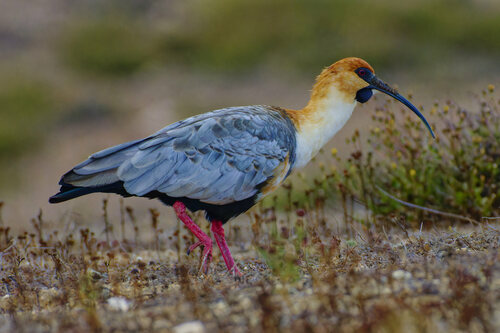
Theristicus melanopis (Gmelin, 1789), commonly called the black-faced ibis, has a total length of approximately 75 centimetres (30 in). Its head, neck, and lower chest are buffish, while its crown and nape are cinnamon. The upperparts and often incomplete chest-band are grey; its belly and flight feathers are black, and its wing-coverts are whitish, which do not contrast strongly with the grey upperparts. Its bill, throat-wattle, and the bare skin around its eyes are blackish, and its legs are red. The closely related buff-necked ibis is almost entirely restricted to warm regions, has contrasting large white wing-patches, a dark grey lower chest (rather than the buff lower chest of the black-faced ibis), and a smaller throat-wattle than the black-faced ibis. The black-faced ibis is mainly distributed in southern South America, ranging across most of southern and central Argentina and Chile, where it occurs from sea level up to an altitude of approximately 2,500 metres (8,200 ft). It also occurs very locally in coastal Peru. While the species remains fairly common in Argentina and Chile, it has now been almost entirely extirpated from the Peruvian portion of its range. Overall, the species is not threatened, so the IUCN has assigned it the conservation status of Least Concern.