About Therea petiveriana (Linnaeus, 1758)
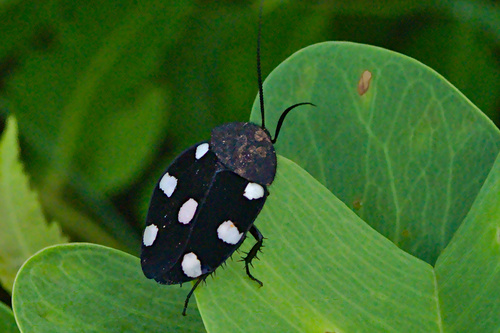
The adult Therea petiveriana has a black and white pattern that is thought to have evolved to mimic the pattern of the aggressively defended ground beetle Anthia sexguttata, which can spray chemical irritants. The upper surface of its abdomen is orange-yellow, but this color is hidden by the insect’s tegmina. The spots on the asymmetrical tegmina are positioned to appear symmetrical when the tegmina are closed. The right tegmen lobe is bright orange-yellow. This species has been described as one of the few cockroaches that possesses "grace and beauty". The head is bent back underneath the pronotal shield in a hypognathous position, and the forward-facing ocelli, or simple eyes, help sense light to detect time of day. Therea petiveriana forages actively during early morning and late evening. After a female copulates with a male, she prevents other males from approaching her by kicking them away with her hind legs. Females lay their eggs in leaf litter. A single female can produce up to 13 oothecae over a period of 3 to 40 days; blocking a female’s ocelli has been found to inhibit egg-laying. Oothecae are produced from secretions of the female’s asymmetrical colleterial glands, as is typical for other cockroach species. Once an ootheca is extruded, it is deposited in appropriately moist leaf litter. Nymphs live hidden underground, and may burrow as deep as 30 cm during the dry season.