About Theodoxus fluviatilis (Linnaeus, 1758)
Theodoxus fluviatilis (Linnaeus, 1758) has a somewhat depressed, strongly calcified shell that usually has a low spire and 3–3.5 whorls including the protoconch. Larger specimens usually have eroded shells. Adult shells are typically 5–9 mm wide, and can reach a maximum width of 11–13 mm. Shell height ranges 4–6.5 mm, and can reach up to 7 mm. These average values vary between populations based on environment: brackish water populations have a maximum shell width of 9.3 mm, a maximum shell height of 5.8 mm, and a maximum shell weight of 124 mg, while freshwater populations have a maximum recorded shell width of 13.1 mm, maximum shell height of 9.3 mm, and maximum shell weight of 343 mg.
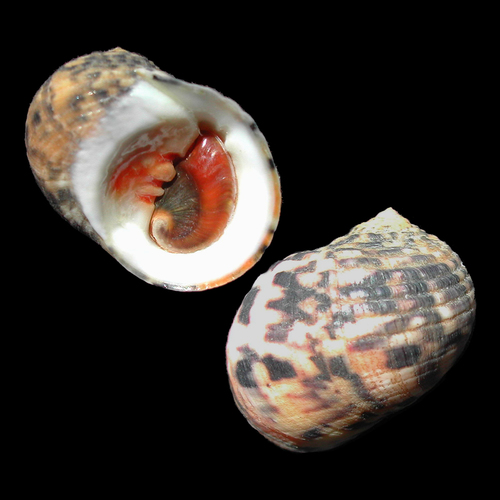
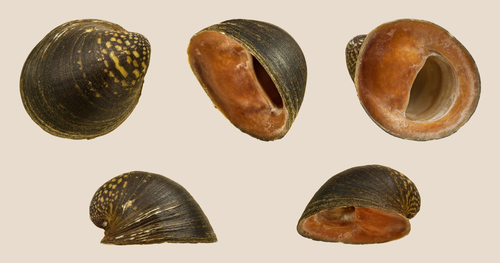
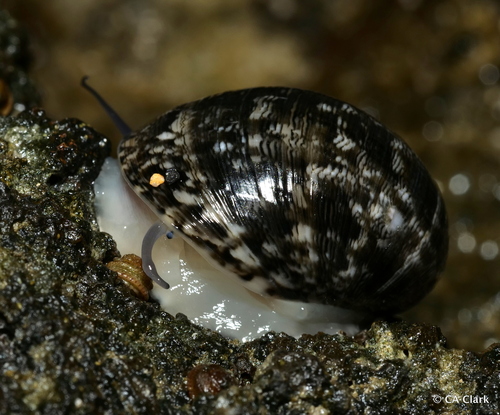
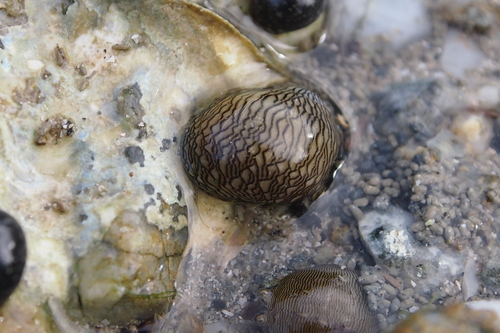
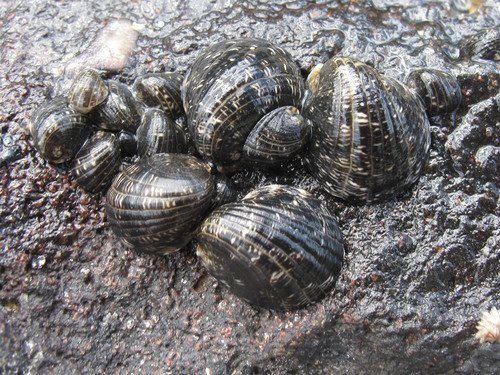
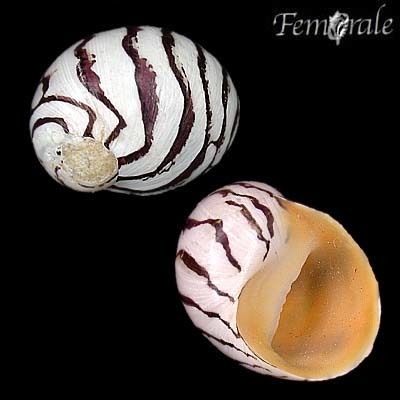
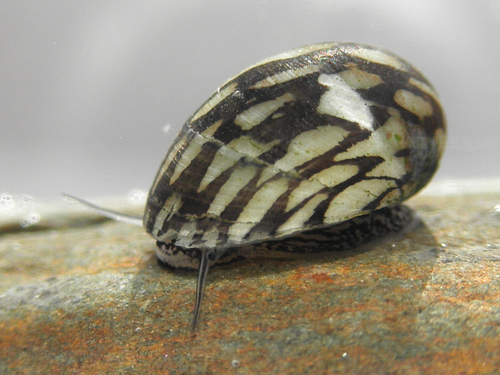
The shell exterior is generally whitish or yellowish, with a net-like dark reddish or violet pattern. This pattern is highly variable based on environmental factors; it may sometimes include partial bands, and can even be evenly dark occasionally. The species shows high polymorphism with extensive variation in shell color and pattern. All species in the genus Theodoxus have highly plastic shell color and pattern, which may be influenced by factors such as water ionic composition, substrate type, and individual nutrition across different habitats. A 2004 study by Zettler and colleagues found that nearly black, often corroded shell forms of Theodoxus fluviatilis are dominant in the outer coastal waters of the Baltic Sea, while yellowish-green forms are common in sheltered inner coastal areas. A 2015 observation by Glöer and Pešić noted that specimens from dark stony substrates are black or dark brown. Northern European specimens have a pattern of white drop-like spots on a dark or red background. Specimens from southern France and Spain have zigzag stripe patterns, while specimens from the Balkans show all possible combinations of white drop-like spots and zigzag stripes. Individuals from lake habitats have dark or light bands on their shells.
The shell shape of Theodoxus fluviatilis is similar to that of Theodoxus transversalis. Theodoxus danubialis has a more spherical shell shape, and Theodoxus prevostianus usually has a descending aperture shape. All of these species have high morphological plasticity, making them difficult to tell apart. Overall shell outline is still used for species identification in modern malacological literature. While shell coloration and patterns are not reliable for identifying specimens, opercular traits can be used for correct identification of Theodoxus fluviatilis. The calcified operculum of T. fluviatilis is D-shaped, light reddish with a red margin, and bears a broad rib (also called a ridge) on its inner surface, to which the columellar muscle attaches. The rib is long and thin, tapering at the base, the callus is thin, and a peg is absent. These characteristic operculum features are already visible in juveniles. There is sexual dimorphism on the border of the operculum's rib shield: it is straight in females and curved in males. Operculum shape aberrations have been observed: a double rib with reduced rib shield was found in a specimen from Vouvant, France and another from a spring near Bar, Montenegro; only the rib shield was reduced in a specimen from Lake Ohrid. T. fluviatilis can be distinguished from the three other species mentioned by the presence of a rib pit, formed by the rib and the rib shield. Theodoxus transversalis, Theodoxus danubialis, and Theodoxus prevostianus lack a rib shield and therefore a rib pit, and all three have a peg in addition to a rib, which is absent in T. fluviatilis.
The visible soft parts of the animal are light yellow with a black head. The tentacles are long and greyish, the eyes are large and black, and the foot is whitish.
The exact type locality for this species is unknown, but it is likely the Main river in southern Germany. Glöer (2002) interpreted Linnaeus' type locality as "Habitat in fluviis, Upsaliae ad molendinam Ulvam & alibi", which would suggest a brackish water environment. Once thought to be distributed only across Europe, the species actually occurs from western to central Palaearctic. It is found scattered across Europe and Western Asia, excluding the Alps and regions immediately north of the Alps. It does not live in Norway or Siberia. Theodoxus fluviatilis has the widest distribution of any species in the genus Theodoxus, and is one of the most widely distributed species in the entire family Neritidae. This species is mainly threatened by river engineering and water pollution in densely populated regions. The overall population trend is stable, but it is declining in some areas such as Germany, while expanding in others such as the Danube river. In the 1970s, Theodoxus fluviatilis nearly went locally extinct in the Rhine river due to water pollution. After over two decades of improving water quality that allowed for recovery, the species became extinct in the Rhine again in the late 1990s for unknown reasons. Since 2006, Theodoxus fluviatilis has recolonized the Rhine, most likely via ship transport through the Main-Danube Canal. Analysis of the cytochrome-c oxidase I (COI) gene indicates the recolonizing population likely originated from the Danube.
Theodoxus fluviatilis prefers lowland habitats (in Switzerland it occurs up to 275 m above sea level) and calcium-rich waters. This small snail lives in the central and lower parts of rivers up to 13 m deep, including brackish water in estuarine tidal rivers. It sometimes lives on unvegetated lake bottoms. It is rarely found in rheocrene springs, groundwater, and caves. For example, it has been found in lakes with a pH of 7.8–8.9 in the Åland Islands, and in streams and rivers with a pH of 7.0–8.4 in Ireland. The species easily attaches to stones, which lets it live in fast-running water and the lake wave zone. Its ability to live in both freshwater and brackish water demonstrates this species' phenotypic plasticity. It can live at depths up to 60 m in coastal waters. Brackish water populations tolerate salinities up to 15‰ in the Baltic Sea, and up to 18‰ in the Baltic and Black Seas. Brackish water populations tolerate higher salinity than freshwater populations, and accumulate much higher levels of ninhydrin-positive substances in the foot. This species lives on hard benthic substrates, most typically rocks. It also lives on pebbles, sometimes on boulders, and rarely on dead wood. It tolerates mild organic pollution and low oxygen content down to below 2 mg/L, but cannot tolerate long periods of drought or ice. It lives in mesotrophic waters, and sometimes in oligotrophic waters. In Germany, Theodoxus fluviatilis is used as an indicator species for river monitoring, but expanding populations also have high tolerance for degraded habitats. Theodoxus fluviatilis has high phenotypic plasticity: it has been found living on stones and dead wood in freshwater environments, while in brackish Baltic Sea waters it lives on stones and on Fucus vesiculosus, Potamogeton spp., and Zostera marina. It can also be found on Mytilus aggregates. Along with the isopod Saduria entomon, this species is a dominant contributor to fauna biomass in the central and northern Baltic Sea. Brackish water populations can reach densities of 200–1000 snails per square meter. Theodoxus fluviatilis dalmaticus in Lake Ohrid can reach population densities up to 6412 snails per square meter. Population densities up to 9000 snails per square meter have been recorded in a spring of the Anços river in Central Portugal, where a stable temperature of 15.3–16.6 °C allows continuous reproduction. In September 2003, a density of 34,932 juvenile snails per square meter was recorded at Gabčíkovo port.
Theodoxus fluviatilis is gonochoristic, meaning each individual is distinctly male or female, and cross-fertilization occurs. The sex ratio is 1:1. The structure of the spermatozoon flagellum is unique: it is divided into two parts. T. fluviatilis usually lays eggs from mid-April to October, at temperatures above 10 °C. Eggs are laid inside egg capsules deposited on stones, and sometimes on the shells of other conspecific individuals. Females usually lay clusters containing 4–5 capsules. A single female lays about 40 capsules over summer, and about 20 capsules over autumn. Fresh capsules are white, while older capsules turn yellow or brown and may develop an epiphytic outer layer. Capsules are around 1 mm in diameter (0.9–1.1 mm), and are usually smaller in brackish water at around 0.8 mm. Empty sterile capsules 0.5–0.8 mm in diameter may also be laid. The number of eggs per egg capsule changes based on environment: each capsule holds 100–200 eggs in freshwater, compared to 55–80 eggs in brackish water. Usually only one egg develops, and the remaining eggs act as nutrition for the embryo, so only a single juvenile snail hatches from each capsule. Juveniles with a shell length of 0.5–1 mm hatch after 30 days at 25 °C, or after 65 days at 20 °C. Newly hatched snails have an ash-free dry weight of 0.012 mg, and their protoconch has one whorl. Capsules laid in spring hatch after 2–3 months, in August to September. Late summer capsules overwinter because embryonic development stops at temperatures below 10 °C, so they hatch the following spring after 7–8 months. Shell growth occurs mainly from May to August, with no growth in winter. Snails reach sexual maturity in less than 1 year, when their shell length is 5.5–5.7 mm. The life span of T. fluviatilis is 2–3 years, and a small number of individuals have been estimated to live up to 3.5 years. Mortality is low in summer, and higher in winter because ice and storms can displace substrate, causing mechanical damage to the snails.