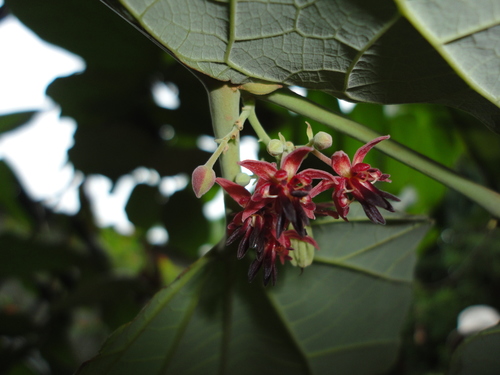
About Theobroma bicolor Humb. & Bonpl.
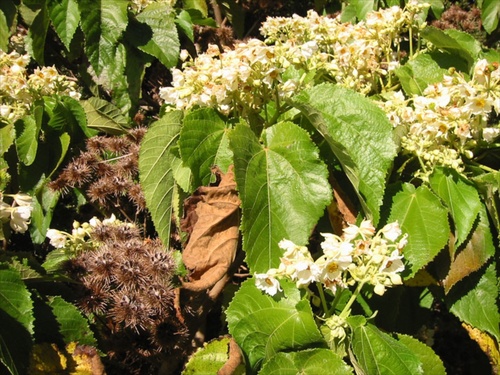
Theobroma bicolor Humb. & Bonpl. reaches heights of 3 to 8 meters when growing in open fields, but may grow to 25 to 30 meters in forest understories. This species is a slow-growing tree that grows best in loose, unconsolidated soils. It is adapted to survive low levels of flooding, and can sometimes persist through deeper flood events. In the central Amazon region, this tree produces fruit from March to November, and flowers from July to September. Like its close relative the cacao tree, the seeds of the mocambo tree (Theobroma bicolor) are edible, high in calories, and rich in protein and fiber. The seeds are also high in omega 9 and contain caffeine. Historically, Theobroma bicolor was cultivated by the Aztecs together with T. cacao to produce chocolate. When chocolate was introduced to the Spanish, they considered the chocolate made from T. bicolor to be lower in quality. The seeds of T. bicolor can also be eaten fried or added to soups. Empty seed pods of this species are used as planters and containers. The pulp that surrounds the seeds can be eaten fresh, and has a sweet, mild flavor. When the fruit is ripe, it naturally detaches from the tree branches and falls to the ground; the standard harvesting method for T. bicolor is collecting these fallen fruits. According to contemporary accounts from the time of the Conquista, the Maya valued the buttery foam produced on top of cacao and maize beverages. Evidence suggests that using T. bicolor fruit as a cacao source creates a thick, stable foam, while T. cacao fruit does not.