About Thelymitra malvina M.A.Clem., D.L.Jones & Molloy
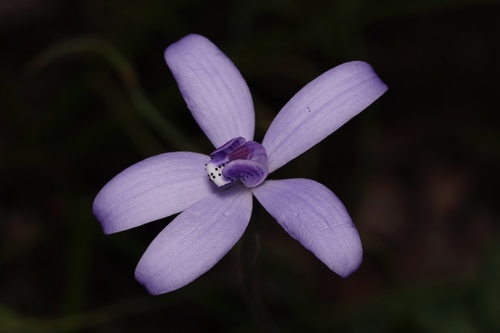
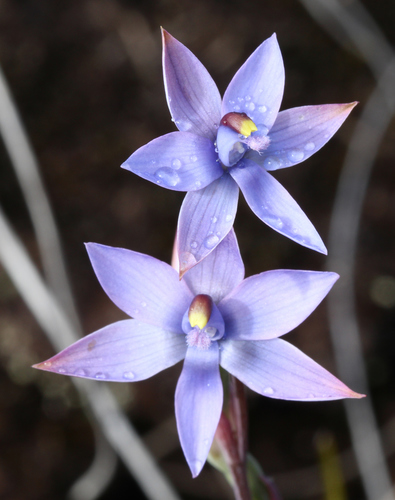
Thelymitra malvina is a tuberous, perennial herb. It produces a single leathery, fleshy, channelled leaf that is dark green and linear to lance-shaped, measuring 100–350 mm (4–10 in) long and 5–20 mm (0.2–0.8 in) wide, with a purplish base. Between three and twenty-five blue to mauve flowers, each 18–32 mm (0.7–1 in) wide, grow arranged on a flowering stem that is 250–750 mm (10–30 in) tall. There are usually three bracts along the flowering stem. Its sepals and petals are 8–20 mm (0.3–0.8 in) long and 3–7 mm (0.1–0.3 in) wide. The column of the flower is white to blue, 6–7.5 mm (0.2–0.3 in) long and 2.5–3.5 mm (0.098–0.14 in) wide. The lobe on the top of the anther is dark reddish brown with a yellow tip and has a tube shape. The side lobes curve forwards, and have pink or mauve, mop-like tufts at their ends. The flowers are scented, pollinated by insects, and only open on hot days. Flowering occurs between November and January. In Australia, this orchid, commonly called the mauve-tufted sun orchid, grows in forest, woodland, and heath habitats. It occurs in Queensland, south from Mount Moffatt in Carnarvon National Park, across coastal areas of New South Wales and southern Victoria, and on the north and east coasts of King Island and Flinders Island in Tasmania. In New Zealand, the species only grows in the northern parts of the North Island, where it inhabits wetlands, most commonly on rotting kauri logs.