About Thelymitra juncifolia Lindl.
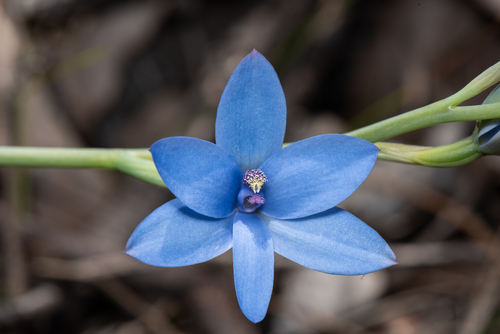
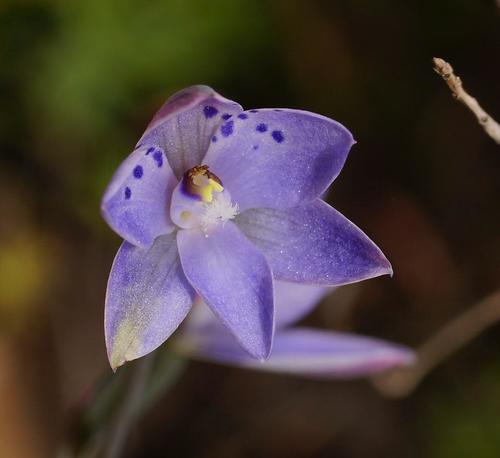
Thelymitra juncifolia Lindl., commonly known as the large-spotted sun orchid, is a tuberous perennial herb. It produces a single dark green leaf that is channelled, ranges from thread-like to lance-shaped, and measures 150–200 mm (6–8 in) long and 8–10 mm (0.3–0.4 in) wide. Up to five greyish blue to light blue flowers grow on a flowering stem 200–300 mm (8–10 in) tall. The flowers themselves are 25–35 mm (0.98–1.4 in) wide, and have relatively large darker blue spots on the dorsal sepal and petals. The sepals and petals are 10–13 mm (0.4–0.5 in) long and 5–7 mm (0.2–0.3 in) wide. This orchid has a white or blue column 4–6 mm (0.16–0.24 in) long and around 3 mm (0.1 in) wide. The lobe on top of the anther is short, yellow or orange with a red or dark purple band on its back, and bears multiple rows of crowded, finger-like glands. The side lobes have relatively sparse, mop-like tufts of white or bluish hairs. Flowers of this species are usually self-pollinating, but are sometimes pollinated by insects. Flowering takes place from October to December. The large-spotted sun orchid is widespread and common across its range in Australia. It grows in heath, forest, woodland and scrub in New South Wales, the Australian Capital Territory, Victoria, South Australia, and Tasmania.