About Thelotrema lepadinum (Ach.) Ach.
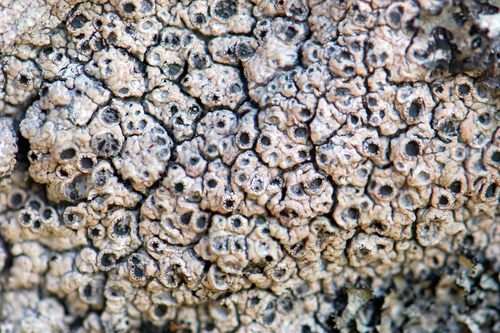
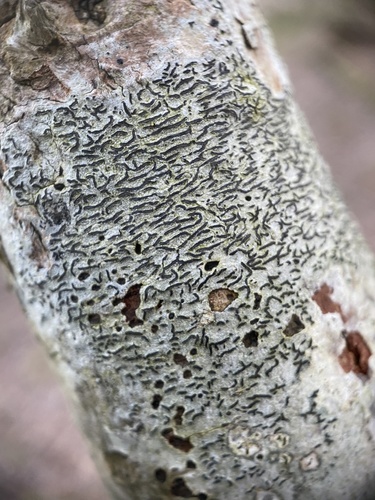
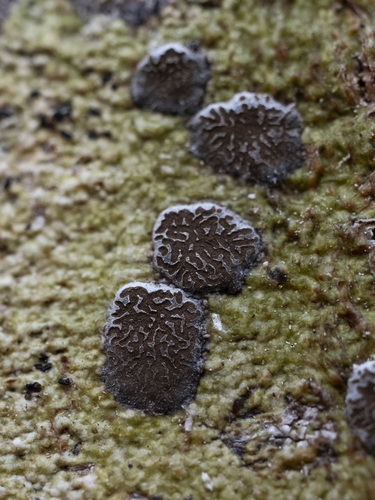
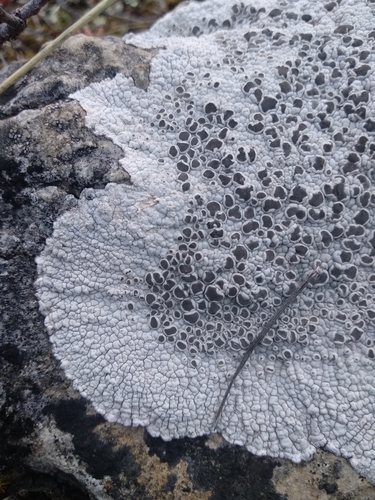
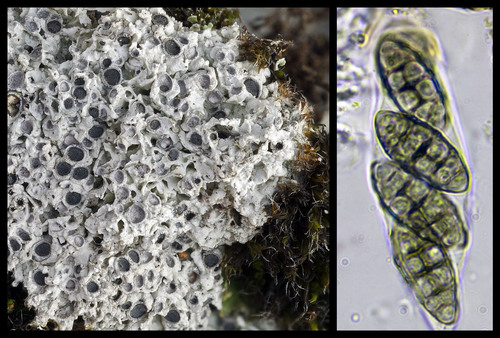
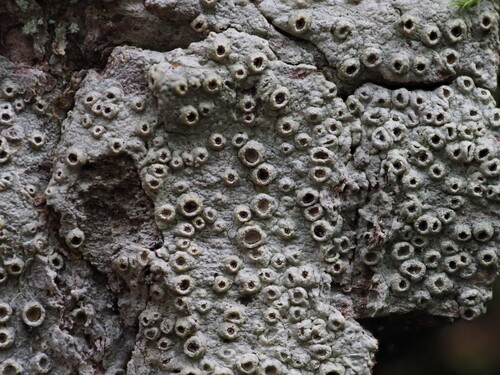
Thelotrema lepadinum (Ach.) Ach. produces a crustose thallus that ranges from thin to quite thick, reaching a maximum thickness of approximately 2 mm. The thallus is most often smooth, though it can be slightly uneven, and it is typically continuous rather than patchy. Its surface colour ranges from greyish fawn to pale ochre, and the thallus grows mostly on the surface of its substrate. In vertical cross-section, the medulla contains many calcium oxalate crystals, which are particularly abundant in the thalline margin that surrounds the apothecia. The apothecia are usually very numerous, more or less evenly scattered, and typically measure 1–2 mm in diameter, though they can occasionally be as small as 0.6 mm. They are immersed inside small, hemispherical warts of the thallus, and are urceolate, or urn-shaped. They have a white ostiolar opening up to around 0.5 mm across, plus an entire thalline margin. The true exciple is separate from the surrounding thallus, and it is often visible through the opening as a colourless, non-striate ring. The apothecial disc itself is blackish, frequently covered by a whitish to greyish pruina, and can generally be seen through an irregular opening in the inner exciple. The hymenium is relatively tall, usually 140–190 micrometres (μm) high, and occasionally ranges from roughly 120 to 200 μm. Asci usually hold 2 to 4 ascospores, but some may hold only one or as many as eight. Ascospores are broadly fusiform (spindle-shaped), typically measuring 60–135 × 15–25 μm, though they can occasionally be as small as about 30 × 10 μm or as large as 150 × 33 μm. They stay colourless when mature, and usually have 10–15 transverse septa (sometimes as few as 8 or as many as 19), along with 1–3 longitudinal septa (occasionally up to 5). Ascospores give a weakly purple iodine reaction (I±) and are enclosed by a thick gelatinous sheath. Standard spot tests on the thallus and medulla give negative results (C–, K–, KC–, Pd–, UV–), and no lichen substances have been detected via thin-layer chromatography. However, internal calcium oxalate crystals may sometimes produce a K+ reaction, turning from yellow to red. In his revision of the Thelotrema lepadinum group, Salisbury considered Thelotrema lepadinum likely to be cosmopolitan in distribution. He cited type or other authentic material matching this species from multiple regions, including Santee Canal in South Carolina (United States), Peradeniya (Sri Lanka), Rangitoto Island (New Zealand, growing on Metrosideros tomentosa), and Katoomba in New South Wales (Australia). He also noted a morphologically similar collection from Tjibodas in Java, whose spores gave a strong iodine reaction, and suggested this collection might represent a separate species. The 2001 publication Lichens of North America notes that the species' distribution in northern North America is largely restricted to coastal areas; despite this limited range, it is the most common Thelotrema species on the continent. In Europe, particularly Britain and Ireland, Thelotrema lepadinum usually grows on smooth or slightly rough bark of deciduous trees, and only rarely grows on siliceous rock. It can become very abundant in long-undisturbed, continuous woodland, with counts of over 400 colonised trees per hectare recorded, so it is used as an indicator of ancient woodland. Within Britain and Ireland, it occurs scattered across suitable habitats. Apothecium shape varies with microhabitat: on dry, exposed trunks of smooth-barked deciduous trees, apothecia tend to be regularly volcano-like with a narrow opening, while in moist, often shaded locations they are larger, more widely open and ulcerose (irregularly open, eroded), with a thick, prominent, somewhat scurfy rim. In humid, oceanic areas, well-developed specimens may be confused with the rarer species Thelotrema macrosporum.