About Thelocactus bicolor subsp. heterochromus (F.A.C.Weber) Mosco & Zanov.
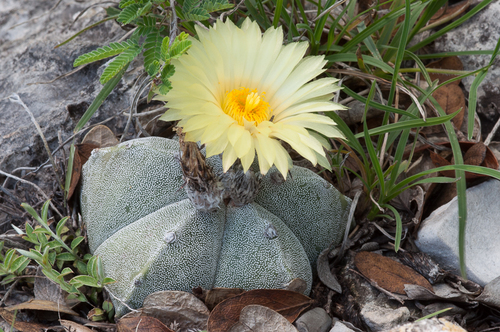
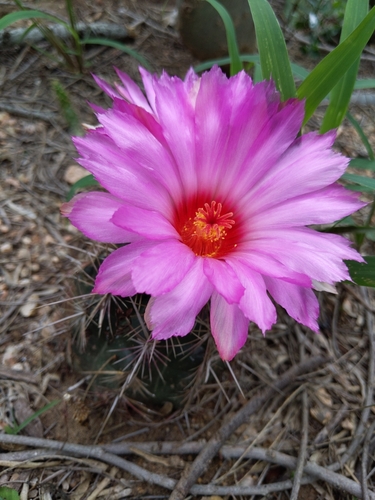
This is a perennial succulent cactus. Plants are usually solitary, but may occasionally form clumps. It typically reaches 6 to 10 centimeters in diameter and grows up to 50 centimeters (20 inches) tall. Its fleshy stem has a blue or gray-green color, is somewhat felty at the apex, and is usually thorny. The cactus has 8 to 13 straight or twisted ribs, each split into crookedly truncated cusps that grow up to 1.5 centimeters high. It produces 9 to 18 marginal spines that are either protruding or slightly curved, reaching up to 3 centimeters long, alongside 1 to 4 central spines that also grow up to 3 centimeters long. The central spines are brightly colored, ranging from white or reddish in the middle to red at the base and yellow at the tip, and gradually turn grayish as the plant ages. The lowest central spine is stretched out and straight, while the upper central spines are erect and flat. In summer, it bears large daisy-like flowers 5–8 cm (2.0–3.1 in) in diameter with ciliate edges. The flower petals are purplish-pink and fade to white toward their base; the inner petal tips form a ring of red that surrounds a prominent yellow central boss. Its fruits are reddish-brown, scaly, and edible. This subspecies is primarily found in the northern Chihuahuan Desert, in Texas and the Mexican states of Chihuahua, Coahuila, Durango, Nuevo León, San Luis Potosí, Tamaulipas, and Zacatecas, growing at elevations between 800 and 2200 meters. It typically grows on flat gravelly soils, limestone or sandstone slopes of hills or outcrops, and alluvial fans in desert or grassland environments. It is cultivated as an ornamental plant, requiring a warm, dry, sunny position planted in sharply-drained specialist cactus compost. It has been awarded the Royal Horticultural Society's Award of Garden Merit.