About Thelephora terrestris Ehrh. ex Fr.
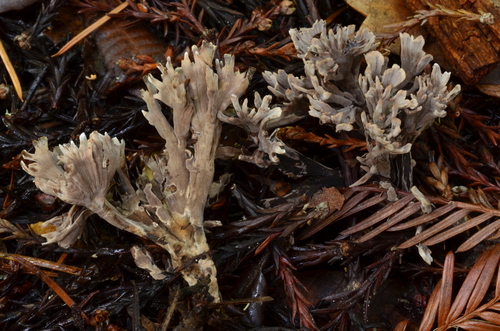
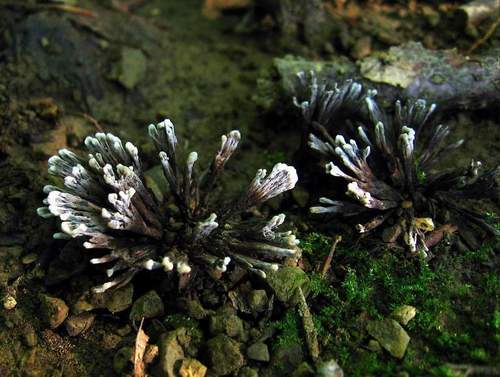
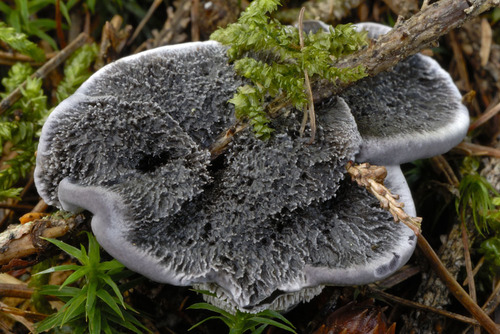
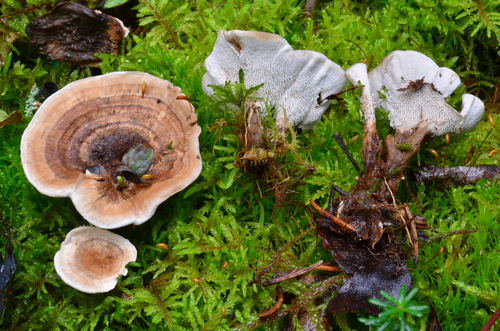
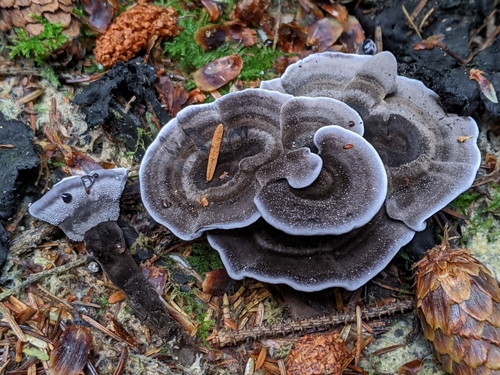
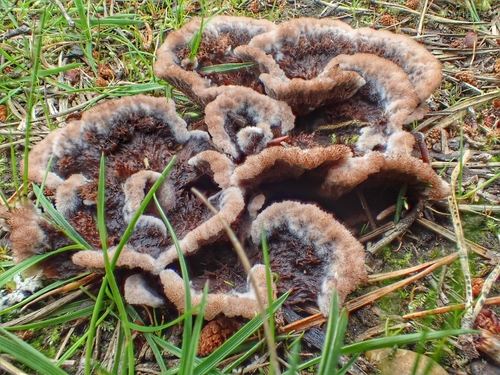
Thelephora terrestris Ehrh. ex Fr. can be found year-round, though it is most commonly seen from July to December. When its basidiome first forms, it is lighter in color, and darkens to a deeper brown as it ages. A stipe (stem) may be absent entirely; if one is present, it is typically very short. This fungus sometimes grows in large colonies. Its basidiome is fan-shaped and can reach up to 6 centimetres (2+1⁄4 inches) wide. It has a moldy, earth-like odor. In mycorrhizal forms, the hyphae develop thicker walls as they age, and may have a spiny texture in their earlier stages. During mating, hyphae form clamp connections. Its spores are purple-brown, with an ellipsoid or angular shape. The edibility of this fungus is unknown, and it is considered too tough to be worth eating. This ectomycorrhizal fungus is found in soil across North America and Europe. It is most commonly encountered in sandy soil under pine trees, growing on roots and twigs. It forms symbiotic mycorrhizal relationships, especially with species in the Pinus (pine) genus. It is commonly found in pine forests, as well as in plant nursery soils worldwide. It is able to obtain water and nutrients from distant locations, and can grow in both low-fertility and high-fertility soils. It is a dominant mycorrhizal fungus that re-establishes quickly after disturbances like forest fire, and is classified as stress tolerant. Beyond the Pinus genus, it can also form mycorrhizae with other trees including alder, birch, oak, beech, and poplar. This fungus can be infected by Thelephora terrestris virus 1 (TtV1), a mycovirus.