About Thelephora palmata (Scop.) Fr.
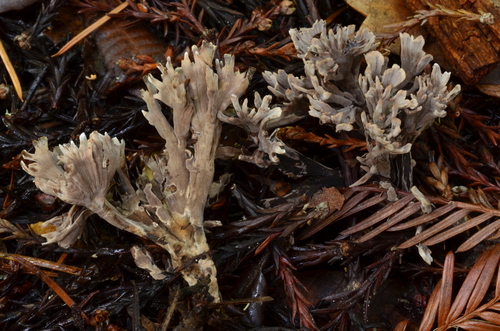
Thelephora palmata (Scop.) Fr. produces coral-like tufted fruit bodies that branch repeatedly from a central stalk, reaching 3.5–6.5 cm (1+3⁄8–2+1⁄2 in) in height. The fruit body branches end in spoon- to fan-shaped tips that are often fringed or grooved. Young branches are whitish, and gradually turn gray to lilac-brown as they mature, while the tips stay whitish or paler than lower sections of the branches. The flesh of the fungus has a tough, leathery texture. The hymenium, the fertile spore-bearing tissue, is amphigenous, meaning it grows on all outer surfaces of the fruit body. Thelephora palmata has a distinctly unpleasant odor, described as similar to fetid garlic, old cabbage water, or overripe cheese. It has been called "a candidate for stinkiest fungus in the forest", and the unpleasant odor becomes stronger after the fruit body dries. The fruit bodies of this species are not edible. Spore deposits are purple-brown to brown. When examined microscopically, spores appear purple. They are angular with lobes, covered in warts, and have fine spines 0.5–1.5 μm long. The elliptic spores measure 8–12 by 7–9 μm overall, and contain one or two oil drops. The spore-bearing basidia measure 70–100 by 9–12 μm, with sterigmata that are 2–4 μm thick and 7–12 μm long. When a drop of potassium hydroxide solution is applied to the flesh, it stains deep blue. The fungus contains the pigment thelephoric acid. It can be confused with similar species: Thelephora anthocephala has a similar general appearance, but can be told apart by its upward-tapering branches, flattened branch tips rather than spoon-like ones, and lack of a fetid odor. The North American species Thelephora vialis has smaller spores and more variable color. Darker species of Ramaria can be distinguished by their non-leathery flesh texture and pointy branch tips. Thelephora palmata is an ectomycorrhizal species that forms mutualistic associations with conifers. Its fruit bodies grow singly, scattered, or in groups on the ground in coniferous forests, mixed forests, and grassy fields. It shows a preference for moist ground and locations along woodland paths. It is an uncommon species, and its fruit bodies can be hard to spot because they blend in well with their surroundings. The species is distributed across Asia (including China, Iran, Japan, Siberia, Turkey, and Vietnam), Europe, North America, and South America (Brazil and Colombia). It has also been recorded in Australia and Fiji. Fruit bodies of Thelephora palmata are eaten by the springtail species Ceratophysella denisana. The fruit bodies can be used for mushroom dyeing. Depending on the mordant used, the resulting dye produces colors ranging from blackish brown to dark grayish green to greenish brown. Without a mordant, the dye produces a light-brown color.