About Thecacera pennigera (Montagu, 1813)
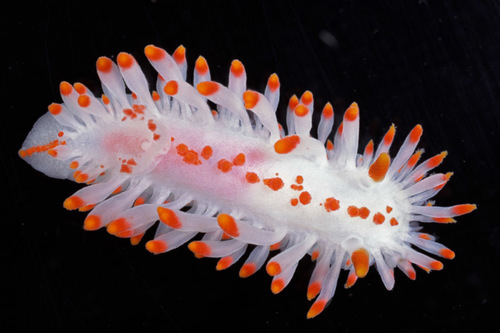
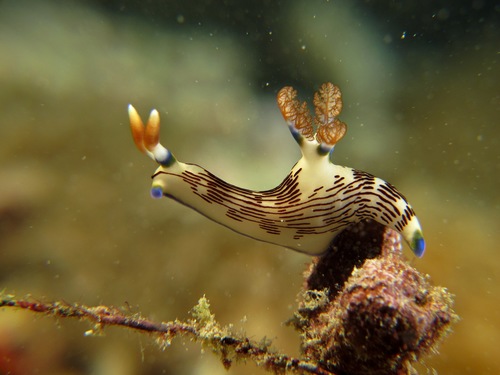
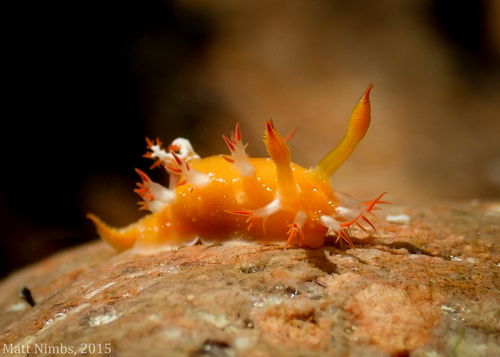
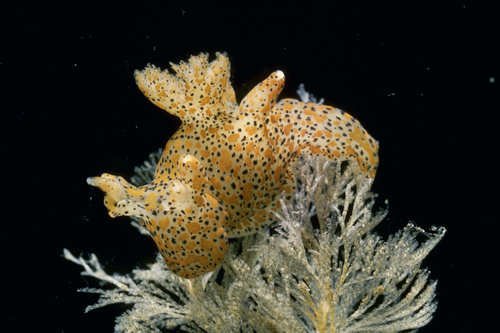
Thecacera pennigera is a nudibranch with a short, wide head that bears two lateral flaps and two sheathed olfactory organs called rhinophores. Its body is wedge-shaped, wide at the front and tapering to a slender foot that has a lateral keel on each side. Halfway along the body, there are two long, thin, club-shaped, glandular postbranchial processes with white tips; these processes serve a defensive function. A cluster of bipinnate or tripinnate gills sits just above and in front of these processes. The general body color is translucent white, and its dorsal surface is covered with orange splotches and small black spots. Adults typically reach lengths between 15 millimeters (0.6 inches) and 30 millimeters (1.2 inches). This species was first described from the south coast of England. It has been reported to have a cosmopolitan distribution, found in temperate waters on both sides of the North Atlantic Ocean, the Mediterranean Sea, around South and West Africa, Brazil, Japan, Korea, Pakistan, and more recently in Australia and New Zealand. There is a notable difference in coloration between Atlantic populations and Pacific specimens, which suggests this group may be a complex of several separate species rather than a single cosmopolitan species. In suitable habitat conditions, it can occur in large numbers, but it is often sporadic or even rare. It occurs at depths down to 36 meters (120 feet), where it lives on arborescent bryozoans. In its type locality, the Northeast Atlantic, it feeds exclusively on the bryozoan Bugula plumosa. This bryozoan sometimes grows on ship hulls as biofouling, and both the bryozoan and Thecacera pennigera have expanded their ranges, likely by hitching rides on ships.