About Theba pisana (O.F.Müller, 1774)
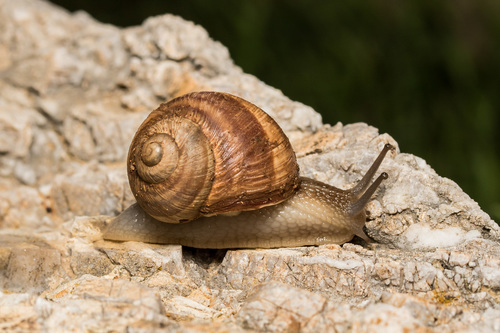
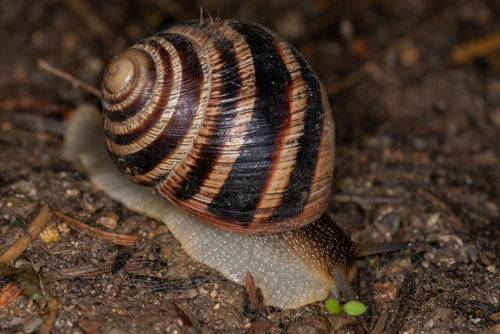
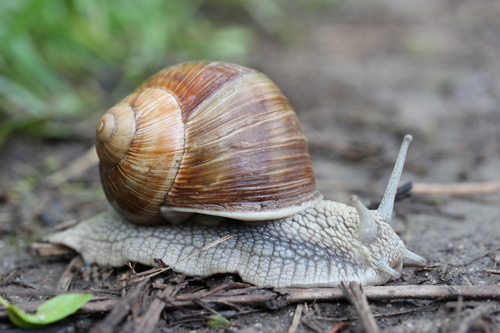
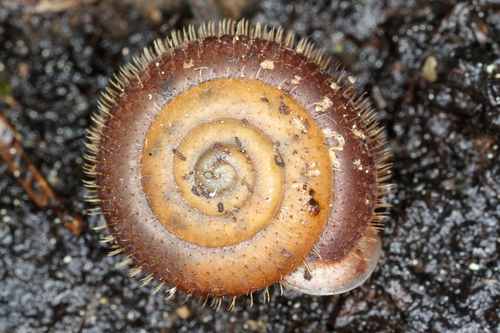
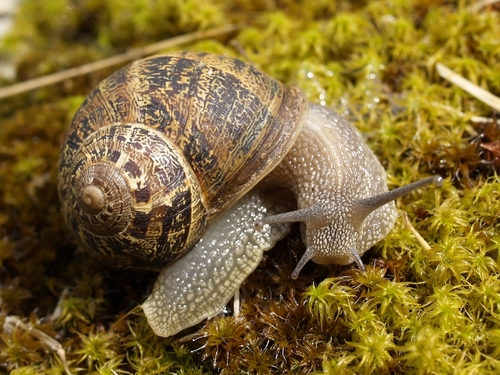
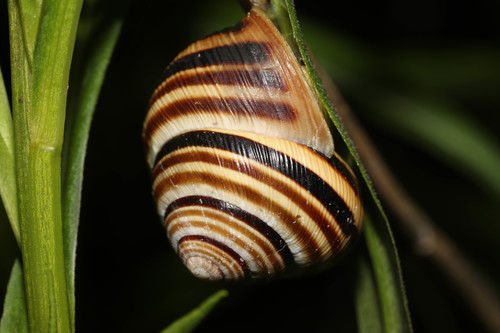
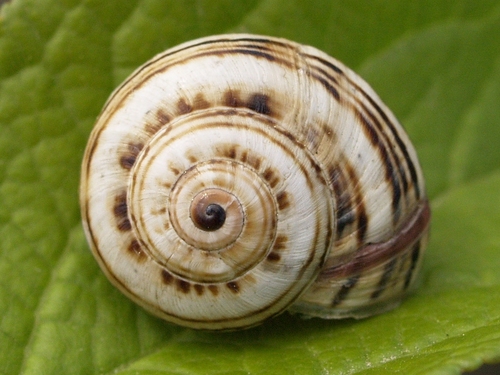
Description: The background color of Theba pisana’s shell is creamy white. Different individuals can have shells with pale to dark brown markings that vary in intensity. When present, markings may take the form of uninterrupted spiral bands, spiral dotted lines, or small radial smudges. While there are many color variants, the shell is fundamentally yellow or white with dark colored bands or spots, and often has a dark bluish grey apex. Juvenile shells are sharply keeled, but the keel does not remain on the final adult whorl. The aperture often has a light reddish lip on the inside, and the lip margin is only reflected on the columellar side. The umbilicus is narrow and half covered by the reflected columellar margin. In the eastern Mediterranean, where no other Theba species occur, the apex of this species has a characteristic size. The umbilicus of this species is also rarely seen in other related species. Compared to juveniles of Eobania vermiculata, juvenile T. pisana have a considerably smaller apex. The shell width ranges from 12 to 25 mm, but adult shells in Greece are usually below 15 mm in width. Shell height ranges from 9 to 20 mm. The visible soft parts are very light yellowish with dark colored bands running from the sides up to the upper tentacles, and the tentacles are very long. This snail is sometimes confused with Cernuella virgata, a species that has a much smaller and less inflated shell. Distribution: The species is native to the Mediterranean region, with a type locality in Italy. Its native distribution includes the Mediterranean region and adjacent Atlantic coasts from central Morocco to northwestern Europe, covering Morocco, Portugal, Spain (where it occurs occasionally in the interior), Italy, Malta, Greece, Israel, Egypt, Belgium, and central Atlantic islands. It has been introduced to Menorca. A subspecies, T. pisana arietina, which occurs in coastal habitats of Spain and Portugal, is listed as Endangered on the Red List. The species has been introduced to many other areas, including southwestern England and south Wales in Great Britain (introduced since at least the 1700s), eastern and southern Ireland (introduced since at least the 1700s, and still spreading across frost-free coastal localities), the Netherlands (non-indigenous), California in the United States, parts of Africa, Asia, southeastern Australia, southwestern Australia, Tasmania, and South Africa. It was introduced into South Africa prior to 1881, and has invaded the fynbos biome there. Because T. pisana can reach very high densities at some sites and appears to have general feeding habits, its potential impact on local vegetation is a concern that requires further investigation. In many introduced areas, T. pisana has become a problematic invasive species and a serious agricultural pest. It is already established in the US, where it is considered a potentially serious pest and invasive species that could negatively affect agriculture, natural ecosystems, human health, or commerce. For this reason, it has been suggested that the species be given top national quarantine significance in the United States. Ecology: Theba pisana typically lives in coastal lands, in or near sandy habitats. In hot climates, it often aestivates while directly exposed to the sun, attached to grasses, shrubs, succulent plants, fence posts, tall weeds, and similar structures. It is common near beaches, and can live on nearly bare sand that is poorly anchored by grasses in dune systems. In colder regions, the snails do not aestivate, but they still climb on plants during dry weather. This snail cannot survive severe winter frosts. Theba pisana is often found alongside two other land snail species, Cochlicella acuta and Cernuella virgata, but it can live slightly deeper in pure sandy habitats, and is usually more common than Cochlicella acuta. It is one of the most common snails in coastal regions from southern Portugal to Greece. A study in South Africa found that these snails are most abundant along roadsides, and densities decrease dramatically with increasing distance from roads. The snails have been observed living on a wide variety of endemic and introduced plant species, and appear able to eat an unusually broad range of different food sources. Theba pisana is also a significant pest of citrus, vines, legume crops, and cereals in South Africa. In Australia, it feeds on a range of agricultural plants. Most T. pisana snails have an annual life cycle, breeding in summer and autumn, though some individuals take 2 years to reach maturity. In aestivating T. pisana populations in Israel, some individuals retain an immature size, shape, and rudimentary genital system, a state referred to as ‘infantiles’; T. pisana populations may be self-regulated through this infantilism mechanism, controlled by humidity, or regulated by both. In South Africa, T. pisana generally follows an annual lifecycle, breeding from autumn to winter and growing to an adult diameter of about 14 mm by the end of the following summer. Maturity is reached at half maximum shell size after 1 year, and maximum shell size is reached after 2 years. This species of snail produces and uses love darts during mating. The diameter of its egg is 2.2 mm. In South Africa, population density can reach up to 300–700 snails per square meter. In South Africa, these snails are active mostly at night, and especially during periods of high humidity, regardless of temperature.