About Thaumetopoea pityocampa (Denis & Schiffermüller), 1776
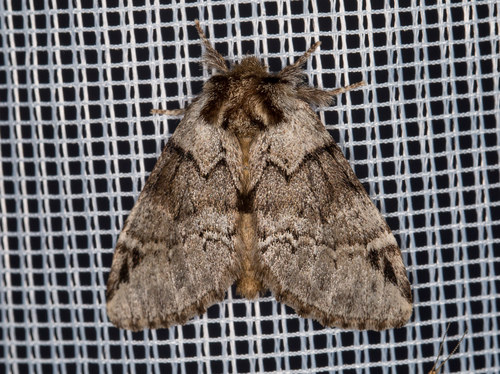
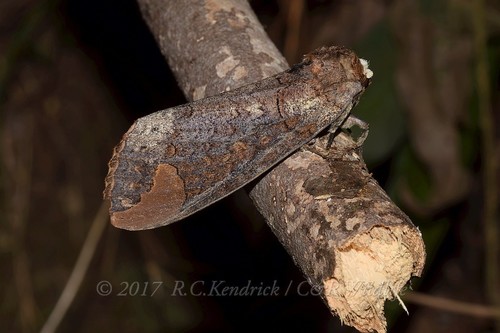
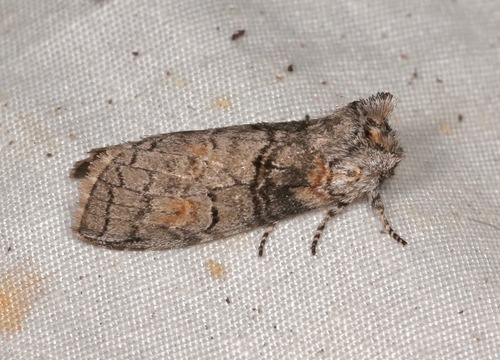
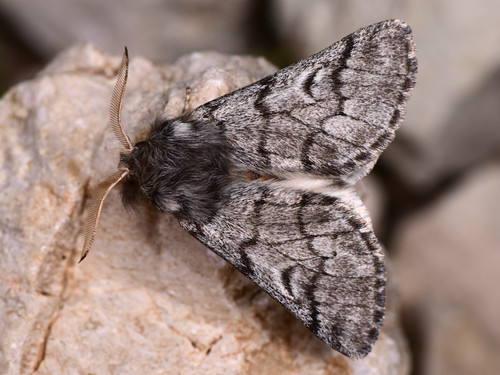
Thaumetopoea pityocampa (Denis & Schiffermüller), 1776 is a species of moth. Adult moths are stout and furry, and hold their wings in a tent shape over their body, similar to eggar moths in the Lasiocampidae family. Adults are larger than the related oak processionary (Thaumetopoea processionea), have a distinct crescent marking on their wings (this marking is not present on the pale eggar moth, while the oak processionary only has an indistinct marking), and inhabit coniferous forests rather than broad-leaved forests. The species' caterpillars are easy to identify by their characteristic processionary movement behavior, their presence in coniferous woods alongside large silken nests, and visible signs of defoliation. The caterpillars are orange-brown, hairy, and marked with blue bands. This species is native to the southern Mediterranean region, North Africa, the Middle East, and southern Europe. It has been spreading northward since the 1990s, aided by climate change and human commercial activities including planting of host trees and transportation, and has now reached Brittany, forests north of Paris, and Strasbourg in northern France. A paler subspecies, T. pityocampa orana, lives in North Africa from Morocco to Libya, and can be found at altitudes up to 2,000 metres (6,600 ft) in the Middle Atlas; adults of this subspecies fly between April and August. While most individual moths of this species complete their life cycle in just one year, some individuals living at high altitudes or in more northern areas may take more than two years to develop. Each female lays an enormous number of eggs near the tops of pine trees. After hatching, larvae eat pine needles as they progress through five developmental stages called instars. To survive the winter, caterpillars build a protective nest from silk threads, making this species one of the few temperate zone insects where larvae develop during the winter. Around the start of April, caterpillars leave their silk nests in the characteristic procession that gives the group its common name. They burrow underground to pupate, and emerge as adults between mid-May and August. Eggs are laid in cylindrical clusters that range from 4 to 5 centimetres (1.6 to 2.0 in) in length. The egg clusters are covered with scales that come from the female's body, and these scales mimic pine shoots for camouflage. The larvae are a major forest pest, and live communally in large silk tents, most often on pine trees, and occasionally on cedar or larch. They march out at night in a single-file line (the trait that gives the species its common name) to feed on needles. It is common for several of these tents to occupy a single tree. When larvae are ready to pupate, they march in their typical single-file procession to the ground, then disperse to pupate individually on or just below the soil surface. The pupal stage develops inside a white silken cocoon under the soil. Pupae measure around 20 millimetres (0.79 in), and are pale brownish-yellow when young, changing to dark reddish brown as they mature. Adult T. pityocampa have predominantly light brown forewings with brown markings, and white hindwings. Females have larger wingspans, ranging from 36 to 49 millimetres (1.4 to 1.9 in), compared to males' wingspans of 31 to 39 millimetres (1.2 to 1.5 in). Adult moths only live for a single day, during which they mate and lay eggs. Males can fly several tens of kilometres, but the species' overall dispersal depends on how far females can fly during their short adult lifespan. The average flying distance for a female is 1.7 kilometres (1.1 mi), with a maximum recorded distance of 10.5 kilometres (6.5 mi).