About Thaumastura cora (R.Lesson & Garnot, 1827)
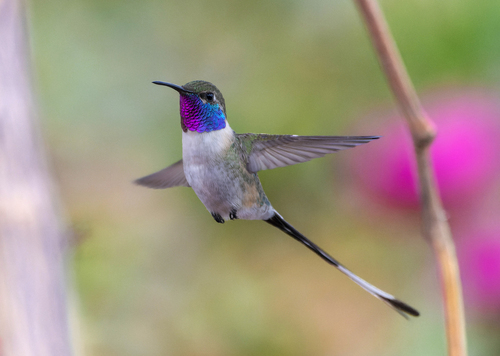
The Peruvian sheartail has the scientific name Thaumastura cora (R.Lesson & Garnot, 1827). Male Peruvian sheartails measure around 14 cm (5.5 in) in length and weigh approximately 2.5 g (0.088 oz), while females are about 7.5 cm (3.0 in) long and weigh roughly 2.6 g (0.092 oz). This species is one of the smallest hummingbirds. Both sexes share a short, straight black bill, and have metallic green upperparts (including the top of the face) that darken approaching the tail. The female's green plumage has a faint beige tint. Both sexes also have an indistinct white spot behind the eye. Males have an iridescent magenta gorget that appears cyan or black when viewed from different angles, while females have a cream-colored throat. Males have off-white to gray breasts and bellies, where the green from the back blends in gently; females have similar breast and belly coloration that is darker than the male's. The most noticeable feature of the male is its tail: the innermost pair of tail feathers are short, with dark green outer vanes and white inner vanes. The next pair is very long, with black outer vanes, white inner vanes, and black tips. The remaining three pairs get progressively shorter, each with black outer vanes, white inner vanes, and black tips outlined in white. The female has a short tail with little length difference between its feathers. The innermost pair of the female's tail feathers have dark white bases, followed by bronzy green outer webs, and inner webs that transition from pale to almost black. The next pair is somewhat longer (not nearly as dramatically as the male's), and are mostly black with white tips. The third pair are black with white coloring both near the body and at the tip. The outermost two pairs are black with white tips. Published weights for the Peruvian sheartail vary across sources. Some sources note it as the lightest hummingbird in South America, though the short-tailed woodstar and the three woodstar species in the genus Chaetocercus are other species that could also claim this title. The Peruvian sheartail is distributed from far southwestern Ecuador, through the full length of western Peru, and into northwestern Chile. Its occurrence in Ecuador was only discovered recently, with the first sighting in the early 2000s, and there are fewer than 10 eBird records for the country as of now. It is expanding its range in Chile, where it was first reported in 1971. The population in the Azapa Valley is currently in the thousands, and the species is also found further south in Chile. Its native habitat is the arid coastal zone with sparse scrub vegetation. It is also commonly found in farmland, gardens, and orchards. In terms of elevation, it occurs from sea level up to around 2,800 m (9,200 ft), and possibly up to above 3,300 m (10,800 ft). It is most common at elevations near sea level.