About Thaumastocoris peregrinus D.L.Carpintero & Dellapé, 2006
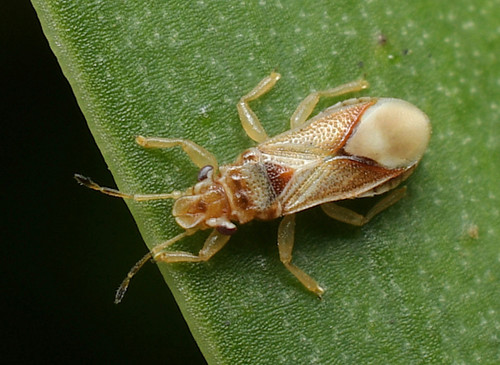
Adult Thaumastocoris peregrinus have dorsoventrally compressed, elongate bodies, and submacropterous forms are documented for both sexes. Adult males measure 2.3–2.9 mm in length and 0.7–1.0 mm in width; adult females measure 2.3–2.7 mm in length and 0.7–0.8 mm in width. Their body is light brown with darker patches, and females are typically darker than males. Their head is broad, projects strongly forward, and has semiglobose projecting eyes. Mandibular plates are elongate, conspicuous, and strongly recurved anterolaterally. The labium extends to the level of the fore coxa. The pronotum of the thorax bears a tubercle on the anterolateral angle of the anterior lobe. Neither parempodia nor pulvilli are present on the legs. All tibiae have a flattened apical projection called the fossula spongiosa. The male tibia has three black tubercles along its anteroventral side, while females lack these tubercles. The male reproductive tract includes a pair of testes with three globular follicles, which are isolated by a peritoneal sheath, plus two pairs of well-developed mesodermal tubular accessory glands. Male external genitalia consist of an asymmetrical, somewhat cylindrical pygophore that can orient either to the right or to the left, with right-side orientation being more common. The genitalia also include a U-shaped paramere covered with uniform setae that become sparser toward the apex; an aedeagus was not observed. The female reproductive tract of T. peregrinus is generally similar to that of the thaumastocorid Proxylastodoris kuscheli. However, P. kuscheli has three meroistic telotrophic ovarioles per ovary, while T. peregrinus only has two meroistic telotrophic ovarioles per ovary. The ovaries of T. peregrinus develop as large, ball-shaped reservoirs. Across the order Heteroptera, the number of ovarioles per ovary ranges from 2 to 17. No spermathecae were observed in T. peregrinus, a trait that has already been reported for other species in the family Thaumastocoridae. Eggs of this species are black and ovoid, with a rough chorion, a round operculum, and a deep, obvious depression on the dorsal side. They measure 0.50–0.61 mm long and 0.20–0.24 mm wide. The species has five nymphal instars. Nymphs have dorsoventrally flattened bodies. Young nymphs (1st to 3rd instars) range in color from milk white to orange, with black spots on the thorax and first abdominal segment. Nymphs have consistently been observed together with adults on heavily infested trees. Ecologically, Thaumastocoris peregrinus is native to the east coast of Australia. This sap-sucking pest has invaded non-native Eucalyptus plantations of multiple species, including E. gomphocephala, E. botryoides, E. camaldulensis, E. saligna, and E. globulus, across Southern Africa, South America, and Europe. Severe infestations lead to leaf loss, leaf senescence, canopy thinning, and in some cases branch dieback.

