About Thamnophis brachystoma (Cope, 1892)
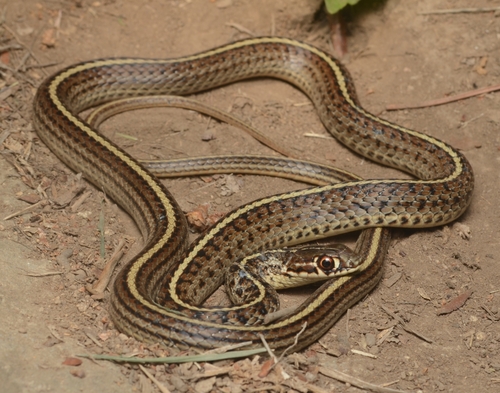
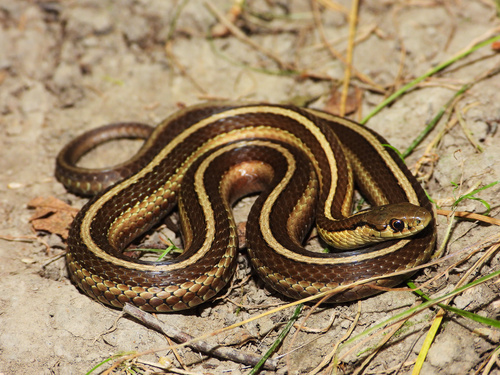
Thamnophis brachystoma is a small species of snake, with a total length (including tail) ranging from 254–559 mm (10.0–22.0 in). There is no apparent difference between its body and head. Unlike the related species Thamnophis sirtalis, T. brachystoma has no black spots between its body stripes. Its dorsal color is most often olive or olive-green, with three full-length stripes (one dorsal, two lateral) that run from head to tail and range in color from beige to yellow. This species shows distinct sexual dimorphism, as females grow larger than males.
Thamnophis brachystoma occurs in small isolated pockets in northwestern Pennsylvania and southwestern New York. Outside of its native range, introduced populations exist in Pittsburgh (southwestern Pennsylvania) and Youngstown, Mahoning County, Ohio. The shorthead garter snake is most commonly found in old fields and meadows, and occasionally occurs in wooded areas. It is almost always located within several hundred meters of an open field. It is thought to bask openly on sunny days, but a population study found individuals almost exclusively under objects like wood and rocks; snakes were only found out in the open on cloudy days.
When handled by humans, Thamnophis brachystoma is slow to bite, but readily expels musk and feces from its cloaca. Multiple shorthead garter snakes are often found together under cover objects, and this co-occurrence does not appear to be linked to seasonal changes or breeding cycles.
Reproduction for T. brachystoma takes place in spring, shortly after snakes emerge from their hibernacula. When females emerge, their ovarian follicles are already well developed. Females in New York breed every other year, while females in Pennsylvania breed annually. Males rely on stored sperm to breed; their testes are small immediately after emergence, and grow to full size by midsummer. After this, sperm is stored for use during the next spring’s breeding season. T. brachystoma is thought to be viviparous, and experiments have confirmed that amino acid transfer occurs between mothers and developing offspring.