About Thamnophilus unicolor (P.L.Sclater, 1859)
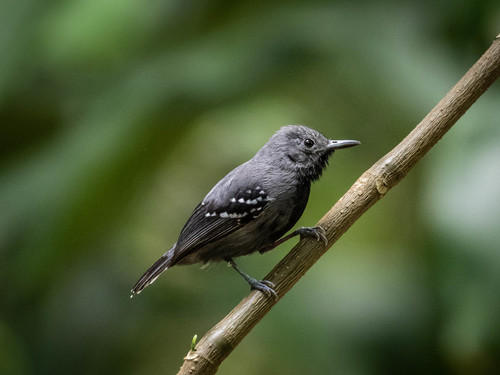
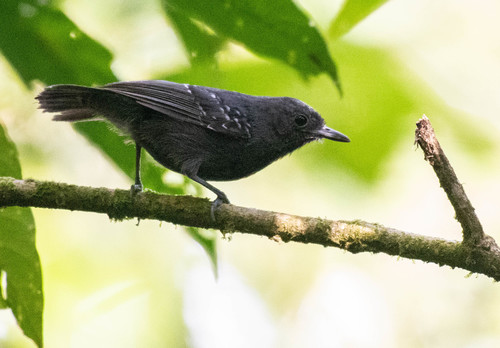
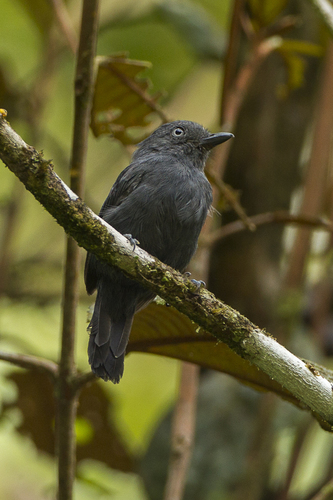
The uniform antshrike, Thamnophilus unicolor, is 14.5 to 17 cm (5.7 to 6.7 in) long and weighs approximately 24 g (0.85 oz). All members of the genus Thamnophilus are largish antbirds, and all share stout hooked bills similar to those of true shrikes. This species shows significant sexual dimorphism. Adult males of the nominate subspecies are mostly deep gray or blackish gray, and sometimes have white tips on their outer tail feathers. Adult females have a rufous crown, a gray face, rufous brown upperparts, and pale rufous brown underparts. Immatures of both sexes resemble adult females. Both sexes have a gray-white to whitish gray iris, a black bill, and gray or blue-gray legs and feet. Subspecies T. u. grandior is very similar to the nominate, though its males more often have small white tips on their outer tail feathers. Males of T. u. caudatus are essentially identical to grandior males. T. u. caudatus females are darker and more rufous than females of the nominate subspecies and grandior. The uniform antshrike has a disjunct distribution. The nominate subspecies occurs along almost the entire length of the Pacific slope of the Andes in Ecuador. Subspecies T. u. grandior is found in all three Andean ranges of Colombia, and also on the east slope of the Andes from southern Morona-Santiago Province in southeastern Ecuador south into northern Peru as far as northern San Martín Department. T. u. caudatus lives on the eastern slope of the Andes from southern San Martín south, occurring locally to Cuzco Department. This species inhabits the understorey of humid montane forest. While it can be found in the forest interior, it prefers forest edges and gaps formed by fallen trees. Its elevation range is 1,200 to 2,200 m (3,900 to 7,200 ft) in Colombia, mostly 1,000 to 2,000 m (3,300 to 6,600 ft) in Ecuador, and 1,250 to 2,300 m (4,100 to 7,500 ft) in Peru.