About Thamnophilus tenuepunctatus Lafresnaye, 1853
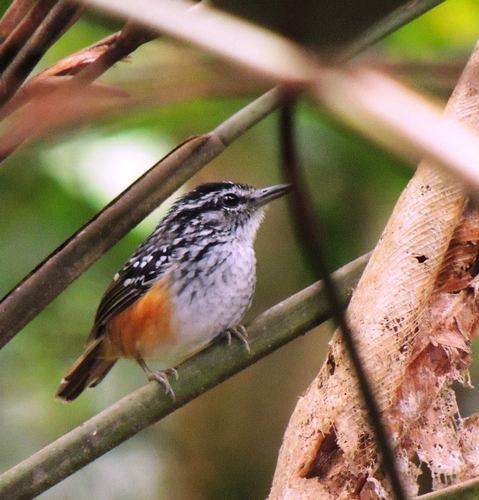
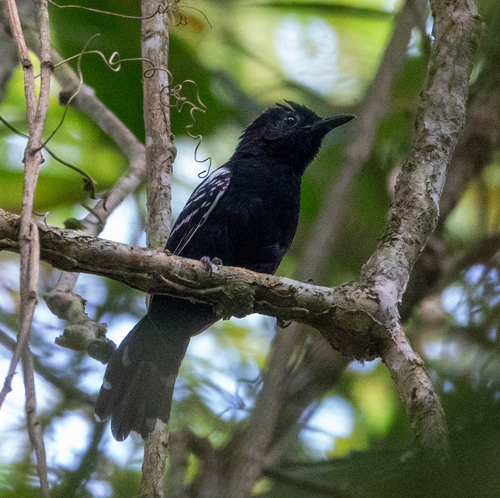
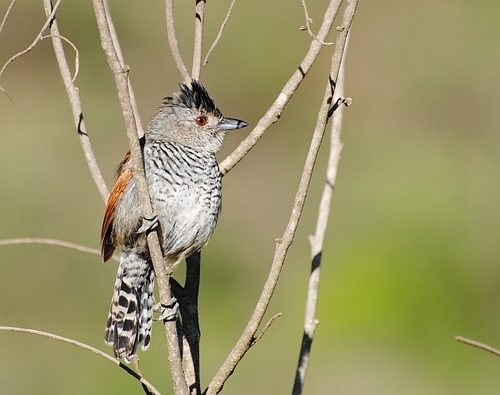
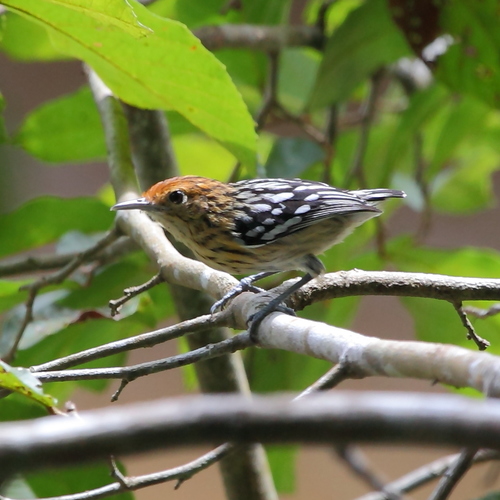
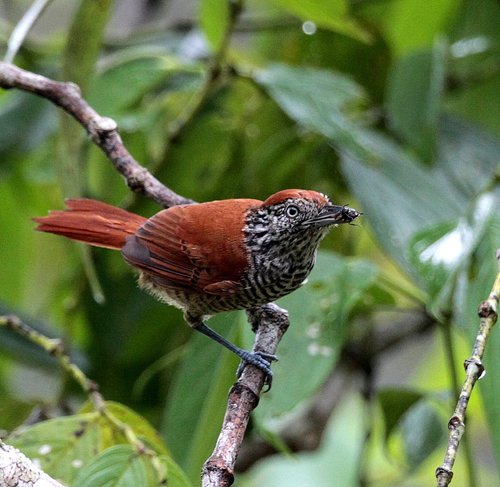
The lined antshrike (Thamnophilus tenuepunctatus) measures 15 to 16 cm (5.9 to 6.3 in) in length and weighs 22 to 23 g (0.78 to 0.81 oz). All species in the genus Thamnophilus are largish members of the antbird family, and all have stout, hooked bills similar to those of true shrikes. This species shows strong sexual dimorphism, though crests are present in both sexes. Adult males of the nominate subspecies have almost entirely narrow white bars and wider black bars across their plumage. Their crown and crest are black, and their throat has black and white streaking. Adult females have rufous crown, crest, upperparts, wings, and tail. Their nape bears a narrow band of black and white, or black and pale reddish brown. The sides of their head and throat are streaked black and white. The rest of their underparts are barred black and white, with a reddish brown tinge on their lower flanks. Adult individuals of both sexes have a pale, variably colored iris. Subadult males resemble adult males, but have a yellowish-brown tinge across their body and flight feathers. Males of the two subspecies T. t. tenuifasciatus and T. t. berlepschi have black and white bars of roughly equal width, and more white on their foreheads than the nominate subspecies. Females of these two subspecies are paler than nominate females, and have wider white bars on their underparts. The lined antshrike occurs along the eastern slope of the Andes in Colombia, Ecuador, and Peru. The nominate subspecies is the northernmost, found in the north-central Colombian departments of Cundinamarca and Meta, with a separate population in Norte de Santander. Subspecies T. t. tenuifasciatus ranges from Putumayo Department in south-central Colombia south through almost all of Ecuador to northern Zamora-Chinchipe Province. Subspecies T. t. berlepschi occurs from southern Zamora-Chinchipe into the northeastern Peruvian departments of Amazonas, Cajamarca, and San Martín. The lined antshrike primarily lives in the edges of humid evergreen forest and secondary forest, and prefers areas with dense shrubs and other undergrowth. In terms of elevation, it is found between 400 and 1,500 m (1,300 and 4,900 ft) in Colombia, and mostly between 400 and 1,400 m (1,300 and 4,600 ft) in Ecuador. In Peru, it occurs between 700 and 1,700 m (2,300 and 5,600 ft) in the Andes, and is found locally as low as 200 m (700 ft) in the Marañón River valley.