About Thamnophilus ruficapillus Vieillot, 1816
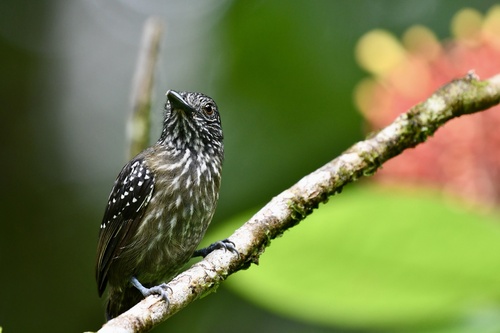
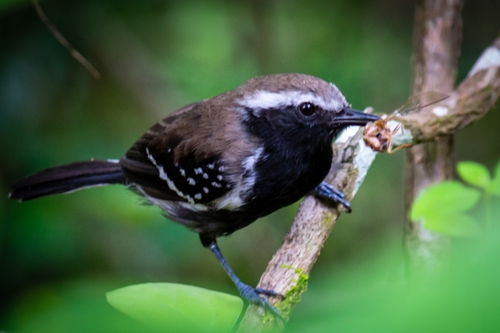
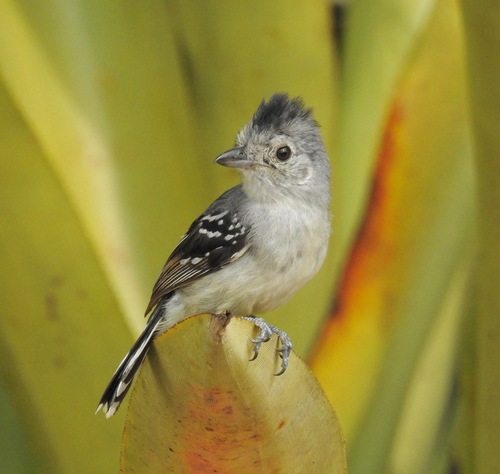
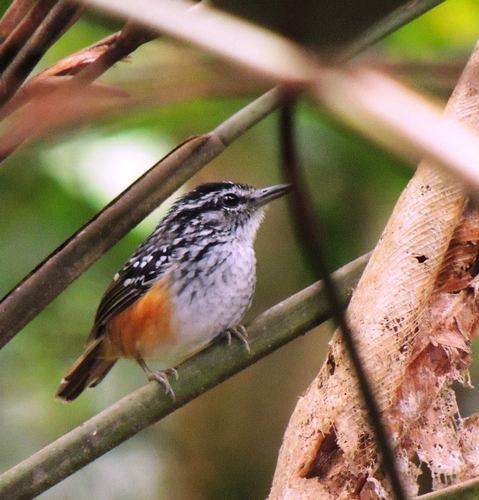
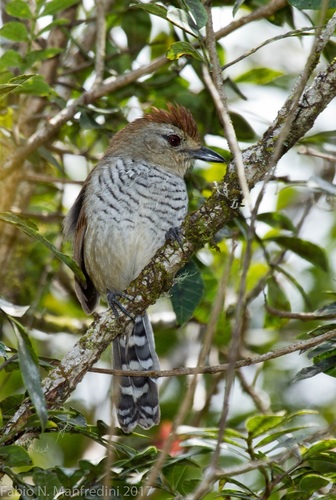
The rufous-capped antshrike, Thamnophilus ruficapillus Vieillot, 1816, is 15 to 17 cm (5.9 to 6.7 in) long and weighs 16.3 to 25 g (0.57 to 0.88 oz). All members of the genus Thamnophilus are fairly large members of the antbird family, and all have stout hooked bills similar to those of true shrikes. This species shows significant sexual dimorphism. For the nominate subspecies T. r. ruficapillus, adult males have a chestnut crown, a buffy gray face and throat with faint dusky mottling and bars. Their upperparts are dark brown, their wings are rufous-brown, and their tail is brownish black with white tips and bars on the inner webs of the outer feathers. Their underparts are mostly buff-tinged white, with black bars on the breast and sides. Their flanks and undertail coverts are buff with an olive tinge. Adult females closely resemble males, but have a cinnamon-brown crown, a rufous-brown tail with no white, and faint or no barring on the breast. Males of the subspecies T. r. cochabambae have a chestnut crown, a buffy white face and throat with light gray streaks, medium gray upperparts, and a more extensively barred tail than the nominate subspecies. Their breast and sides are buffy with black bars, their belly is buffish white, and their flanks and undertail coverts are a mix of light buff and gray. Females of this subspecies have olivaceous upperparts; their underparts are whitish with a buff tinge on the breast and sides, and an olive-buff tinge on the flanks and undertail coverts. Males of T. r. subfasciatus have a darker rufous cap than the nominate, a darkish gray face, throat, and upperparts, and buff-tinged white underparts that are barred from the breast through the belly. Females have rufous underparts, unlike the nominate subspecies' whitish underparts. Males of T. r. jaczewskii have a darker gray face and throat than T. r. subfasciatus, olive-tinged dark gray upperparts, and chestnut wings. Their underparts are barred with black and white, and their flanks have an olive tinge. Females have olivaceous upperparts and bright buff underparts that are paler on the belly. Males of T. r. marcapatae have a dark gray face, upperparts, and flanks. Their lower throat and underparts are streaked black and white, with heavier black bars than those of T. r. jaczewskii. Females have dark olive-brown upperparts; their underparts are reddish yellow-brown, which is paler on the throat and belly and has some gray mixed in on the flanks. The rufous-capped antshrike has a disjunct distribution, with each subspecies occupying a separate range. Thamnophilus ruficapillus jaczewskii is found in the Andes of northern Peru, in the departments of Cajamarca, Amazonas, and San Martín. Thamnophilus ruficapillus marcapatae occurs on the eastern slope of the Andes of southern Peru, in the Cuzco and Puno departments. Thamnophilus ruficapillus subfasciatus is found on the eastern slope of the Andes of northwestern Bolivia, in La Paz and western Cochabamba departments. Thamnophilus ruficapillus cochabambae is distributed along the eastern slope of the Andes from eastern Cochabamba in Bolivia southeast through Santa Cruz Department into northwestern Argentina, as far as Tucumán Province. Thamnophilus ruficapillus ruficapillus is found in southeastern Brazil, from eastern Minas Gerais and Espírito Santo south and west into eastern Paraguay, northeastern Argentina as far as Buenos Aires Province, and Uruguay. This species inhabits a variety of landscapes that differ by geographic region. In the Andes of Peru and northern Bolivia, it occurs in semi-humid montane forest, secondary forest, and scrublands, and favors forest edge; in northern Peru it also occurs inside forest interior. In the Andes from southern Bolivia into Argentina, it occupies the same habitats as further north, and also occurs in scrub and riparian forest along watercourses in more open areas. At lower elevations in Brazil, Uruguay, Paraguay, and Argentina, it avoids forest interior, and most often occurs in isolated patches of shrubs and small trees. It is also found there in scrublands, hedgerows, brushy areas, and along the edges of urban areas. Its elevation range varies by region: from sea level to 2,400 m (7,900 ft) in Brazil, between 1,800 and 3,000 m (5,900 and 9,800 ft) in Peru, and between 600 and 2,700 m (2,000 and 8,900 ft) in Bolivia. In Argentina, it occurs at somewhat lower elevations than it does in Bolivia.