About Thamnophilus pelzelni Hellmayr, 1924
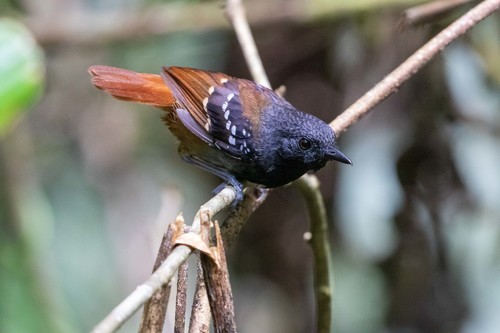
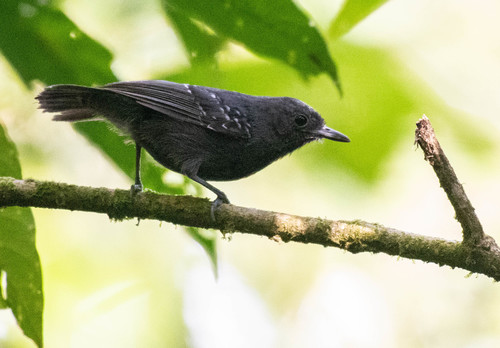
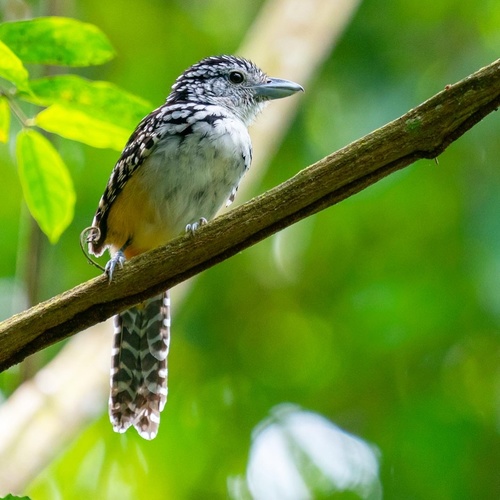
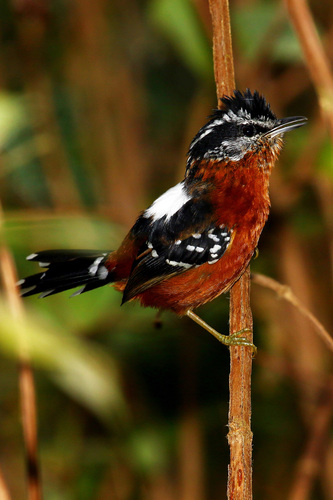
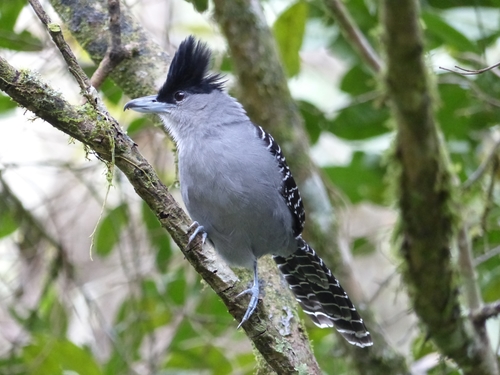
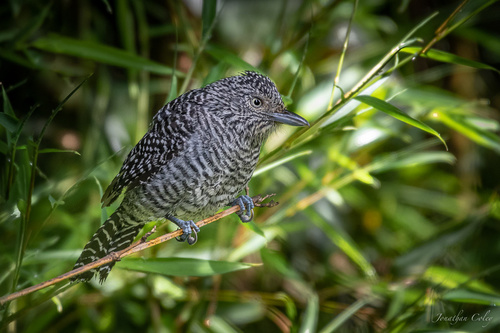
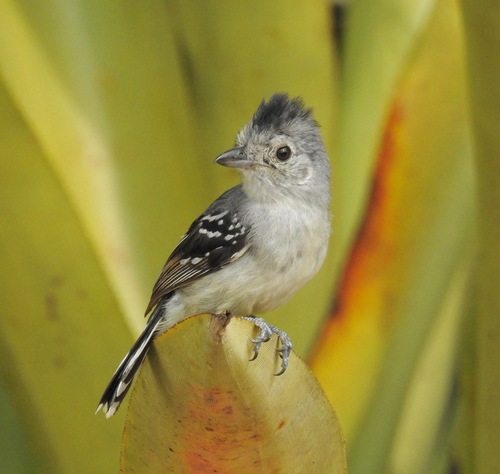
The planalto slaty antshrike, Thamnophilus pelzelni Hellmayr, 1924, is approximately 14 cm (5.5 in) long and weighs 16 to 20 g (0.56 to 0.71 oz). Members of the genus Thamnophilus are largish birds in the antbird family. All species in this genus have stout hooked bills similar to those of true shrikes. This species shows significant sexual dimorphism. Adult males have a mixed black and gray forehead and a black crown. Their back is gray with a small number of black spots and a hidden white patch between their scapulae. Their face is gray. Their wings and wing coverts are brownish black with white spots and edges. Their tail is black, with white tips and spots on individual feathers. Their throat and belly are white, and the belly often has a faint buff tinge. The remaining parts of their underparts are gray. Adult females have a bright rufous crown and cinnamon-rufous upperparts, which sometimes have a few black feather tips. Their wings are dark brown with white spots and edges, and pale buff edges on the flight feathers. Their tail is dark brown with white tips on the feathers. Their underparts are light cinnamon-buff, turning almost white on the throat and belly.
The planalto slaty antshrike is distributed across central and eastern Brazil, in a broad range that extends from eastern Maranhão, Ceará, and Paraíba southwest to northern Mato Grosso do Sul, extreme northern Paraná, and western São Paulo. In the northern section of its range, it mostly lives in deciduous and semi-deciduous forest, especially areas with dense vine growth. In the southern and western parts of its range, it is primarily found in gallery forest. It also occurs locally on the edges of evergreen forest. Across most of its range, it is found at elevations between 400 and 800 m (1,300 and 2,600 ft), and reaches up to 1,100 m (3,600 ft) in the central part of its range. In all forest types it occupies, it mainly stays in the understorey to mid-storey.