About Thamnophilus palliatus (Lichtenstein, 1823)
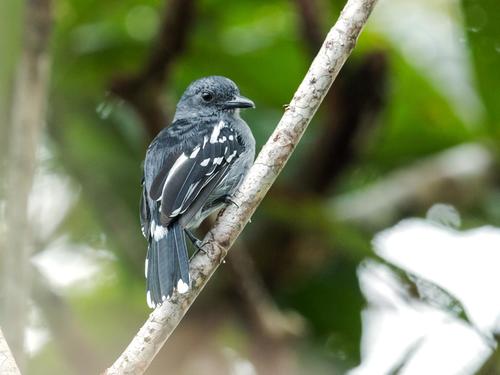
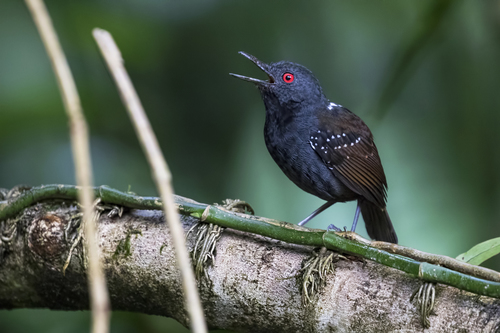
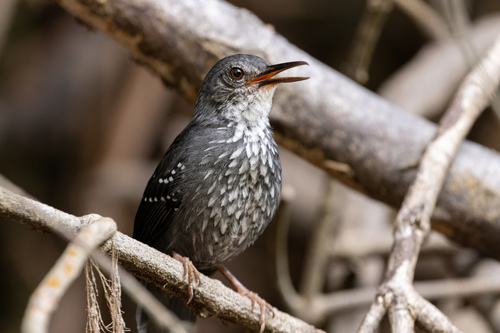
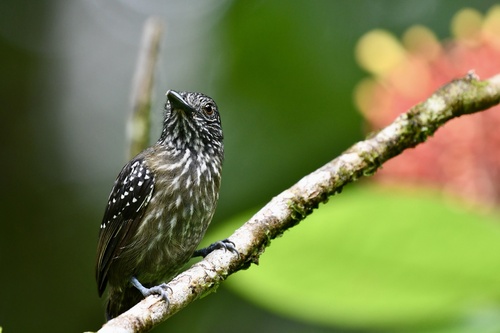
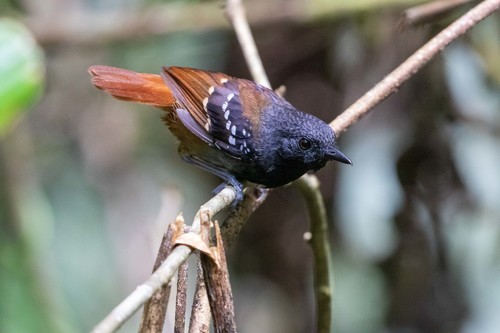
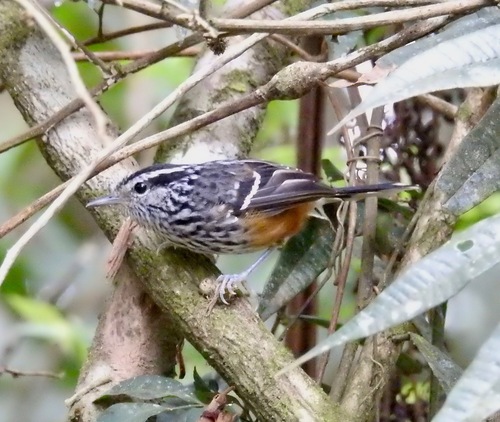
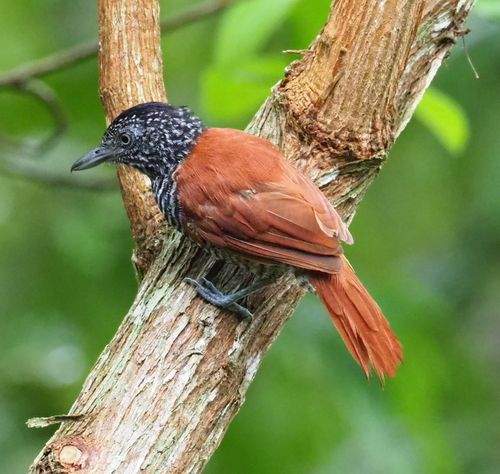
Thamnophilus palliatus, commonly called the lined antshrike or chestnut-backed antshrike, is 16 to 17 cm (6.3 to 6.7 in) long and weighs 26 to 28 g (0.92 to 0.99 oz). As members of the genus Thamnophilus within the antbird family, this species has the genus' typical characteristics: largish size and stout hooked bills that resemble those of true shrikes. This species shows some sexual dimorphism, though both sexes have a crest. For the nominate subspecies T. p. palliatus, adult males have a black crown with white spots on the forehead, a black face and nape marked with white spots, rufous-brown upperparts, wings, and tail, and black and white stripes on the throat. The rest of their underparts are barred black and white, with a rufous tinge on the flanks. Adult females are very similar to males, but have a deep rufous-brown crown and wider white bars on their underparts. Adult individuals of both sexes have a pale, variably colored iris. Subadult males resemble adult males, with a mix of black and deep reddish brown on the forehead and a reddish-brown tinge on the lower underparts. Subadult females resemble adult females, with narrower black bars on their underparts and a strong yellow-ochre wash on their lower underparts. The subspecies T. p. similis is similar to the nominate subspecies. Both sexes of T. p. puncticeps are paler overall than the nominate, and females of this subspecies have a strong yellow-ochre wash on their nape. T. p. vestitus has even paler upperparts than T. p. puncticeps, and wider dark bars on its underparts than the other three subspecies. This species has a disjunct distribution, with the subspecies T. p. vestitus found separately from the other three. T. p. vestitus occurs in coastal eastern Brazil from southern Bahia south to Rio de Janeiro state, with a few records in São Paulo state. T. p. puncticeps is the most widespread subspecies; it is found in the Cuzco and Puno departments of southeastern Peru, across northern Bolivia, and in Brazil south of the Amazon east to the Tapajós River. The nominate subspecies T. p. palliatus occurs in Brazil south of the Amazon, from the Tapajós east to the Atlantic coast between Paraíba and northern Bahia. T. p. similis is found in central Peru, between the departments of Huánuco and Junín. The species inhabits a variety of mostly somewhat open landscapes, including edges of evergreen forest and mature secondary forest, regrowing clearings, and abandoned plantations (especially those with bamboo). In the Amazonian lowlands, it also occurs in várzea and in some areas in pure stands of Guadua bamboo. In coastal southeastern Brazil, it also occupies shrubby parks and gardens. Its elevation range varies by region: it is mostly found between 400 and 1,700 m (1,300 and 5,600 ft) in the Peruvian Andes, up to 2,200 m (7,200 ft) in Bolivia, and mostly below 300 m (1,000 ft) in southeastern Brazil, where it occurs as high as 1,000 m (3,300 ft).