About Thamnophilus nigriceps P.L.Sclater, 1869
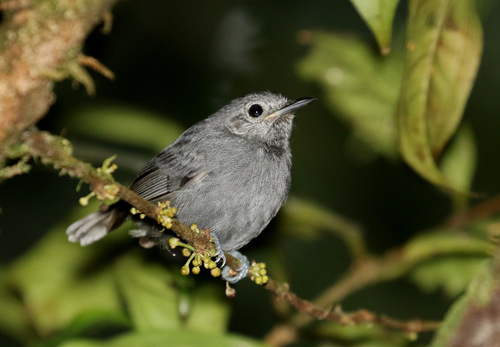
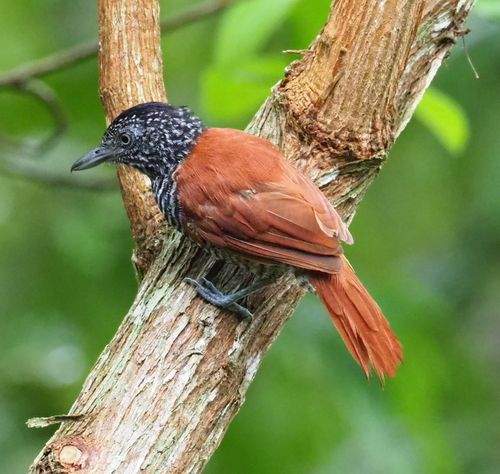
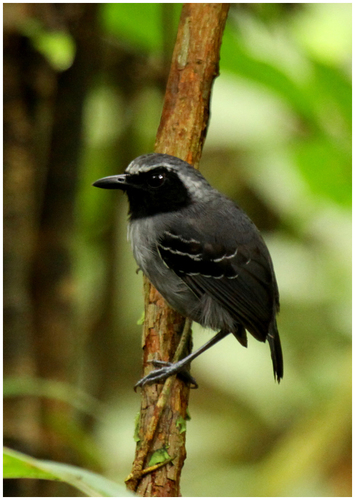
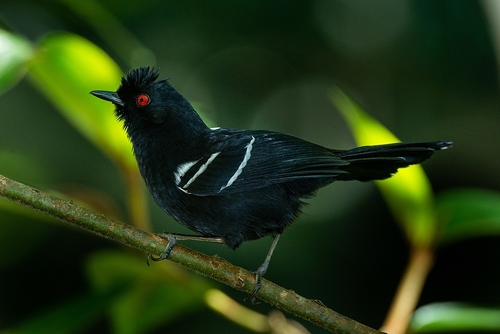
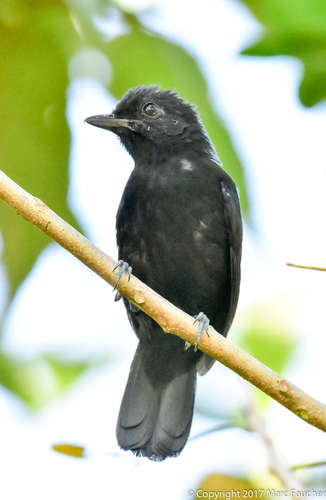
The black antshrike (Thamnophilus nigriceps P.L.Sclater, 1869) measures 15 to 16 cm (5.9 to 6.3 in) long and weighs 23 to 24 g (0.81 to 0.85 oz). Members of the genus Thamnophilus are largish birds in the antbird family, and all species have stout hooked bills similar to those of true shrikes. This species displays some sexual dimorphism. Adult males are almost entirely black, with dark gray flanks, and white underwing coverts and white edges on the underside of their flight feathers. Adult females have a blackish gray head and upper breast marked with buff-white streaks. Their upperparts, wings, and tail are rufous-brown. Their lower breast and belly are gray with buff-white streaks, and their crissum is unstreaked buff. Streak width varies between individuals, and the total amount of streaking increases from nearly none in the northern portion of the species' range to a significant amount in the south. Subadult males resemble adult females, but have pale edges on their wing coverts and black bars on the crissum. Subadult females have wider breast streaks than adult females. The black antshrike is distributed from eastern Panamá Province in Panama, south through Darién Province into northern Colombia. In Colombia, it occurs from northern Chocó Department east to the boundary of western La Guajira Department (it does not extend into the Sierra Nevada de Santa Marta), and south through the Magdalena River valley to Tolima Department. It primarily lives in the edges and regrowing clearings of evergreen forest, and also occurs in secondary forest and semi-open woodlands. It strongly prefers dense thickets made up of vines, thorns, and Heliconia. Its elevation range extends from sea level up to 600 m (2,000 ft).