About Thamnophilus doliatus (Linnaeus, 1764)
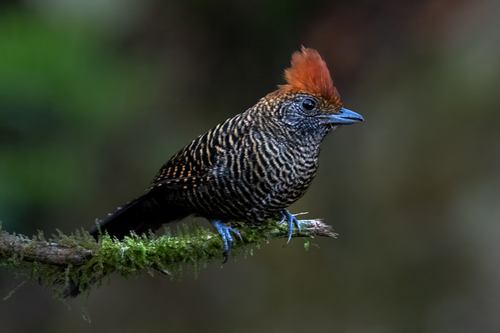
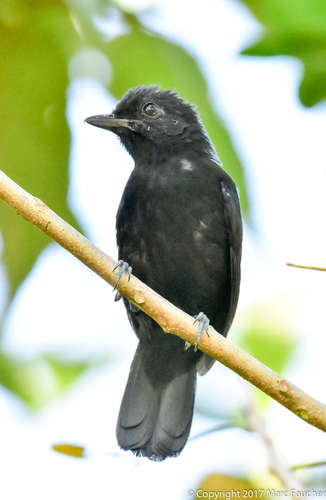
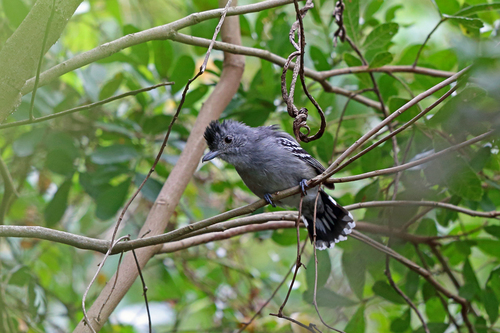
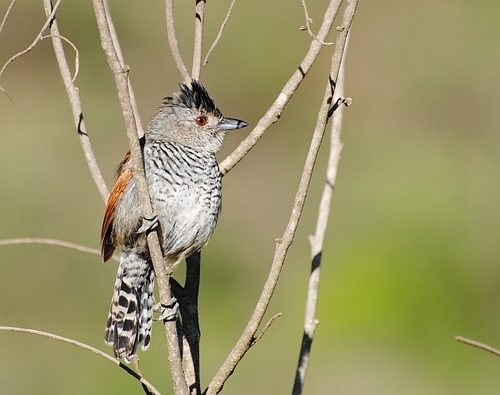
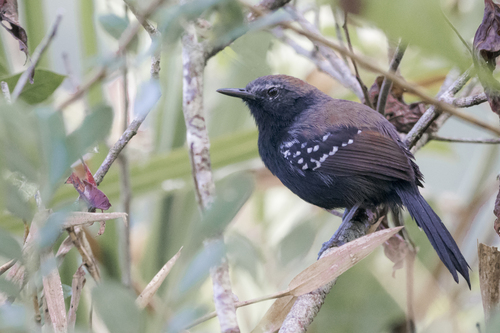
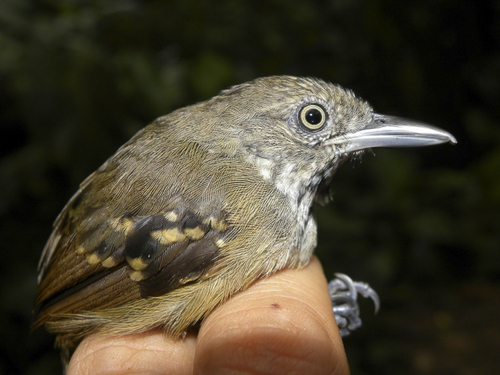
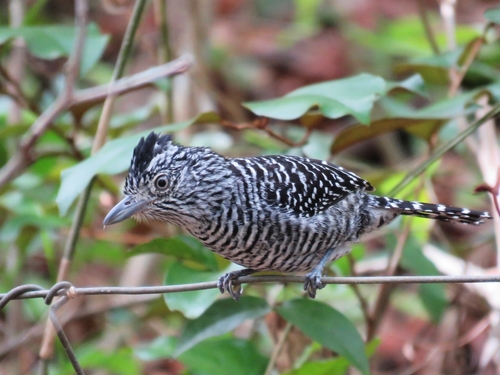
Barred antshrike (Thamnophilus doliatus, first described by Linnaeus in 1764) is 15 to 18.5 cm (5.9 to 7.3 in) long and weighs 24 to 32 g (0.85 to 1.1 oz). All species in the genus Thamnophilus are largish members of the antbird family, and all have stout hooked bills similar to those of true shrikes. This species shows strong sexual dimorphism, though both sexes have a bushy crest. For adult males of the nominate subspecies T. d. doliatus, almost the entire plumage has alternating black and white bars. Black bars are thicker than white bars on the upperparts, while on the underparts black bars are thinner than white bars. The face, throat, and chin have thin black and white streaks, and the black crest has white bases on its middle feathers. Adult females have a cinnamon-rufous crest and upperparts. The sides of the head and neck are streaked black and white or buff; the chin is buff, and the underparts are ochraceous-buff. Adult birds of both sexes have a pale yellow iris, a black upper mandible (maxilla), a bluish gray lower mandible, and lead-gray legs and feet. Juvenile males have black barring over a light yellowish brown base color. The other subspecies of barred antshrike differ from the nominate subspecies and from one another as follows. T. d. intermedius males are darker and have wider black bars than the nominate. For T. d. nigricristatus, males have faint or no barring on the belly, and females have unstreaked throats. T. d. nesiotes is similar to T. d. nigricristatus but has deeper overall coloration. T. d. eremnus is also similar to T. d. nigricristatus but with deeper coloration. For T. d. albicans, males have a white belly with very few bars on the underparts, and females have a white throat and pale underparts. T. d. nigrescens is very dark overall, and all its black bars are wider than the white spaces between them. T. d. tobagensis males have whiter underparts than the nominate, while T. d. tobagensis females have darker underparts than the nominate. For T. d. radiatus, males have white spots on the forehead, whiter underparts than the nominate, and few to no black bars on the belly. T. d. difficilis males are similar to T. d. radiatus, with a whiter forehead and grayer underparts. For T. d. capistratus, males have an entirely black crown and white spots on the tail. Females have streaked throats, faintly barred breasts, and white bellies. Both sexes have reddish or chestnut irises. These consistent differences led Assis et al to propose that T. d. capistratus should be recognized as a separate species. T. d. cadwaladeri males are paler than the nominate, with very little barring on the belly; T. d. cadwaladeri females have mostly white underparts, with buff coloring only on the sides and breast. Different subspecies of barred antshrike occupy different ranges. T. d. intermedius ranges from San Luis Potosí and Tamaulipas in east-central Mexico south through both sides of Central America to Costa Rica, and possibly extends into Panama. T. d. nesiotes is found only on the Pearl Islands in the Gulf of Panama. T. d. eremnus occurs only on Coiba Island off the Pacific coast of western Panama. T. d. nigricristatus is found in Panama between eastern Chiriquí Province and western Guna Yala (San Blas). T. d. albicans lives on the Caribbean slope of northern and western Colombia, and extends south into the Magdalena Valley. T. d. nigrescens is found in north-central Colombia east of the Andes, and in northwestern Venezuela north of the Andes. T. d. tobagensis is restricted to Tobago. The nominate subspecies T. d. doliatus occurs in northeastern Colombia, most of Venezuela (excluding the northwest but including Margarita Island), Trinidad, the Guianas, and northern Amazonian Brazil. T. d. difficilis is found in east-central Brazil, in an area roughly bounded by eastern Maranhão, eastern Mato Grosso, Goiás, and western Bahia. T. d. capistratus occurs in eastern Brazil between the states of Ceará, Bahia, and the Atlantic coast. T. d. radiatus ranges across Amazonas Department in southeastern Colombia, northeastern Ecuador, eastern Peru, northern and eastern Bolivia, most of Paraguay, northern and northeastern Argentina, and western and south-central Brazil. T. d. cadwaladeri is found in Tarija Department in southern Bolivia. The barred antshrike lives in a variety of landscapes, with some geographic variation in habitat preferences. Across all of its range, it favors thick undergrowth over higher levels of the habitat, and avoids the interior of mature forest. In Mexico, Central America, northern South America, and much of Peru, it inhabits scrublands (especially second-growth scrub), riparian thickets, the edges of dry woodlands and secondary forest, and even gardens. Three subspecies are exceptions to this general pattern: T. d. eremnus inhabits tropical deciduous forest on Coiba Island; T. d. tobagensis inhabits mature humid forest on Tobago; and T. d. capistratus primarily lives in caatinga and restinga habitats in eastern Brazil. In eastern Colombia, the species often occurs on river islands. In Ecuador, northern Peru, and most of Brazilian Amazonia, it occurs almost exclusively on river islands. In Brazil, it is also found along rivers on the adjacent mainland. In southern Bolivia, Paraguay, and Argentina, it also occupies savanna in addition to scrub, secondary forest, and riverine belts. Elevationally, the barred antshrike occurs from sea level or near sea level up to 1,500 m (4,900 ft) in Mexico, Central America, and Colombia. In Venezuela, it reaches up to 2,000 m (6,600 ft), though most records are from below 1,250 m (4,100 ft). In Peru, it reaches elevations of 1,400 m (4,600 ft). In Ecuador, it is found only below 250 m (800 ft).