About Thamnophilus caerulescens Vieillot, 1816
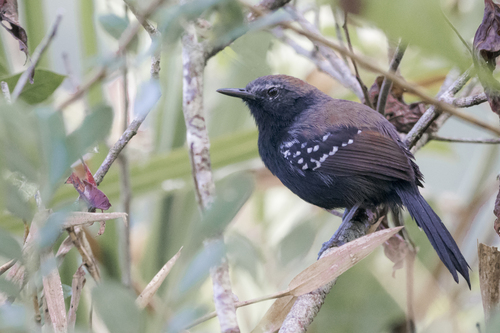
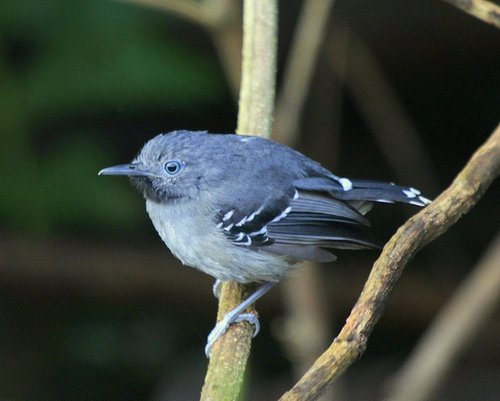
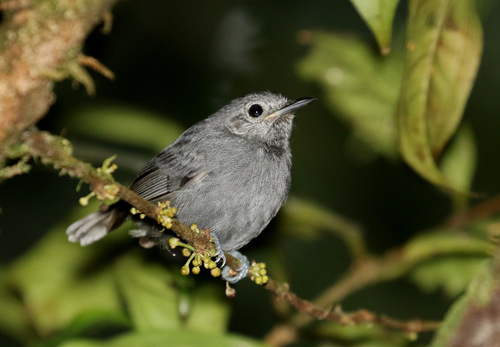
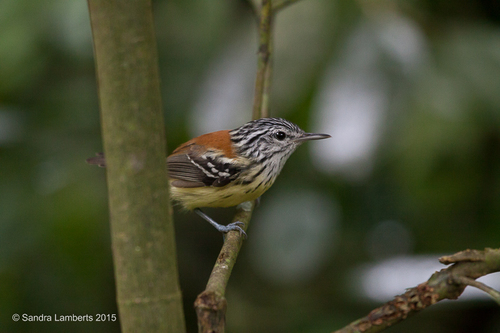
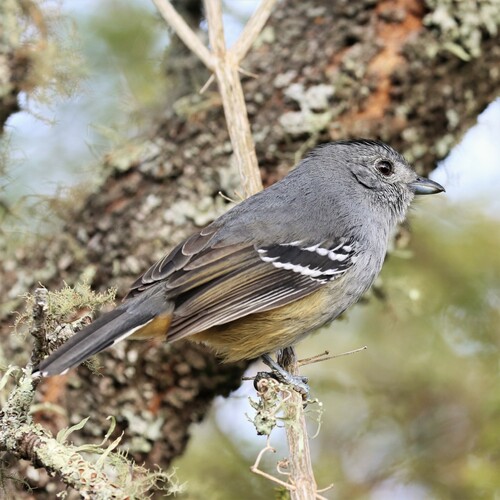
Thamnophilus caerulescens Vieillot, 1816, commonly called the variable antshrike, is an antbird widely recognized for having the most variable plumage among all antbird species. Adults measure 14 to 16 cm (5.5 to 6.3 in) long and weigh 15 to 24 g (0.53 to 0.85 oz). Members of the genus Thamnophilus are largish antbirds, and all have stout hooked bills similar to those of true shrikes. This species shows significant sexual dimorphism, in addition to plumage differences between its recognized subspecies.
For the nominate subspecies T. c. caerulescens, adult males have a black crown and nape, a gray face, and dark gray upperparts with some black on the lower back and a white patch between the scapulars. Their outer scapulars are black with white edges; wing coverts are black with white spots; flight feathers are blackish brown with pale brown and white edges; the tail is brownish black with white feather tips. Their underparts are gray, with a somewhat lighter belly that often has faint scalloping. Adult females of the nominate subspecies have an olive-brown crown, and mostly olive-brown upperparts with a clay tinge and yellow-brown edges on the uppertail coverts. They have little to no white between the scapulars. Their wing coverts are very dark brown with white edges on the tips, flight feathers are dark brown with clay edges, and tail feathers are dark brown with small white tips. Their throat and upper breast are ochraceous-gray, while the rest of their underparts are cinnamon-tawny with an olive tinge on the lower breast and sides. Subadults resemble adult females but are more buffy in color.
Other subspecies differ from the nominate and each other as follows: T. c. melanchrous males are mostly black, with gray mixed into the rump, belly, and crissum, white edges on the primaries, and small white spots on the tail feathers. Females of this subspecies have an olive-gray forehead and nape, a black crown, very small spots on the wing coverts, and cinnamon-tawny belly and crissum. T. c. aspersiventer is similar to T. c. melanchrous in both sexes, but males add black and white scallops on the belly and crissum, and have larger white spots on the tail. Females have a dark olive-gray crown with blackish spots. T. c. dinellii males have underparts that range from mostly cinnamon to cinnamon only on the crissum, with a blackish throat and breast. Females have ochraceous gray crown and upperparts, yellow-brown flight feathers, light gray throat and upper breast with a faint yellow tinge, and pale cinnamon belly and crissum. T. c. paraguayensis individuals of both sexes are paler than the nominate subspecies. Males have white or buff-tinged white belly and crissum. Females have an olive-gray crown, olive-gray wing coverts with white tips and in some regions blackish spots, and white underparts with a variable intensity of yellowish brown tinge. T. c. gilvigaster males have clay-colored edges on their flight feathers, gray throat, breast, and upper belly, and gray lower belly and crissum with a cinnamon-tawny wash. Females are yellowish gray from the throat to upper belly, and cinnamon-tawny on the lower belly and crissum. T. c. ochraceiventer males have a clay tinge on their upperparts and flight feathers, a gray throat, and grayish ochraceous underparts. Females have a black crown with some olive-gray on the forehead. T. c. cearensis males are similar to the nominate, but have a lighter black crown and lighter upperparts. Females have a rufous crown, ochraceous olive-brown wing coverts, a clay tinge on the tail, and a pale ochraceous throat.
The variable antshrike has a disjunct distribution: subspecies T. c. cearensis is geographically separate from the large contiguous range of the other subspecies. Individual subspecies are distributed as follows: T. c. melanchrous is found on the eastern slope of the Peruvian Andes, from south of the Marañón River in Amazonas Department south to northern Puno Department. T. c. aspersiventer occurs from southeastern Puno in Peru into west-central Bolivia north of the Andes, as far as Santa Cruz Department. T. c. dinellii is found south and east of the Bolivian Andes from Santa Cruz Department south into northwestern Argentina, reaching as far south as northern Córdoba Province and east to Formosa Province. T. c. paraguayensis occurs in eastern Santa Cruz, Bolivia, northwestern and north-central Paraguay, and Mato Grosso do Sul, Brazil. T. c. gilvigaster is found in northeastern Argentina east of the Paraná River (excluding Misiones Province), southeastern Brazil from São Paulo state southward, and most of Uruguay. The nominate T. c. caerulescens occurs in southeastern Paraguay, Argentina's Misiones Province, and southeastern Brazil between southeastern Bahia and western Paraná states. T. c. ochraceiventer is found in east-central Brazil, in southern Tocantins, Goiás, and south-central Bahia. T. c. cearensis occurs in the northeastern Brazilian states of Ceará, Pernambuco, and Alagoas.
Across its range, the variable antshrike inhabits a variety of landscapes, generally including evergreen forest, secondary woodland, and thickets in more open areas. In most regions it favors forest edges over the interior of dense forest, and it avoids arid habitats. In the northern Andes within its range, it occurs in humid forest where it favors thickets and undergrowth, as well as stunted ridge-top forests, at elevations between 1,200 and 2,800 m (3,900 and 9,200 ft). Further south in the Andes and at lower elevations in northwestern Argentina, it occurs in the understorey of somewhat open woodlands, watercourse-side scrublands, and heavy shrub cover on canyon hillsides, at elevations between 200 and 2,700 m (700 and 8,900 ft). T. c. paraguayensis is native to the Gran Chaco, where it lives in dense shrubs and low-stature woodlands along watercourses, and scrubby semi-deciduous forest, at elevations between 150 and 850 m (500 and 2,800 ft). Subspecies T. c. gilvigaster occurs in thick streamside woods and swampy areas, from near sea level to about 1,050 m (3,400 ft). The nominate T. c. caerulescens mostly occurs on steep vine-dense forest hillsides, and is also found in bamboo, streamside vine tangles, and dense second growth; locally it occurs in restinga on nutrient-poor soils. Its elevation ranges from sea level to 1,300 m (4,300 ft). T. c. ochraceiventer occurs in gallery forest and small woodlands between 750 and 1,350 m (2,500 and 4,400 ft). The geographically isolated subspecies T. c. cearensis inhabits the Atlantic Forest, where it occurs in vine-rich patches of humid and semi-humid forest up to about 850 m (2,800 ft).