About Thamnophilus bridgesi P.L.Sclater, 1856
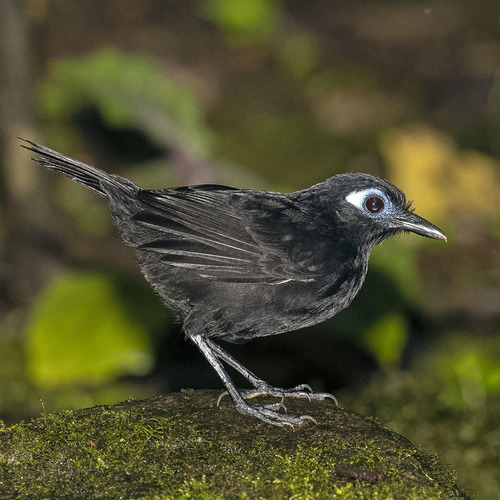
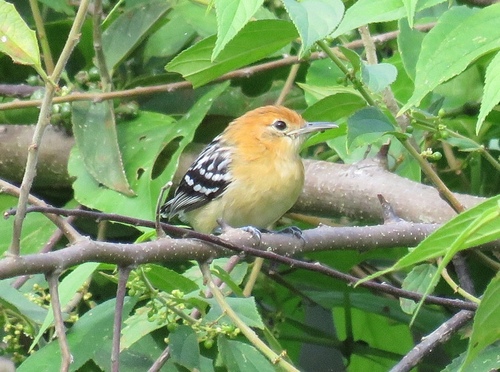
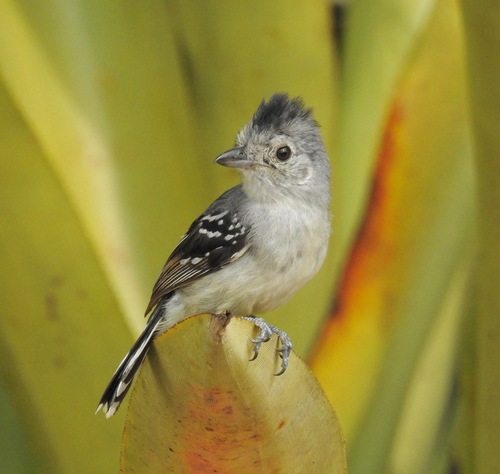
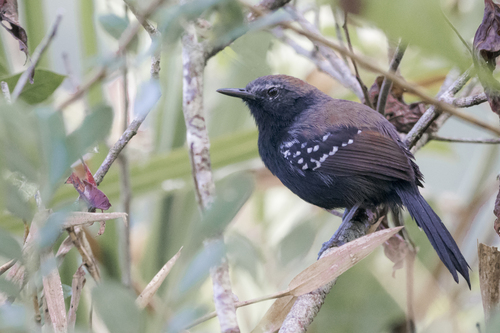
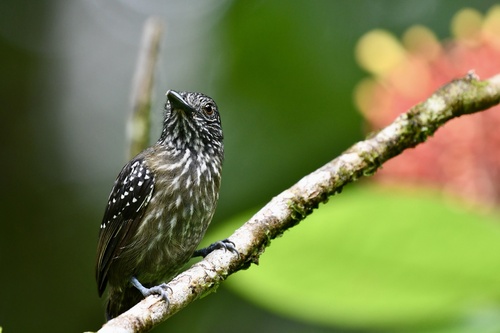
The black-hooded antshrike (Thamnophilus bridgesi P.L.Sclater, 1856) measures 15 to 17 cm (5.9 to 6.7 in) long and weighs 26 to 27 g (0.92 to 0.95 oz). All members of the genus Thamnophilus are largish birds in the antbird family, and all have stout hooked bills that resemble the bills of true shrikes. This species displays some sexual dimorphism. Adult males are mostly black, with a white patch between their scapulars, small white dots on their wing coverts, and dark gray belly and undertail coverts. Adult females have blackish gray forehead, crown, and face marked with narrow white streaks. Their upperparts and wings are very dark grayish brown, with white-edged scapulars and white-spotted wing coverts. Their tail is blackish brown, with white spots on the outer feathers. Their underparts are olive that darkens toward the upper body, with white streaks on the throat, breast, and belly. Juveniles are similar to adults but browner, with larger white spots on the wing coverts. Subadult males resemble adult males but are more brownish, with white streaks on their breast. The black-hooded antshrike is distributed from southern Guanacaste Province in Costa Rica, south along the Pacific slope through western Panama, extending as far as Los Santos Province. It inhabits the edges of lowland evergreen forest, semi-deciduous forest, gallery forest, taller secondary woodland, and mangroves. It generally occupies the understorey to mid-storey, and favors shrubby areas and vine tangles. It is also found in the interior of gallery forest. In terms of elevation, it mostly occurs below 1,000 m (3,300 ft), but can reach as high as 1,200 m (3,900 ft) in Costa Rica.