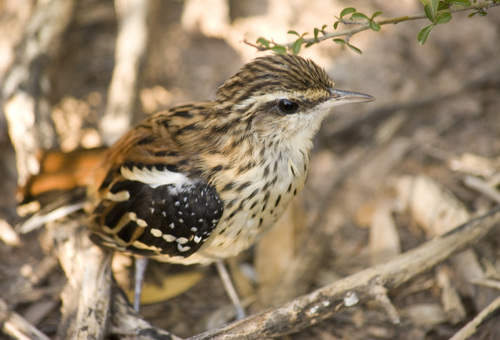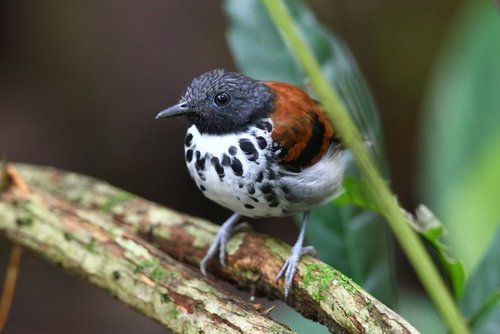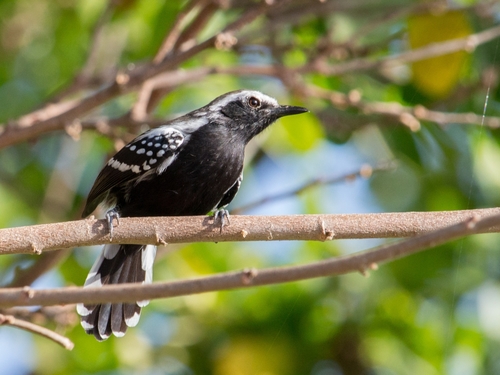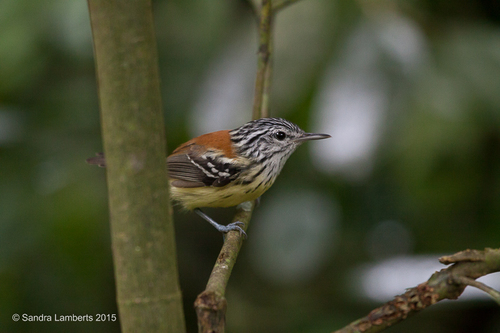
About Thamnophilus bernardi Lesson, 1844
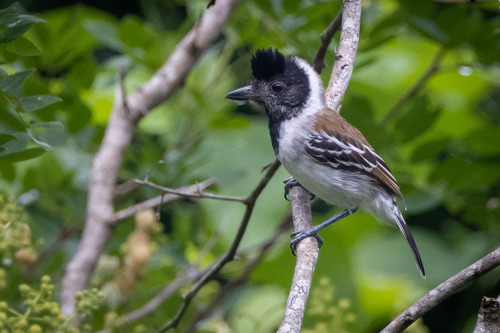
The collared antshrike (Thamnophilus bernardi Lesson, 1844) is 16.5 to 18 cm (6.5 to 7.1 in) long and weighs 30 to 38 g (1.1 to 1.3 oz). All members of the genus Thamnophilus are largish antbirds, and all have stout hooked bills that resemble the bills of true shrikes. Both sexes of the collared antshrike have a bushy crest.
Adult males of the nominate subspecies have a black crown and crest, with white spots on the forehead. Their face is mostly black, with grayish white lores. They have a white collar that connects to their white underparts. Their upperparts are mostly dull rufous brown, with a hidden white patch between the scapulars. Their wings are dark brown, with white or buffy brown edges on the coverts and flight feathers. Their tail is black, with white tips on all feathers and white edges on the outermost feather pair. Their throat is black, with white scaling on its upper portion and sides; the black extends onto the breast as a pointed patch. The rest of their underparts are mostly white, with a buff wash on the flanks.
Adult females have a black and white forehead, a dark rufous brown crest, and a black rear crown; some individuals have an almost entirely black crown. Their face is dark gray with thin white streaks. Their collar is buff, and like the male's it connects to the upperparts. Their back is dark reddish brown, with some white on the feather bases and wide white edges on the scapulars; their rump is a paler reddish brown than the back. Their wing coverts are dark brown or blackish with wide buff edges and tips; their flight feathers are brown with reddish brown edges. Their tail is dull rufous. Their throat is white or whitish buff with gray mottling, and their breast and belly are buff.
Immature males resemble adult females, but also have a black patch on the center of the throat and upper breast. Both sexes have a chestnut brown iris, a black maxilla, a blue-gray mandible with a black tip, and blue-gray legs and feet.
Both sexes of the subspecies T. b. shumbae differ from the nominate subspecies. Males have more white on the lores and face, and gray-brown upperparts. Their chin is white or pale gray, with black only on the center of the lower throat and upper breast. Females are paler overall than the nominate, especially on the underparts. Their crown is a brighter rufous than the nominate's, they have minimal black on their hindcrown, and their face has more white. The edges and tips of their wing coverts are white, and their flight feathers have pale cinnamon edges. Their underparts are white with a pale buff wash on the breast and flanks, and their crissum is pale buff.
The collared antshrike has a disjunct distribution. The nominate subspecies has by far the larger range; it is found along the Pacific slope from Manabí and Guayas provinces in west-central Ecuador, south into northwestern and north-central Peru as far as northern Ancash Department. Subspecies T. b. shumbae is found in north-central Peru, in the watersheds of the Marañón River and its tributary the Chinchipe River. The species inhabits deciduous forest, arid scrublands, and shrubby secondary forest. In terms of elevation, it mostly ranges up to 1,500 m (4,900 ft), but occurs locally up to 1,850 m (6,100 ft) in Ecuador, up to 1,200 m (3,900 ft) in western Peru, and up to 1,950 m (6,400 ft) in the Marañón Valley.