About Thamnophilus atrinucha Salvin & Godman, 1892
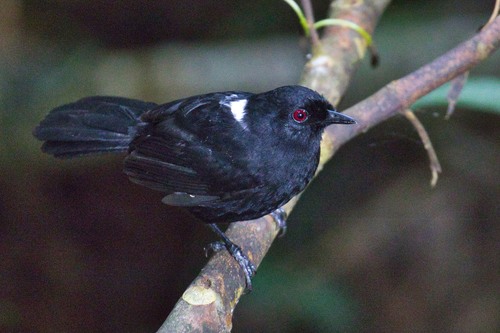
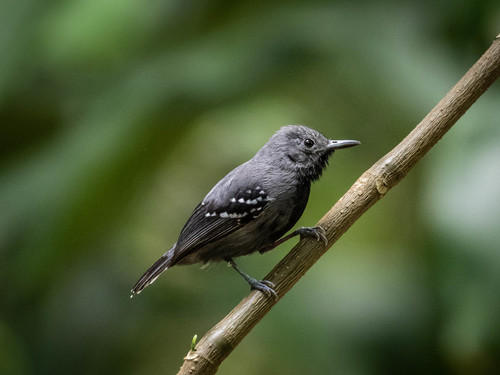
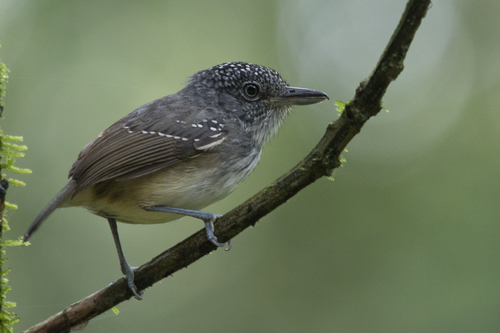
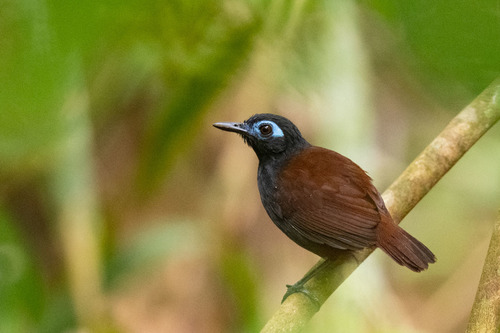
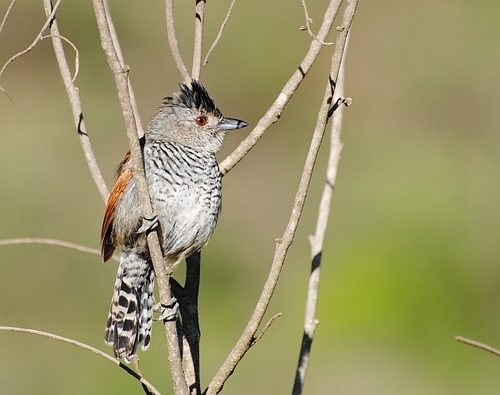
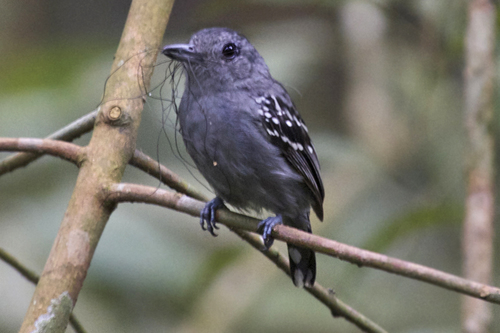
The black-crowned antshrike (Thamnophilus atrinucha Salvin & Godman, 1892) measures 14 to 15 cm (5.5 to 5.9 in) long and weighs 20 to 28.5 g (0.71 to 1.0 oz). All members of the genus Thamnophilus are relatively large antbirds, and all share stout, hooked bills similar to those of true shrikes. This species shows marked sexual dimorphism. Adult males of the nominate subspecies have slaty gray upperparts, a gray forehead, a black crown and nape, a hidden white patch between their scapulars, and black uppertail coverts tipped with white. Their face is grizzled gray, their wings are black with white-tipped coverts and white or gray edges on flight feathers, and their tail is black with a white spot at the tip of each feather. Their underparts, including the underside of the tail, are slaty gray. Adult females have brown to buffy brown upperparts; their wings are fuscous-black with brown edges and white-tipped flight feathers, and their underparts are buffy brown to grayish brown. Both sexes have a brownish red to chocolate-brown iris, and medium to dark gray legs and feet. Males have a dark gray bill, while females have a light gray bill. Juveniles have dull cinnamon-brown upperparts and grayish white underparts. Compared to the nominate subspecies, males of T. a. gorgonae have more gray on the forehead and lighter gray underparts. Females of T. a. gorgonae have a much darker crown, more rufous upperparts, and darker underparts than the nominate. The nominate subspecies has the far larger range of the two recognized subspecies. In Central America, it occurs on the Caribbean slope from southern Belize through Panama, and on the Pacific slope in northwestern Costa Rica and in Panama from Coclé Province eastward. In South America, it ranges across northern Colombia including the Magdalena Valley, into northwestern Venezuela as far as Trujillo state, and along the Pacific slope of Colombia and Ecuador to the Department of Tumbes in far northwestern Peru. Subspecies T. a. gorgonae is found only on Gorgona Island, off the southwestern coast of Colombia. The black-crowned antshrike lives in a variety of forested habitats, including primary and secondary semi-deciduous and evergreen forests. It prefers the forest interior, though it also occurs at forest edges. It favors the understorey to mid-storey, but can be found all the way up to the canopy. Its elevation range extends from sea level to 1,250 m (4,100 ft) in Central America, up to 1,500 m (4,900 ft) in Colombia, and mostly below 1,100 m (3,600 ft) in Ecuador. It reaches up to 1,000 m (3,300 ft) in Venezuela, and occurs between 400 and 800 m (1,300 and 2,600 ft) in Peru.