About Thamnophilus ambiguus Swainson, 1825
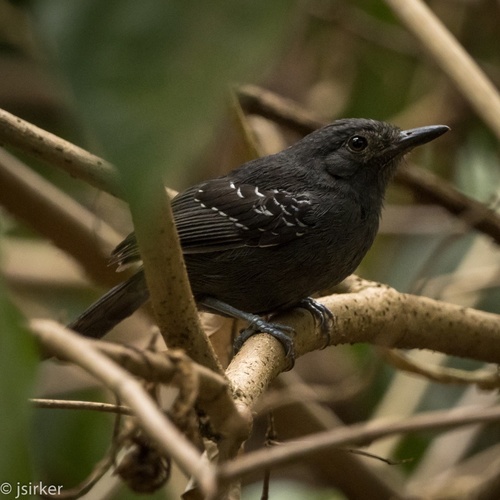
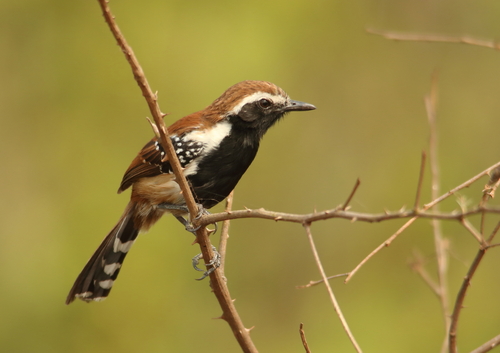
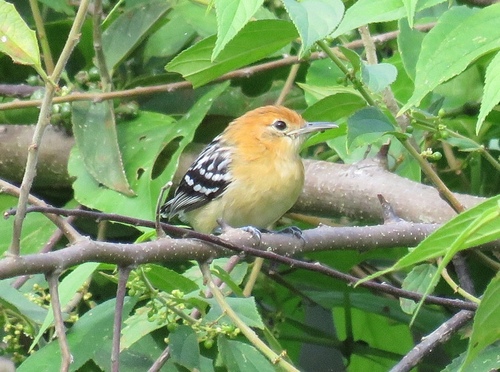
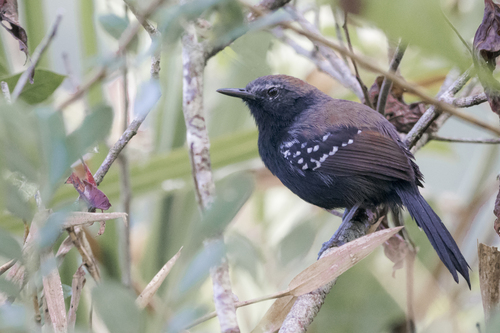
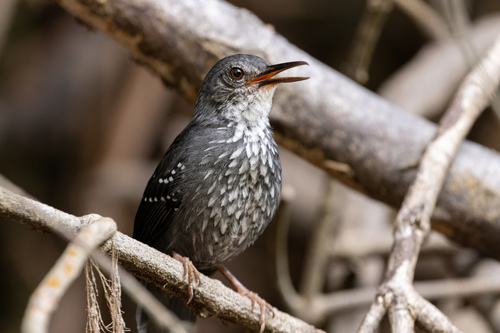
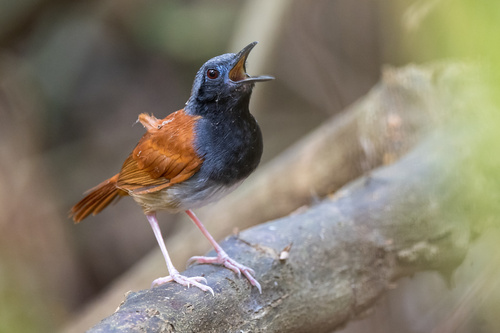
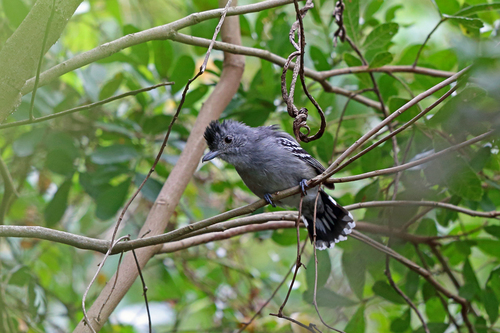
The Sooretama slaty antshrike, Thamnophilus ambiguus Swainson, 1825, measures 14 to 15 cm (5.5 to 5.9 in) in length. All species in the genus Thamnophilus are largish members of the antbird family, and all have stout hooked bills similar to those of true shrikes. This species shows notable sexual dimorphism. Adult males have a black forehead with a few gray spots and a black crown. Their back is gray, with a black spot at its center and a hidden white patch between the scapulars. Their face is gray. Their wings and wing coverts are black with white spots and edges. Their tail is black, with white tips and spots on the individual feathers. Their underparts are gray, and the throat and belly are often whiter than the rest of the underparts. Adult females have a warm tawny-brown crown. Their back is olive-gray with a clay-colored tinge and a few black feather tips. Their wings are dark brown with white spots and edges, and pale clay edges on the flight feathers. Their tail is dark brown with white tips and spots on the individual feathers. Their underparts are a mix of clay and smoke-gray, and the throat and belly are whiter. The Sooretama slaty antshrike is distributed along the coastal region of southeastern Brazil, ranging from southern Sergipe to Rio de Janeiro state, and inland up the Doce River valley in Minas Gerais. It lives in the understorey to mid-storey of evergreen forest, sandy soil woodlands, and adjacent secondary forest. Across its range it prefers forest edges and gaps created by fallen trees. It occurs at elevations from sea level up to 700 m (2,300 ft).