About Thamnophilus amazonicus P.L.Sclater, 1858
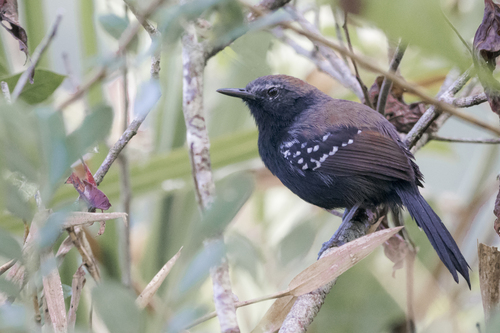
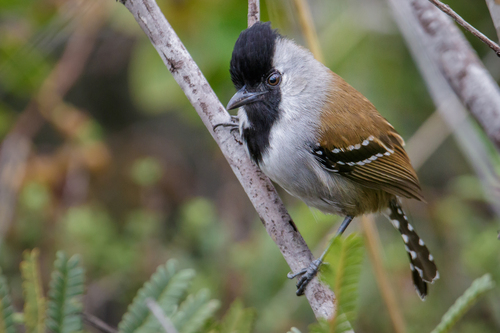
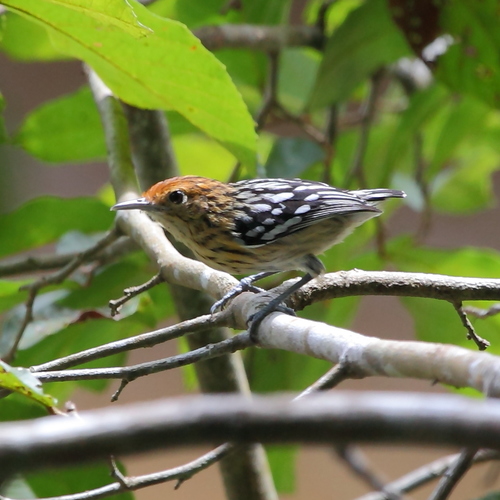
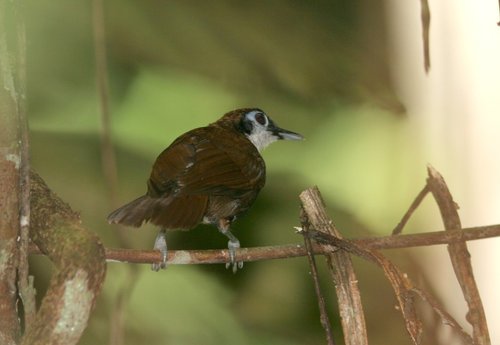
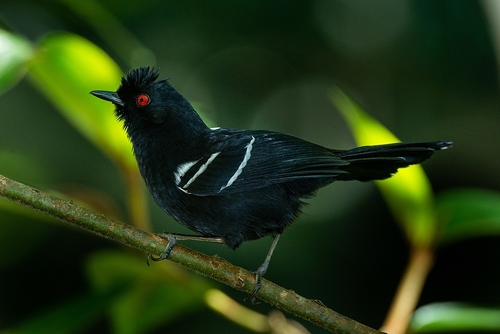
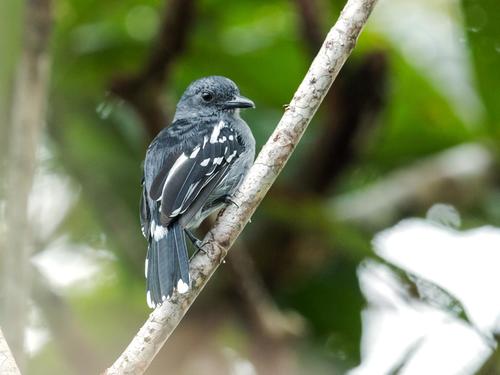
The Amazonian antshrike (scientific name Thamnophilus amazonicus P.L.Sclater, 1858) measures 14 to 15 cm (5.5 to 5.9 in) long and weighs 17 to 21 g (0.60 to 0.74 oz). Members of the genus Thamnophilus are largish birds in the antbird family, and all have stout hooked bills similar to those of true shrikes. This species shows significant sexual dimorphism. Adult males of the nominate subspecies T. a. amazonicus have black on the center of the forehead and crown, with the rest of the head gray. Their back is mostly black with a gray rump and a hidden white patch between the scapulars. Their wings, scapulars, and wing coverts are black with white spots and edges. Their tail is black with white tips and spots on the outer feathers, and their underparts are gray. Adult females have a bright rufous crown. The rest of their head and their underparts down to the belly are bright yellowish red-brown, and their belly is buff. Their back is deep olive. Their wings and tail are similar to the male's, but are browner with pale olive edges on the flight feathers. Both sexes of subspecies T. a. cinereiceps are smaller and paler than the nominate. Males of this subspecies have a gray crown and gray upperparts with a few black feathers. Females have gray mixed into their yellowish red-brown breast, olive-gray flanks, and buff-tinged smoky white belly and crissum. Males of subspecies T. a. divaricatus have a blackish gray face and a back mixed with black and gray. Females have paler, grayer underparts than the nominate subspecies. Subspecies T. a. obscurus is the darkest of all. Males have nearly or entirely black upperparts and dark gray underparts. Females are dark, and their tail feathers often lack pale tips. Males of T. a. paraensis have paler underparts than the nominate, and often have faint white bars on their belly. Females have a reddish tinge on their tail and pale cinnamon-buff belly and crissum. The Amazonian antshrike is found throughout the Amazon Basin. The ranges of the subspecies are as follows: T. a. cinereiceps ranges from western Amazonas in Venezuela, south through east-central Colombia, and into northwestern Brazil along the upper Negro River and its lower right bank to the Solimões River (upper Amazon). T. a. divaricatus is found in eastern Bolívar state in extreme eastern Venezuela, and extends east through the Guianas and northeastern Brazil north of the Amazon to the Atlantic coast in Amapá and Pará. T. a. amazonicus occurs from southern Amazonas Department in Colombia, south through eastern Ecuador's Orellana Province and eastern Peru into northern Bolivia, and in western Brazil south of the Amazon east to the Tapajós River and south to Acre, Rondônia, and western Mato Grosso. T. a. obscurus is found in south-central Brazil south of the Amazon between the Tapajós and Tocantins rivers. T. a. paraensis occurs in Brazil south of the Amazon east from the Tocantins River to western Maranhão. The Amazonian antshrike lives in somewhat different landscapes across its range. In general, its habitats are evergreen forest and secondary forest. In all forest types, it occurs from the understorey to the mid-storey. Subspecies T. a. cinereiceps occurs mostly in areas with sandy soil, such as low-stature savanna woodlands on white sand and the edges of taller terra firme and igapó forest. Subspecies T. a. divaricatus primarily lives in vine-heavy terra firme, but also occurs near tepui summits and along rivers. The nominate T. a. amazonicus is almost entirely restricted to seasonally flooded várzea and igapó, where it favors viny edges and interior light-gaps such as those created by fallen trees. T. a. obscurus also inhabits edges, and also occurs in forest interior, dense secondary forest, and stands of Guadua bamboo in terra firme and transitional forest. T. a. paraensis occurs mostly in secondary forest, less often in light-gaps within terra firme and igapó, and rarely in várzea. In terms of elevation, it occurs below 400 m (1,300 ft) in Colombia, below 200 m (700 ft) in Ecuador, and below 400 m (1,300 ft) in Venezuela, with only a single recorded occurrence at 1,300 m (4,300 ft).