About Thamnomanes caesius (Temminck, 1820)
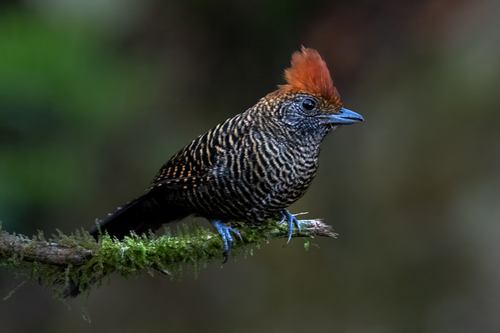
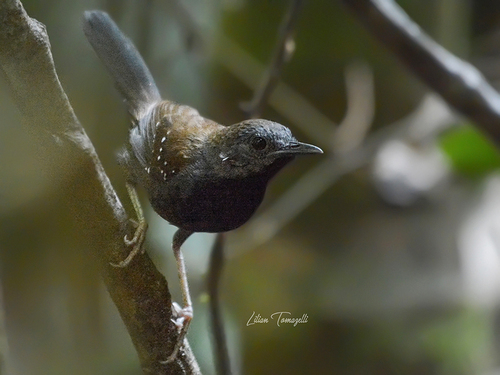
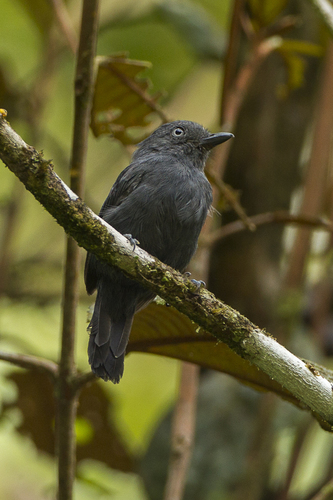
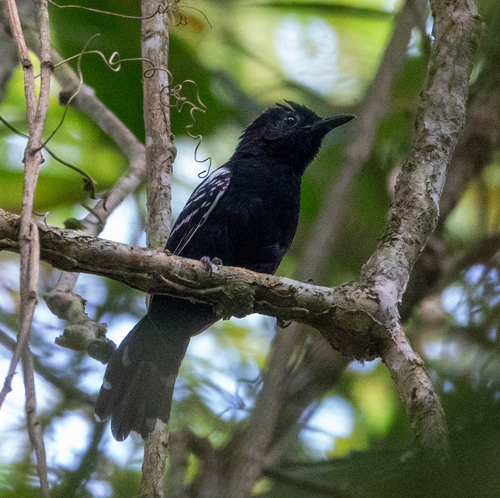
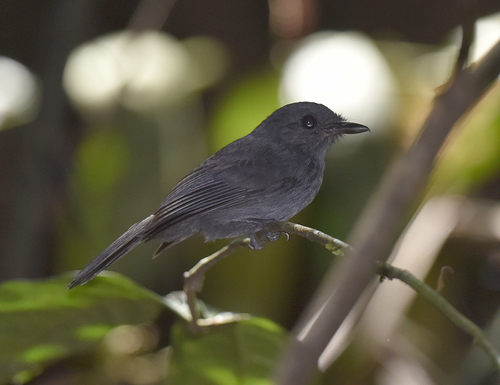
The cinereous antshrike, Thamnomanes caesius, is 14 to 15 cm (5.5 to 5.9 in) long and weighs 16 to 18 g (0.56 to 0.63 oz). Adult males of the nominate subspecies T. c. caesius are almost entirely dark gray; the inner edges of their secondaries and their underwing coverts are white. Adult females have olive-brown upperparts with a small white patch between the scapulars. Their wings and tail are olive-brown with a rufous tinge. Their throat is buff, their breast, sides and flanks are olive with a tawny-cinnamon tinge, and the center of their belly and their crissum are tawny-cinnamon. Other subspecies of the cinereous antshrike differ from the nominate subspecies and one another as follows: T. c. hoffmannsi: Males are paler than the nominate, with white streaks on the ear coverts and throat. Females have a buff-white throat, and their flanks are less olive and more tawny-cinnamon than the nominate's. T. c. persimilis: Males are slightly darker than hoffmannsi and lack white streaks. Females have cinnamon-rufous lower breast, belly, and crissum, with a cinnamon-rufous tinge across all other parts of the body. T. c. simillimus: Males are darker than the nominate and have a small white patch between the scapulars. Females are similar to female persimilis. T. c. glaucus: Males have a whitish throat and a large white intrascapular patch. Females have a large white intrascapular patch, deep tawny-rufous lower breast, belly, and crissum, with a rufous tinge across all other parts of the body.
The cinereous antshrike has a disjunct distribution, with each subspecies occupying its own range as follows: T. c. glaucus is found from eastern Colombia south through eastern Ecuador into northeastern Peru, extending east through southern Venezuela, the Guianas, and in Brazil from northern Amazonas state east to the Atlantic coast in Amapá. T. c. persimilis occurs in central Brazil south of the Amazon, between the Juruá and Tapajós rivers, and ranges south through Rondônia and western Mato Grosso into extreme northeastern Bolivia. T. c. simillimus is found in the middle of the Purus River basin in south-central Brazil. T. c. hoffmannsi is located in east-central Brazil south of the Amazon, extending east from the Tapajós to western Maranhão and south to northeastern Mato Grosso. T. c. caesius is separated from the other subspecies, found in coastal southeastern Brazil from Pernambuco south to Rio de Janeiro state, and inland in Minas Gerais.
The cinereous antshrike inhabits the understorey to mid-storey of terra firme, várzea, and igapó evergreen forest. It seldom occurs in secondary forest. Across most of its range it is found at elevations below 600 m (2,000 ft), but it reaches 700 m (2,300 ft) in Colombia and 1,100 m (3,600 ft) on tepuis in Venezuela.