About Thamnolia vermicularis (Sw.) Schaer.
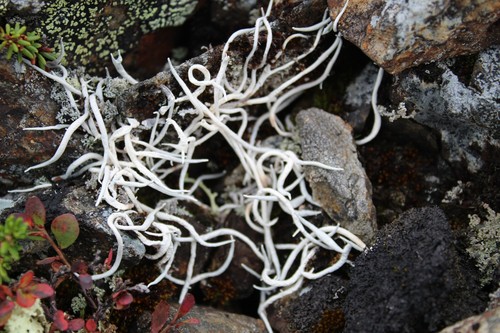
Thamnolia vermicularis (Sw.) Schaer. is a lichen with a thallus that forms loose mats or scattered tufts of slender, worm-like branches. Most branches reach about 5 cm long and 1–2 mm in diameter, though one treatment notes branches can grow up to 10 cm long and 2 mm wide. Branches most often lie decumbent or straggling across the substrate, and less frequently stand roughly erect. Short lateral side branches are uncommon, but the thallus may form dense tufts in some patches. The branches are smooth, cylindrical, often hollow with thin walls, have tapered tips, and are uniformly a distinct chalky white. Vegetative propagules like soredia and isidia are not present. Asexual reproduction occurs via small pustule-like swellings called conidiomata on the branch surface. These structures are roughly hemispherical, 200–350 micrometres (μm) across and 150–200 μm high, with an irregular pore-bearing surface that releases pinkish droplets of mucilaginous mass holding conidia. Inside the conidiomata, elongate conidiophores are arranged in chains of conidiogenous cells, each with small peg-like outgrowths near the upper cell septum where new conidia form. Conidia are tiny, rod-shaped spores measuring 3–5 × 1–2 μm, slightly narrowed at one end, colourless, thin-walled, and lack internal septa. Thamnolia vermicularis has an extremely broad geographic range across cold regions. It occurs in arctic and alpine tundra habitats on all continents except Africa and Antarctica. In the Northern Hemisphere it is circumpolar, while in the Southern Hemisphere it grows in disjunct high-elevation areas including New Guinea, New Zealand, Australia, and the South American Andes. This lichen grows on a wide range of tundra terrain, from bare open gravel and frost-heaved soil (called "frost boils") to rich, moist mossy thickets among dwarf willows and heaths. It is primarily an alpine and Arctic species, but can also be found at low elevations in far northern coastal areas that are windswept and exposed. In China, it has been recorded from high-elevation and high-latitude cold regions, with records concentrated in the south-western Hengduan Mountains and extending to Yunnan, Sichuan, Tibet, Shaanxi, Xinjiang, Inner Mongolia, Jilin and Heilongjiang, at altitudes from 1,350 to 5,200 m. In the Venezuelan Andes, it is widespread above about 3,500 m, and was collected in large quantities for study from páramo sites above 4,200 m at Pico Piedras Blancas. Thamnolia vermicularis is essentially sterile and lacks a functional sexual stage. It does not produce true apothecia (sexual fruiting bodies); early reports of apothecia on this species were likely misidentifications of parasitic fungi. It reproduces and spreads only through asexual methods. The most common propagation method is thallus fragmentation: its white, worm-like branches break into lateral branches or longitudinal strips, and each fragment contains both the fungal partner (mycobiont) and the photosynthetic algal partner. Fragments detach as longitudinal strips along pre-formed separation zones, forming from the medulla outward toward the cortex, and stay temporarily attached via internal hyphae before breaking free. Additionally, Thamnolia produces pycnidia on the thallus surface that bear conidiospores (mitospores). The release of large numbers of these tiny conidia is thought to enable long-distance dispersal, which may explain the lichen’s broad cosmopolitan distribution and low genetic variation between populations. An experimental trampling study in Slovakia’s Belianske Tatras recorded T. vermicularis in native alpine plant communities, and found its response to trampling was context-dependent and generally weak: it was more resistant to heavier trampling in one community but more resistant to lighter trampling in another, and after regeneration it was only recorded in a single trampled plot, where its seasonal resistance remained low. The study authors also noted that some mosses and lichens disappear as a delayed response to trampling, and T. vermicularis was absent from several regenerated, previously trampled communities in 2022. A 14-year long-term reciprocal turf-transplant experiment in the alpine zone of New Zealand’s Rock and Pillar Range, South Island, tracked T. vermicularis across sites with very different snow cover depth and duration. The lichen rapidly colonized turves moved to the exposed summit plateau, where it is naturally common, but declined quickly when turves were transplanted into snowbeds, and was almost absent from these sites after several years. The authors suggested that this rapid, directional response to changed snow cover makes T. vermicularis a useful bioindicator of shifting alpine snow regimes. In a shorebird nesting study in the arctic tundra of Siberia’s western Taymyr Peninsula, ruddy turnstones and Pacific golden plovers preferred to line their nests with Thamnolia vermicularis, supplemented with other lichens, willow leaves, and a small amount of moss. The authors suggested that using local materials improves nest crypsis, and noted that Thamnolia provides better camouflage in these breeding habitats than some more strongly insulating materials. Derek Ratcliffe reported that this lichen is a frequent lining material in golden plover nests, recorded in 175 of 273 British nests with described lining (and forming the sole lining in 34 nests). "Reindeer moss" Cladonia lichens can form a thick pad beneath the eggs, and their tubular thalli were suggested to provide good insulation. Ratcliffe also cited Sauer’s work on Pacific (Asiatic) golden plovers on St Lawrence Island, where T. vermicularis was the preferred nest-lining material, and noted that many golden plovers add more lining material as incubation proceeds. Over geological timescales, the current distribution of Thamnolia is thought to reflect ancient dispersal events; the lichen is absent from recently formed volcanic terrain, which suggests it colonized its current sites long ago and does not easily establish on new substrates in modern times. In polar-desert environments, the occurrence of Thamnolia vermicularis is strongly shaped by substrate and moisture regime. A survey of 157 sample plots at Cape Zhelaniya on northern Novaya Zemlya found that overall lichen cover and species richness generally declined with increasing elevation, and lichen cover also decreased as bryophyte cover increased. In contrast, both species richness and lichen cover increased on better-drained, coarse-textured surfaces, defined by a higher proportion of soil particles larger than 0.125 mm. The survey authors recorded 84 total lichen species and categorized Thamnolia vermicularis s. l. as the single most widespread active species in the area, present across all recognized habitat types, though it usually occurs as scattered thalli rather than forming high cover. Vegetation surveys in arctic–alpine tundra have recognized Thamnolia vermicularis as the character species of a small-scale terricolous lichen community called the Thamnolietum vermicularis, recorded from both Greenland and the Austrian Alps, that occurs mainly in wind-exposed dwarf-shrub and dwarf shrub–graminoid vegetation. In this study of 69 vegetation plots, authors distinguished eight floristic groups and separated two subassociations tied largely to substrate conditions: an acidic typicum and a calcareous vulpicidetosum tubulosi, reflecting a strong pH gradient and differences in soil stability. They interpreted the Thamnolietum as an indicator of strong wind exposure, and described a distinct vertical layering within stands: the uppermost layer is fully exposed, while lower layers are more sheltered and retain moisture. This layering allows many species typical of less extreme conditions to persist in protected gaps, and helps explain the high small-scale diversity recorded in these lichen-rich patches. In the high Venezuelan Andes’ Páramo de Piedras Blancas, thalli occur as loose, vagrant strands on needle-ice soils and even on the domed surfaces of cushion plants; Pérez inferred that local dispersal and redistribution are driven mainly by wind, with thalli also accumulating in hollows and depressions. Physiological measurements in upland Alaskan tundra found that carbon gain in Thamnolia vermicularis is tightly limited by light, hydration and temperature. The lichen requires moderate light to achieve net carbon gain, and net photosynthesis declines when thalli are very wet; authors noted that this high-moisture reduction in photosynthesis can be prevented at elevated CO2 and is also visible in field observations. They also found that T. vermicularis can remain photosynthetically active at low temperatures, with measurable net photosynthesis even at the freezing point, and suggested that photoinhibitory after-effects may explain why field photosynthesis rates are sometimes lower than predicted by laboratory measurements. Thamnolia vermicularis has a long history of use in traditional Chinese medicine as "snow tea" (xuecha), and has been described as having anti-inflammatory properties. Market material sold as xuecha in Yunnan may be a mixture of T. vermicularis and T. subuliformis, which cannot be told apart by morphology. Some sources give it the Chinese name Baixuecha, meaning "white snow tea". A 2017 food-science study describes T. vermicularis as an edible lichen in East Asia that is consumed as a tea, and is commonly called "white snow tea" in China; it also notes that reported medicinal uses are not supported by scientific evidence. In China, material sold as "snow tea" (also called "Taibai tea") is used in folk practice as a mixture of two Thamnolia species. In 2015, Yang and colleagues reported that minority communities in north-west Yunnan have consumed Thamnolia lichens as a tea drink for a long time, but increased harvesting linked to tourism and local economic development has greatly reduced wild populations; they noted that lichens grow very slowly and protection measures are lacking, and called for conservation to support sustainable use. In the Nepal Himalaya, Thamnolia vermicularis is mainly used for ritual and spiritual purposes rather than as food. Devkota and colleagues reported that some households keep a handful of the lichen above their main entrance, believing it wards off evil spirits and helps maintain peace at home and among family members. In the same study, Sherpa and Lama communities use T. vermicularis (along with Usnea longissima) as an ingredient in incense powder, mixed with aromatic plant material and burned during prayers and religious ceremonies. Authors also recorded the Nepali vernacular name Dankini Jhyauu, meaning ‘witch mushroom’, which reflects that respondents sometimes considered this species a mushroom rather than a lichen.