About Thamnistes anabatinus P.L.Sclater & Salvin, 1860
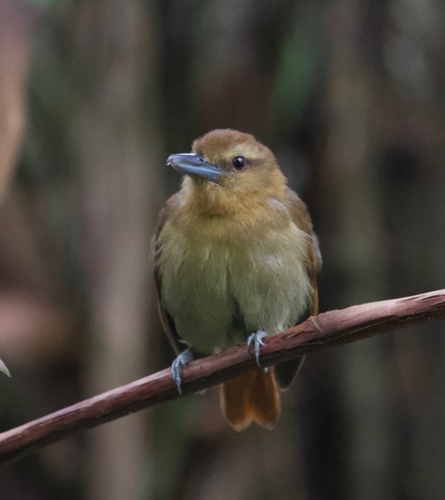
The russet antshrike (Thamnistes anabatinus) is 13 to 15 cm (5.1 to 5.9 in) long and weighs approximately 19 to 24 g (0.67 to 0.85 oz). It has a stocky body and a heavy hooked-tipped bill. The plumage of males and females is almost identical, with only a small, hard-to-see shoulder patch found only in males. Adults of the nominate subspecies T. a. anabatinus have an olive-yellow supercilium, a dusky line through the eye, and pale olive-brown ear coverts. Their forehead, crown, and upperparts are olive-brown. The tail is rufous, and the wings are cinnamon-rufous. Their throat, breast, and belly are pale yellowish olive, while their flanks and undertail coverts are olive. Males have an easily hidden patch of cinnamon or orange-rufous between the shoulders; females do not have this patch. For both sexes, the iris is red-brown to brown, the bill is dark gray to blackish or dark brown, and the legs and feet are blue-gray to pale gray. Each recognized subspecies differs slightly in coloration and markings. T. a. saturatus is slightly darker than the nominate, with a red-brown iris, greenish black maxilla, horn-colored mandible, and greenish slate legs and feet. T. a. coronatus has a rufescent crown and yellower underparts than the nominate, with a red or auburn iris, a slate or gray maxilla with some fuscous-black markings, a bluish gray or light gray mandible, and light green to gray legs and feet. T. a. intermedius is slightly darker than T. a. coronatus, and the male's shoulder patch has blackish spots. T. a. gularis has a more ochre-colored throat than the nominate. T. a. aequatorialis has a very dark olive-brown crown, olive-brown upperparts, an olive-yellow throat, and olive underparts; its shoulder patch is orange-rufous with black spots. The six subspecies of russet antshrike have distinct geographic ranges. T. a. anabatinus is found on the Caribbean slope from Chiapas, Tabasco, and Oaxaca in Mexico, south through northern Guatemala and southern Belize into northern Honduras. T. a. saturatus occurs on the Caribbean slope of Nicaragua, on both the Caribbean and Pacific slopes of Costa Rica (excluding far northwest Costa Rica), and extends slightly into Chiriquí Province of western Panama. T. a. coronatus ranges from central Panama to and possibly into northwestern Colombia. T. a. intermedius is found along the Pacific slope of Colombia's Western Andes, south from Antioquia Department, and along the western slope of the Andes in Ecuador, south almost to Peru. T. a. gularis occurs in Táchira state, Venezuela, and possibly in adjacent northeastern Colombia. T. a. aequatorialis is found on the eastern slope of Colombia's Eastern Andes, from Meta Department south through eastern Ecuador, just into the far northern Peruvian department of Amazonas; note that the South American Classification Committee of the American Ornithological Society does not recognize any confirmed records of this species in Peru. Across most of its range, the russet antshrike inhabits lowland and montane evergreen forest, as well as adjacent secondary forest. In northern Central America, it also occurs in semideciduous forest. It typically stays within the forest subcanopy and canopy. Its elevation range varies by region: from near sea level to about 1,300 m (4,300 ft) in northern Central America, to 1,500 m (4,900 ft) in both Costa Rica and Colombia. In Ecuador, it mostly occurs between 400 and 1,300 m (1,300 and 4,300 ft), though it is found at lower elevations in far northwestern Ecuador. In Venezuela, it occurs around 1,250 m (4,100 ft).