About Thalictrum dioicum L.
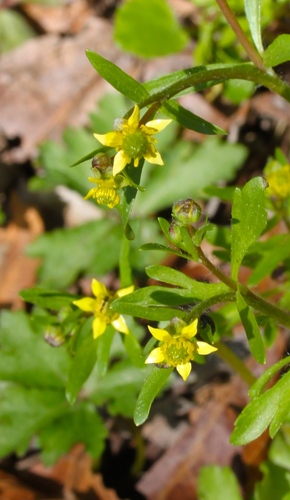
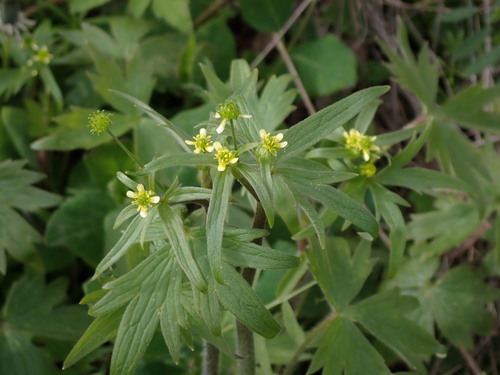
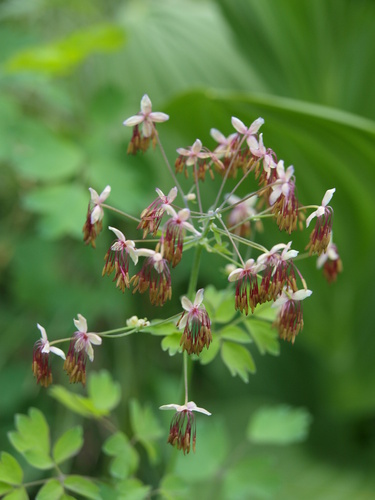
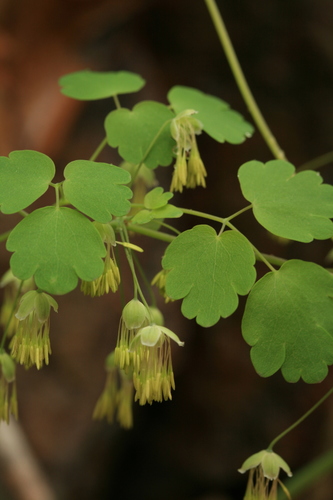
Thalictrum dioicum, commonly known as early meadow-rue or quicksilver-weed, is an herbaceous plant species belonging to the family Ranunculaceae. It is an upright-growing woodland native, with a range extending from Colorado Rocky Mountain forests to central and eastern North America, including parts of southeastern Canada. This species is dioecious: male and female flowers grow on separate individual plants, and bloom from early to mid spring. Thalictrum dioicum grows 30 to 80 cm tall from an upright caudex, and has thick, yellow-gold fibrous roots. A new caudex is produced each year by the current year's plant, and the old caudex withers away during the fall and early spring of the following year. In early spring, new growth emerges, producing leaves that are either glabrous or glandular. It produces both basal and cauline leaves, which have long petioles. Leaf blades are 1-4 times ternately compound, with leaflets that range in shape from reniform or cordate to obovate or orbiculate. Leaflets are 10–45 mm wide, with lobed, often crenate margins; their undersides are typically either glabrous or glandular. Inflorescences are panicles or corymbs, produced both terminally and axillary, with many-flowered branches. The flowers do not have petals, but instead have greenish sepals 1.8–4 mm long, that are sometimes tinted purple. Sepals range in shape from ovate to obovate or oval. On male plants, the flower filaments are the most prominent part of the hanging flowers; they are yellow to greenish-yellow in color, and 3.5-5.5 mm long. The filaments end in anthers 2–4 mm long, which are mucronate to acuminate in shape, with purple stigmas. After blooming, fertilized female plants produce green fruits called achenes. Each fertilized flower typically produces (3-)7 to 13 achenes, which are not reflexed, are sessile or nearly sessile, and arranged in tight clusters. The achenes are ovoid to ellipsoid in shape, not laterally compressed, 3.5–5 mm long, glabrous, and very strongly veined, with 1.5 to 3 mm long beaks. They ripen in mid summer. This plant is grown in shade gardens for its attractive lacy foliage, which resembles the foliage of columbines or maiden hair fern. Male plants produce more showy flowers than female plants. It blooms in early spring, with flowers and foliage emerging from the ground in club-like clusters, and basal leaves unfolding first. Plants begin flowering before their compound leaves have fully unfolded. Like some other species in its genus, Thalictrum dioicum is pollinated by wind, a trait called anemophily. Male plants are taller than female plants at the start of the growing year, but females typically become taller than males by summer as their fruits develop.