About Thalera fimbrialis (Scopoli, 1763)
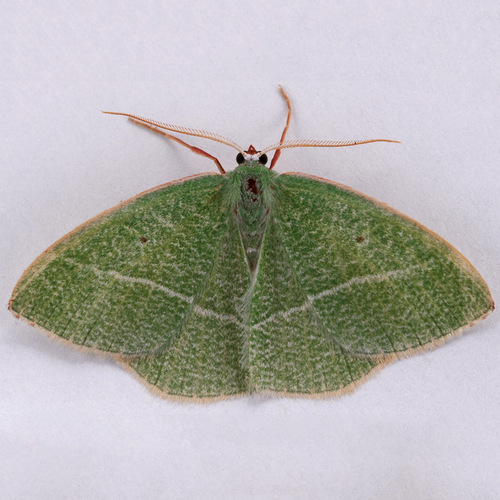
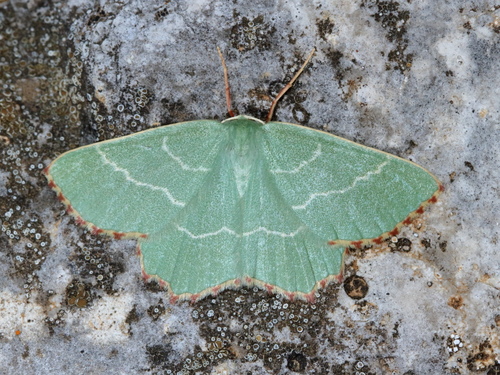
Thalera fimbrialis (Scopoli, 1763) has a wingspan of 25–30 mm. Its base wing color is green, which can fade to yellowish tints as the moth ages. The outer edge of the wings is yellowish, and the hair fringes along the edge are alternately white and reddish-brown. The forewings have two white crosslines, while the hindwings only have a single line that continues the outer line of the forewing. The middle of the hindwing has a slightly pointed forward corner, with an indentation above this corner. This moth flies from June to August, with flight timing varying by location. Larvae of this species overwinter while partially grown. When fully grown, larvae are long and thin, and green with a brownish-red dorsal stripe that is sometimes broken into a series of spots. The larval head is split in the middle by a deep cleft. A pair of spikes protrudes above the head from the first body segment behind the head. When the caterpillar molts during ecdysis, it eats its discarded skin. This behavior may occur to gain nutritional value, or to remove traces that predators could use to locate the moth. larvae feed on a variety of woody and herbaceous plant species, likely including many not recorded here. In the United Kingdom, this species only lives in vegetated shingle habitats, and primarily feeds on wild carrot (Daucus carota). Late larval instars are occasionally found feeding on plants in the ragwort genus (Senecio species). This species is distributed across Europe and Asia, reaching as far east as China. In the UK, it is a Red Data Book species, and only breeds in the Dungeness area of Kent and at one site in Rye, East Sussex.