About Thaleichthys pacificus (Richardson, 1836)
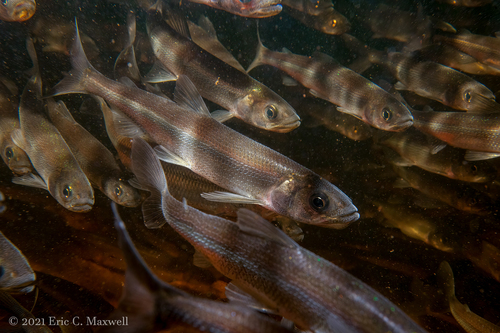
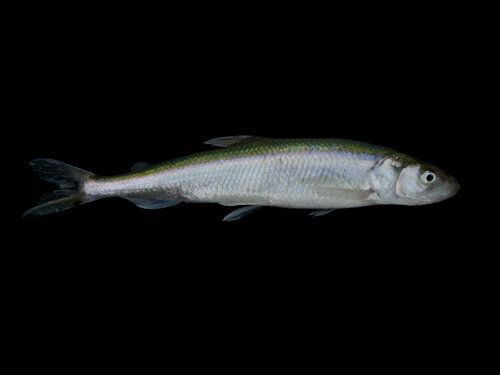
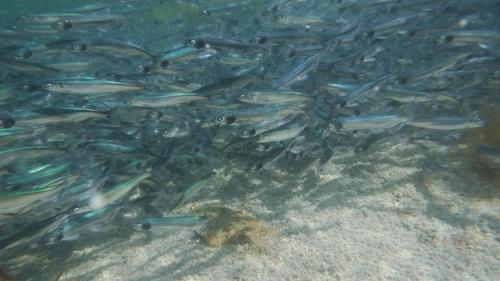
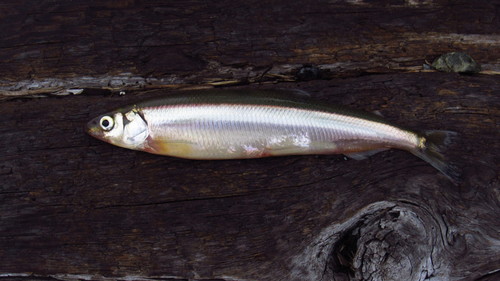
Thaleichthys pacificus, commonly called eulachon, has several distinguishing physical traits. It can be identified by large canine-like teeth on the vomer bone, and 19 to 31 rays in its anal fin. Like salmon and trout, eulachon have a sickle-shaped adipose fin located aft of the dorsal fin. Paired fins are longer in male eulachon than in females. All fins of ripe males have well-developed breeding tubercles, which are raised tissue bumps; these tubercles are poorly developed or entirely absent in females. Adult eulachon have brown or blue coloration on the back that extends to the top of the head. Their sides are lighter, ranging to silvery white or light blue, and their ventral surface is white. Any speckling on adults is extra fine and sparse, and is restricted to the back. Adults can reach a maximum length of 30 cm (12 in), but most adults measure between 15 and 20 cm (6 and 8 in). Striae on the operculum help distinguish Thaleichthys pacificus from other types of smelt. Eulachon only feed while they are at sea. They feed primarily on plankton, and also eat fish eggs, insect larvae, ocean debris, and small crustaceans. Eulachon are an important part of the diet for many ocean and shore predators, and are a prominent food source for human communities living near their spawning streams. Eulachon are anadromous fish: they spend most of their adult lives in the ocean, but return to their natal freshwater streams and rivers to spawn and die. Because of this spawning behavior, one stream may regularly see large runs of eulachon, while a neighboring stream sees few or none. Regular annual runs are common, but not entirely predictable. Occasionally, a river that usually has large runs will see no returning eulachon in a given year, and the reasons for this variability are not known. A characteristic feature of eulachon runs is that the early portion of the run is almost entirely made up of males, with females arriving about midway through the run, until the run concludes. During the spawning season, males can be easily distinguished from females by fleshy ridges that form along the full length of the males' bodies.