About Thalassoma trilobatum (Lacepède, 1801)
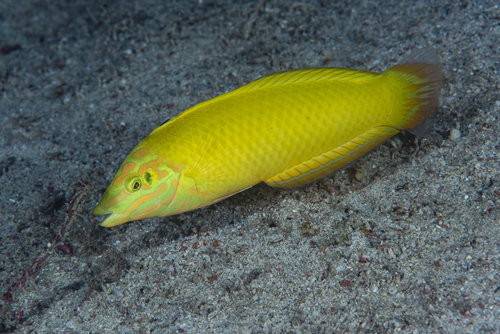
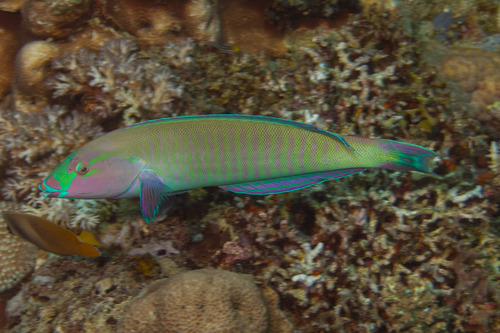
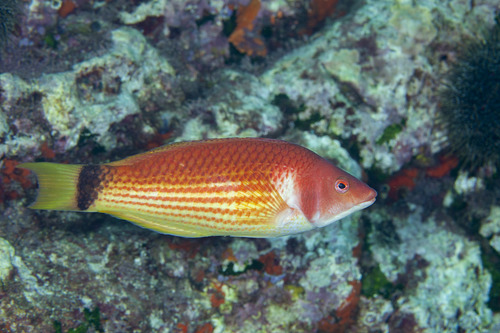
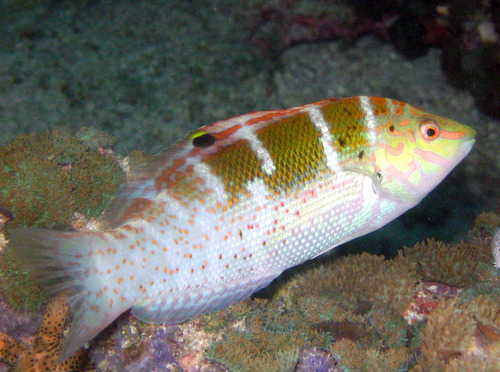
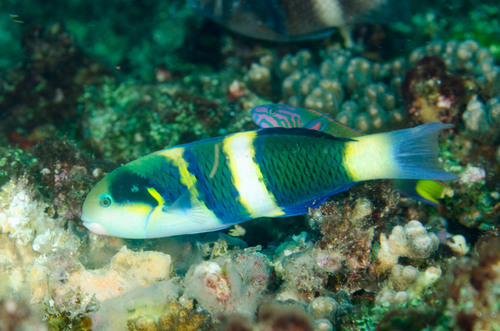
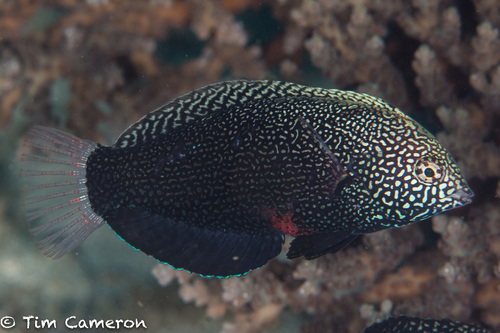
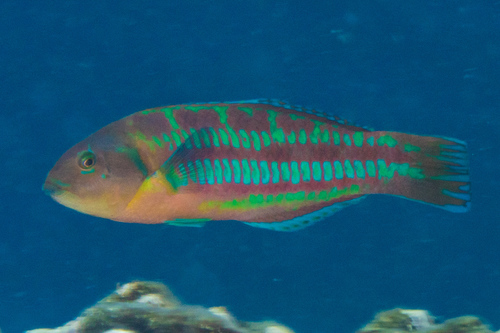
The Christmas wrasse, Thalassoma trilobatum, has 8 spines and 13 soft rays in its dorsal fin, and 3 spines and 11 soft rays in its anal fin. It normally has 16 pectoral fin rays and 25 scales along the lateral line. In the initial, female phase, the caudal fin is slightly rounded or truncate; in the terminal, male phase, the caudal fin is truncate or slightly double emarginated. Females have a greenish grey to pale green body, with 5 to 6 dark blotches along the back, two poorly defined dark stripes on the flank, and a dark vertical line on most body scales. They also have a diagonal or C-shaped pink to dark red marking below the front of the eye. Terminal phase males have a salmon-pink to orange body colour that is most intense toward the head, with two horizontal rows of vertically oriented green rectangles. Every fourth pair of rectangles in the upper row extends to form a single green bar across the back. The male's head is orange-brown and has no bands, while the tail is brownish to greenish, fading to pink toward the margin, with the fin rays in the last third of the tail coloured blue. This species is similar to the surge wrasse (Thalassoma purpureum), but can be distinguished by the spotted head of female Christmas wrasses, the absence of a V-shaped mark on the snout, and the distinct head colour of males. Christmas wrasses can reach a maximum total length of 30 centimetres (12 in). This species was first formally described in 1801 by French naturalist Bernard Germain de Lacépède (1756–1825) under the name Labrus trilobatus, with the type locality given as Mauritius. It has a wide distribution across the Indo-Pacific. It occurs along the east coast of Africa from Somalia to South Africa, with no confirmed records from Madagascar, and ranges across the Indian Ocean east into the Pacific Ocean as far as Pitcairn Island. In the Pacific, its range extends north to the Ryukyu Islands and south to northern New South Wales. The Christmas wrasse inhabits wave-exposed reef margins and reef flats with mixed coral, algae, and seagrass, and occurs at depths between 0 and 10 metres (0 and 33 ft). It is a carnivorous species that feeds on a variety of small invertebrates including crabs, molluscs, and brittle stars. Younger fish feed mainly on small benthic invertebrates. Christmas wrasses are oviparous; males and females form pairs to spawn, and after eggs hatch, the larval stage lasts between 60 and 99 days.