About Thalassoma pavo (Linnaeus, 1758)
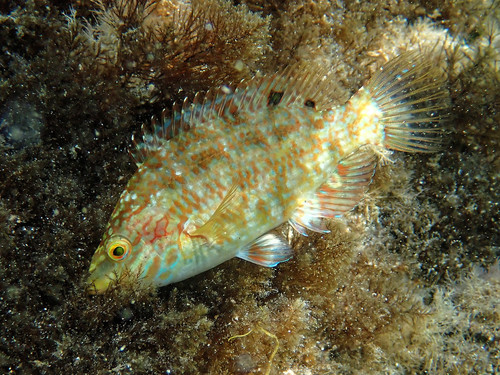
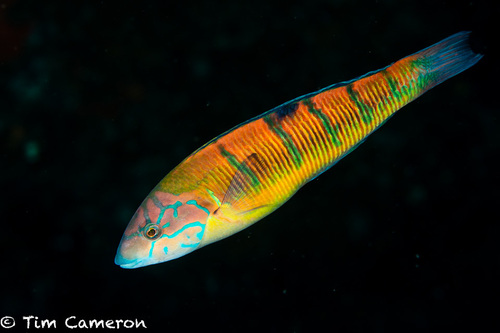
The ornate wrasse, Thalassoma pavo, exhibits sexual dichromatism. Females are greenish-brown, with a dark bar on each scale and five bluish vertical stripes. Males have red heads marked with blue; they have a vertical blue stripe with red margins located immediately behind the pectoral fin. The caudal fin of both sexes is turquoise. Juveniles are green overall, with a black spot halfway along the back, directly below the dorsal fin.
This species has an elongated, laterally compressed body, with a sharp, oval head, short snout, small terminal mouth, and thick lips. The caudal fin is rounded in young fish; as the fish matures, the fin becomes concave, with elongated outer rays that form filaments. The maximum recorded total length of the ornate wrasse is 25 cm (9.8 in), though most individuals do not grow longer than 20 cm (7.9 in). Its dorsal fin has 8 spines and 12 to 13 soft rays, while the anal fin has 3 spines and 10 to 12 soft rays.
The ornate wrasse is native to the eastern Atlantic Ocean and the Mediterranean Sea. In the eastern Atlantic, it occurs from Portugal south along the coast of West Africa as far as Senegal. It is also found around the Macaronesian archipelagoes: the Cape Verde Islands, Canary Islands, Madeira, Salvage Islands, and the Azores. In the Mediterranean, it occurs along all of the African and Asian coasts, and most of the northern coasts, except for the northern Adriatic and parts of the northwestern Mediterranean. Global warming may be allowing the species to extend its range northward; it has been increasingly collected in the Ligurian Sea and off Provence. It is not found in the Black Sea.
This wrasse inhabits rocky areas with algal growth and Posidonia seagrass beds, at depths ranging from 0 to 50 metres (0 to 164 ft). It can also be found living on human-made structures, including shipwrecks, piers, and jetties. Females and juveniles typically live in small groups, while adult males are solitary. During the breeding season, males become territorial and guard a harem. Its diet is made up of small molluscs and crustaceans; juvenile ornate wrasses act as cleaner fish, feeding on ectoparasites removed from the skin of other fish. The species hunts prey by swimming with quick, jerky movements. At night, they bury into sandy areas by vigorously shaking their tails, and spend the night resting on their sides in the sand.
The ornate wrasse is a protogynous hermaphrodite: females may transform into males, a change marked by a shift in body coloration. This results in populations dominated by large numbers of young, fertile females that can produce many eggs. Older, larger solitary males are fewer in number, as they face higher predation pressure. Spawning takes place in spring, and the eggs are pelagic.