About Thalassoma jansenii (Bleeker, 1856)
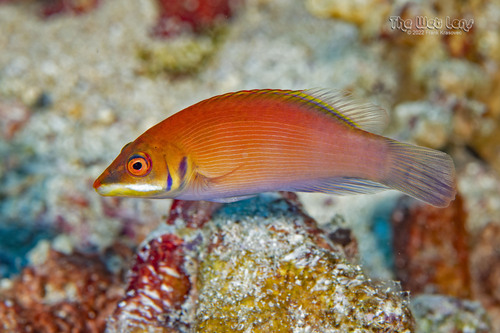
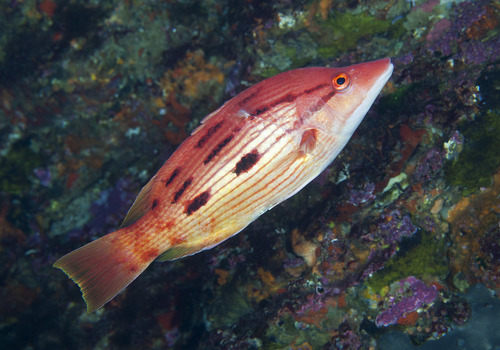
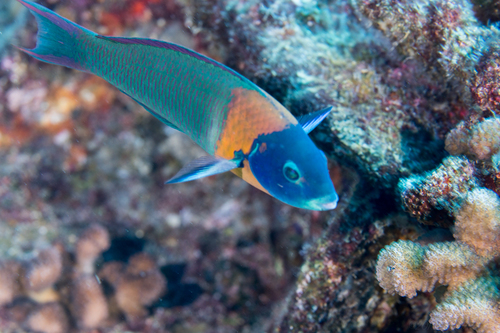
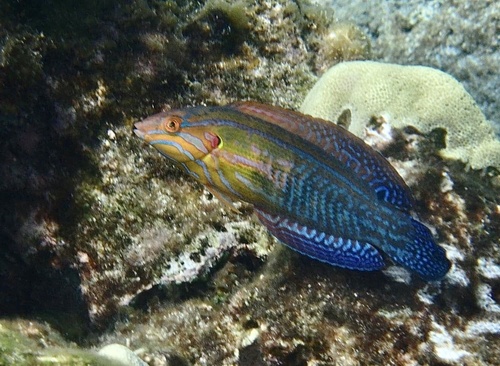
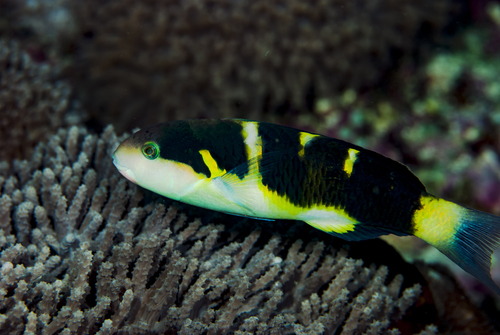
Thalassoma jansenii, commonly called Jansen's wrasse, has distinct color patterns across its life phases. In its initial phase, this wrasse is white with three black bars. The first bar covers the upper half of the head and anterior body, and bears a yellow stripe along the margin of the gill cover. The second black band runs across the dorsal fin and ends at the anus, while the third covers most of the body and the rear sections of the dorsal and anal fins. Terminal phase males have yellow coloring in the areas between the black bars. The pectoral fins of this species are bluish. Jansen's wrasse can reach a total length of 20 cm (7.9 in). Its dorsal fin has 8 spines and 13 soft rays, and its anal fin has 3 spines and 11 soft rays. Jansen's wrasse was first formally described in 1856 as Julis jansenii by Dutch zoologist and military doctor Pieter Bleeker (1819–1878), with the type locality recorded as Manado on Sulawesi. The species is named to honor Albert Jacques Frédéric Jansen (d. 1861), an administrator in the Dutch East Indies who provided the type specimen. Jansen's wrasse occurs in the Indian and Pacific Oceans, ranging from the Maldives to Fiji, north to Japan, and south to Shark Bay, Western Australia. It inhabits coral reefs and reef flats at depths between 1 and 15 metres (3.3–49.2 ft), and is not normally found at depths greater than 12 metres (39 ft). This is a carnivorous social species that lives in groups. Its diet consists of benthic invertebrates and larger animals. Like many other coral reef wrasses, Jansen's wrasse swims actively over reefs using only its pectoral fins to generate thrust, a movement pattern called labriform locomotion. This species is a protogynous hermaphrodite: when no males are available, some females change sex to become males. Individuals of this species have also been observed acting as cleaner fish.