About Thalassia testudinum Banks & Sol. ex K.D.Koenig
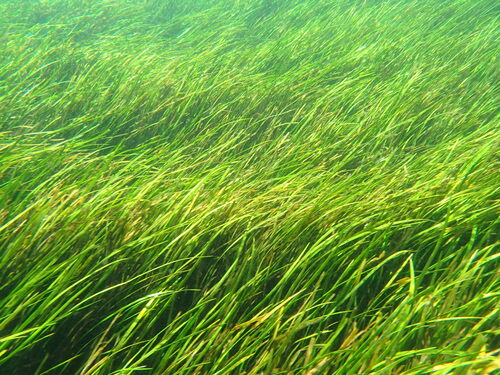
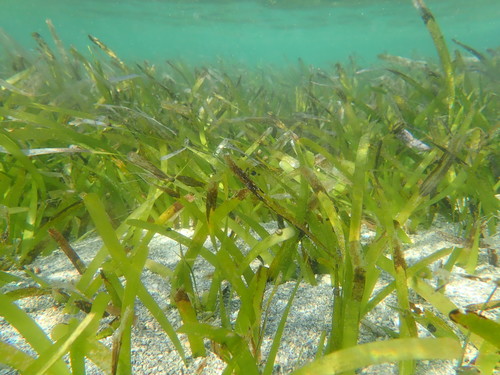
Thalassia testudinum, commonly known as turtle grass, is a perennial seagrass that grows from a long, jointed rhizome. The rhizome is typically buried 5 to 10 cm (2 to 4 in) deep in the seabed substrate, and may reach depths of up to 25 cm (9.8 in) in exceptional cases. Some rhizome nodes are leafless, while others grow a tuft of several erect, linear leaf blades. The blades can reach up to 30 centimetres (12 in) long and 2 cm (0.8 in) wide, and have rounded tips. Its flowers grow on short stalks from the leaf axils, are greenish-white, sometimes tinged with pink, and develop into seed pods after flowering.
Turtle grass forms extensive meadows in calm shallow waters across the Caribbean Sea, the Gulf of Mexico, and northward to Cape Canaveral, Florida. It grows well on muddy sand, coarse sandy, and clayey seabeds, particularly those with calcareous content. The species favors high-salinity, low-turbidity waters such as calm lagoons. It cannot grow in fresh water, but limited growth is possible at a salinity of 10 parts per thousand; its preferred salinity range is 25 to 38.5 parts per thousand, with a preferred temperature range of 20 to 30 °C (68 to 86 °F). It occurs from the low-tide mark down to depths of 30 metres (98 ft), with maximum depth depending on water clarity. It often grows in mixed meadows with other seagrasses, where it acts as the climax species. Its known temporal range extends from the Middle Eocene to the present day.
Turtle grass can reproduce through both vegetative and sexual reproduction. Its primary method of propagation is via extension of its underground rhizome. Increasing rhizome length produces asexual ramets: clonal colonies that are genetic replicates of the original parent plant. While asexual propagation increases the size of the turtle grass meadow, extensive asexual reproduction reduces genetic diversity, leaving meadows at severe risk during disease outbreaks. Mechanically damaged rhizomes, such as those cut by boat propellers, cannot regrow from their cut ends, which can leave bare gaps in the turtle grass meadow.
Sexual reproduction occurs through the production of underwater flowers and pollination in water. Turtle grass is dioecious, meaning male and female flowers are borne on separate individual plants, with each plant producing only single-sex imperfect flowers. Sexual reproduction typically occurs from April to July depending on location, though flowering has also been observed during warm winters in Tampa Bay, Florida. Each small flower is borne on a peduncle: female plants usually produce one green flower, while male plants most often produce three to five pink or white flowers. When male flowers reach full maturity at night, they release mucilaginous pollen into the water column, and female flowers open the following morning.
Pollination happens through two methods: hydrophily and biotic pollination. In hydrophilic pollination, tides or water currents carry pollen grains through the water column to deposit them on open female flowers. More recent underwater camera observations have shown crustaceans, polychaetes, and amphipods are attracted to open male flowers, drawn by the carbohydrate-rich mucilage that holds pollen. As these invertebrates feed on the mucilage, excess pollen grains stick to their bodies. They then move between flowers while feeding, carrying pollen from male to female flowers. If fertilization occurs, seeds begin to develop after 2 to 4 weeks. Female fruits develop into green capsules around 20–25 mm in diameter, which can hold 1 to 6 small seeds. After approximately 8 weeks of growth, the fruit undergoes dehiscence, releasing neutrally buoyant seeds into the water. Significant water turbulence may break immature fruits off their peduncles, and these buoyant fruits continue developing while being transported by wind, currents, and tides. Eventually the fruit splits open to release negatively buoyant seedlings into a new area. If environmental conditions are favorable in the new location, the seedling will begin growing, allowing viviparous seedlings to establish new patches of seagrass.
Turtle grass and other seagrasses form meadows that serve as important habitats and feeding grounds. Common associated seagrass species are Halophila engelmannii and Syringodium filiforme. Many epiphytes grow on the grass, and algae, diatoms, and bacterial films cover the surface of the leaf blades. The grass itself is eaten by turtles, herbivorous parrotfish, surgeonfish, and sea urchins, while the leaf surface films are a food source for many small invertebrates. Decaying turtle grass leaves produce most of the detritus found in meadow areas. Periodic dieback episodes have been recorded for this species in Florida Bay; a 1987 dieback killed a large proportion of local populations, and increased sedimentation and greater epiphyte growth on surviving plants triggered a secondary dieback event. The affected areas have since been reseeded and planted with rhizomes, and have recovered. Overall, the global population of this grass is stable. Rhizomatous green algae of the genus Caulerpa often grow among the grass, and many animals live in the seagrass meadows, including bivalves and other mollusks, polychaete worms, amphipods, juvenile fish which hide among the leaf blades, sea urchins, crabs, and caridean shrimps.