About Thalasseus sandvicensis (Latham, 1787)
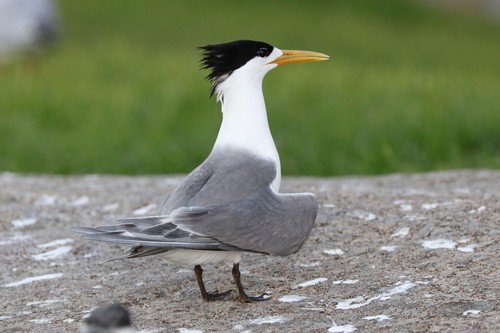
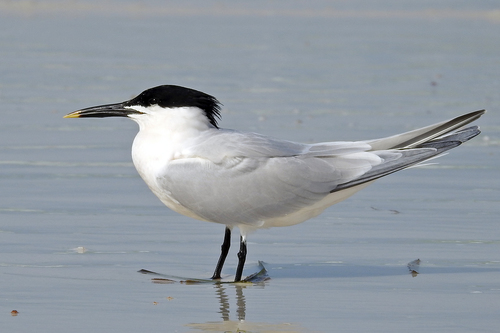
Sandwich tern, Thalasseus sandvicensis (Latham, 1787), is a medium-large tern species. It measures 36–41 cm (14–16 in) in length, has a wingspan of 95–105 cm (37–41 in), and weighs between 200–300 g. Males average slightly heavier than females, but there is extensive overlap in weight between the sexes. This tern has a thin, sharp black bill with a yellow tip, and short black legs. Its upper wings are pale grey and its underparts are white, making the bird appear very pale in flight. The primary flight feathers darken during the summer. After post-breeding moult in late summer (July-August), adult Sandwich terns develop an extensively white forehead in autumn and winter. They regain their black forehead during spring moult between February and March. Juvenile Sandwich terns have dark-tipped tails, an overall blackish bill that lacks the yellow tip of adults, though it may sometimes appear yellowish at the base. They also have a scaly pattern on the back and wings. This scaly appearance resembles juvenile roseate terns, but juvenile Sandwich terns have less black on the crown. Cabot's tern is the species most similar to Sandwich tern, and both share a black bill with a yellow tip. However, Cabot's tern can be distinguished by its noticeably stouter bill, different moult timing that sees it lose its black forehead earlier in the summer, and different primary feather colouration. Sandwich tern has a broad white margin on the inner web of its primary feathers, while this margin is grey in Cabot's tern. This white fringe on Sandwich tern primaries wears away through the summer, creating a distinctive 'hook tip' by late summer. Cabot's tern primaries stay symmetrical because their grey inner web is more resistant to wear. Juvenile Cabot's terns also generally lack the scaly body pattern of juvenile Sandwich terns, and are plainer grey, though plain grey juvenile Cabot's terns can be confused with first-winter plumage Sandwich terns. Lesser crested terns and elegant terns differ from Sandwich tern by having entirely orange bills. Additionally, lesser crested tern has a grey rump and a marginally stouter bill, while elegant tern has a slightly longer, more slender bill. Chinese crested tern is also similar in appearance to Sandwich tern, but it has reversed bill colouration: a yellow bill with a black tip. The two species do not have overlapping ranges, so confusion is unlikely. The Sandwich tern is a very vocal species, with a characteristic loud grating call transcribed as kear-ik or kerr ink. It is unlikely to be confused with other tern species across most of its range.