About Thalasseus bergii (M.H.K.Lichtenstein, 1823)
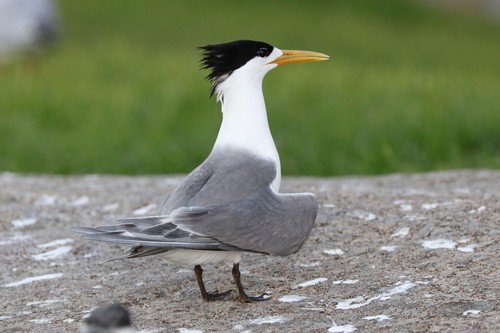
The greater crested tern, Thalasseus bergii, is a large tern with a long 5.4–6.5 cm (2.1–2.6 in) yellow bill, black legs, and a glossy black crest that is noticeably shaggy at the rear. Breeding adults of the nominate subspecies T. b. bergii measure 46–49 cm (18–19.5 in) in length, with a 125–130 cm (49–51 in) wingspan, and weigh 325–397 grams (11.5–14.0 oz). Their forehead and underparts are white, while their back and inner wings are dusky-grey. In winter, the upperparts plumage fades to a paler grey, and the crown of the head turns white, merging at the rear into a speckled black crest and mask. Adult birds of both sexes have identical appearance, but juvenile birds are distinct: they have a head pattern matching that of a winter adult, and strongly patterned upperparts marked with grey, brown, and white, with dark bars visible on closed wings. After moulting, young terns resemble adults, but retain a variegated wing pattern with a dark bar on the inner flight feathers.
The northern subspecies T. b. velox and T. b. thalassinus develop breeding plumage between May and September or October, while the two southern African subspecies are in breeding plumage from December to April. For T. b. cristatus, moult timing depends on location: birds from Australia and Oceania are in breeding plumage from September to around April, while populations in Thailand, China and Sulawesi have breeding plumage from February to June or July.
The royal tern is similar in size to the greater crested tern, but has a heavier body structure, broader wings, a paler back and a blunter, more orange bill. The greater crested tern often associates with the lesser crested tern, but is 25% larger than the lesser crested tern, with a proportionately longer bill, longer and heavier head, and bulkier body. Lesser crested terns have an orange-tinted bill, and their immature plumage is much less variegated than that of immature greater crested terns.
The greater crested tern is highly vocal, especially at its breeding grounds. Its territorial advertising call is a loud, raucous, crow-like kerrak. Other calls include a korrkorrkorr given at the nest by anxious or excited birds, and a hard wep wep given during flight.
Greater crested terns occur in tropical and warm temperate coastal areas of the Old World, ranging from South Africa around the Indian Ocean to the Pacific and Australia. The subspecies T. b. bergii (including the doubtfully distinct T. b. enigma) breeds in southern Africa from Namibia to Tanzania, and possibly on islands around Madagascar. There is a gap in the species' breeding distribution until T. b. velox is encountered in Somalia, the Red Sea, and the Persian Gulf, with another gap further east in southern India. The subspecies T. b. thalassinus breeds on many islands in the Indian Ocean, including Aldabra and Etoile in the Seychelles, the Chagos Archipelago, and Rodrigues. In the Pacific Ocean, colonies of T. b. cristatus are found on numerous Pacific islands, including Kiribati, Fiji, Tonga, the Society Islands and the Tuamotus, and more broadly on islets off the coasts of China, Taiwan, the Philippines, Indonesia, New Guinea, and Australia, extending south to Tasmania.
Nests of the greater crested tern are placed on low‑lying sandy, rocky, or coral islands, sometimes amongst stunted shrubs, and often with no shelter at all. When not breeding, greater crested terns roost or rest on open shores, and less often on boats, pilings, harbour buildings and raised salt mounds in lagoons. They are rarely seen on tidal creeks or inland waters.
All populations of greater crested tern disperse after breeding. When Southern African birds leave colonies in Namibia and Western Cape Province, most adults move east to the Indian Ocean coastline of South Africa. Many young birds also travel east, sometimes more than 2,000 km (1,200 mi), while others move northwards along the western coast. T. b. thalassinus winters on the east African coast north to Kenya and Somalia, and may travel as far south as Durban. Populations of T. b. velox that breed from the Persian Gulf eastwards appear to be sedentary or dispersive rather than truly migratory, but populations breeding in the Red Sea winter south along the east African coast to Kenya. T. b. cristatus mostly stays within 400 km (250 mi) of its colonies, but some individuals wander up to around 1,000 km (620 mi). This species has been recorded as a vagrant in Hawaii, New Zealand, North Korea, Jordan, and Israel. In India, the greater crested tern is protected within the PM Sayeed Marine Birds Conservation Reserve.