About Thalasseus bengalensis (R.Lesson, 1831)
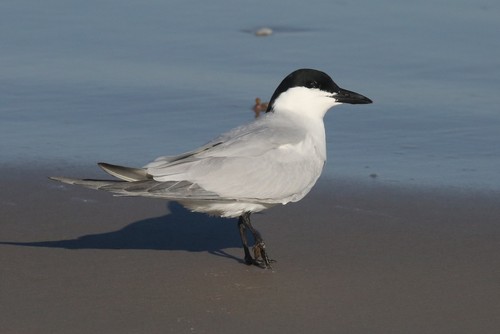
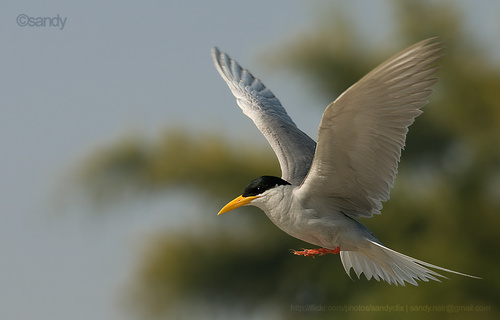
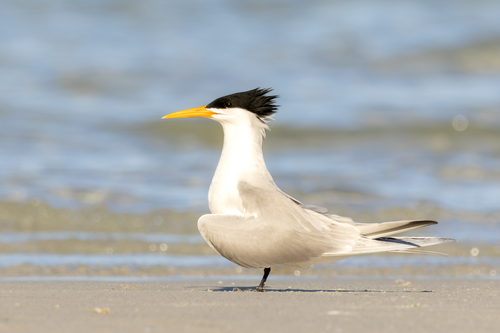
Lesser crested tern, with the scientific name Thalasseus bengalensis (R.Lesson, 1831), is a medium-large tern. It measures 35–43 cm in length, has a wingspan of 88–105 cm, and weighs between 185–242 g. It is very similar in size and general appearance to its three very close relatives: the Sandwich tern, Elegant tern, and Chinese crested tern. Summer adults have a black cap, black legs, and a long sharp orange bill. Their upperwings, rump, and central tail feathers are grey, and their underparts are white. The primary flight feathers darken over the summer. In winter, the forehead becomes white. The call is a loud grating noise, just like the call of the Sandwich tern. The grey rump is a useful identification feature in flight that sets this species apart from related species. The Elegant tern also differs from the lesser crested tern in having a slightly longer, more slender bill. Chinese crested terns differ in having a black tip to the bill, while Sandwich terns have a black bill with a yellow tip. Juvenile lesser crested terns resemble juvenile Sandwich terns, but have a yellow-orange bill, are paler overall, and only have faint dark crescents on the mantle feathers. Within this species' range, there are two other orange-billed terns: the West African crested tern and the Greater crested tern. Both are larger and have stouter bills than the lesser crested tern. The West African crested tern also has a white rump and tail, while the Greater crested tern (which shares the grey rump with the lesser crested tern) is darker overall on its upper side and has a yellower to greenish-yellow bill. Like all Thalasseus terns, the lesser crested tern feeds by plunge-diving for fish, usually in saline environments. It typically dives directly, rather than using the "stepped-hover" approach favored by the Arctic tern. As part of the species' courtship display, males offer fish to females. This species breeds in dense colonies on coasts and islands. It nests in a scrape dug into the ground and lays one to two eggs, rarely three. Its nesting behavior is very similar to that of Sandwich terns: it avoids predators by nesting in very dense colonies, and for the subspecies T. b. emigratus at least, it also nests in late summer when predatory yellow-legged gulls have finished breeding and left the nesting area. This species breeds in subtropical coastal regions across most of its range, mainly from the Red Sea across the Indian Ocean to the western Pacific, and Australia. It has a significant breeding population on the southern coast of the Mediterranean, on two islands off the Libyan coast. It is an occasional vagrant to Europe, where pure and mixed pairs (with Sandwich terns) have been recorded breeding. Australian birds are probably non-migratory, while other populations are migratory and winter as far south as South Africa.