About Thalassarche salvini (Rothschild, 1893)
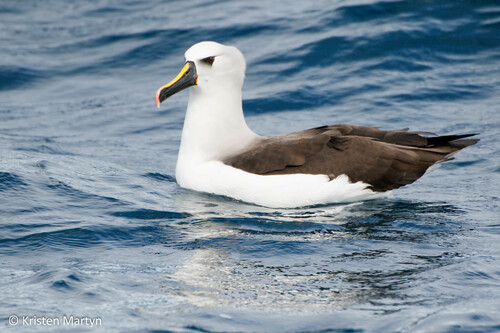
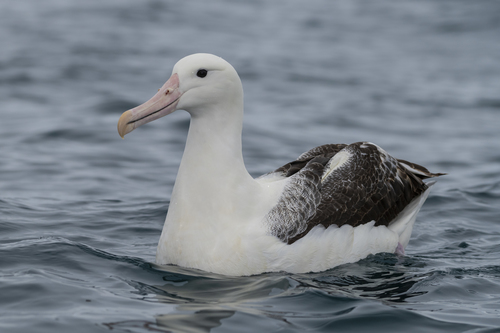
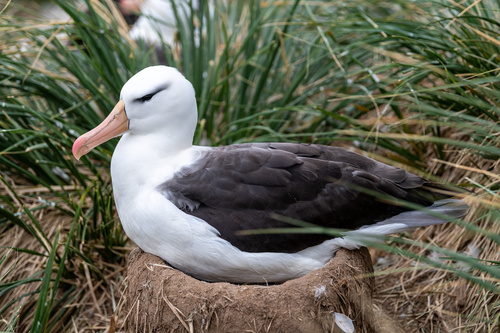
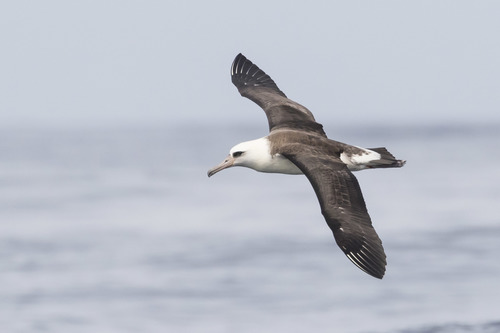
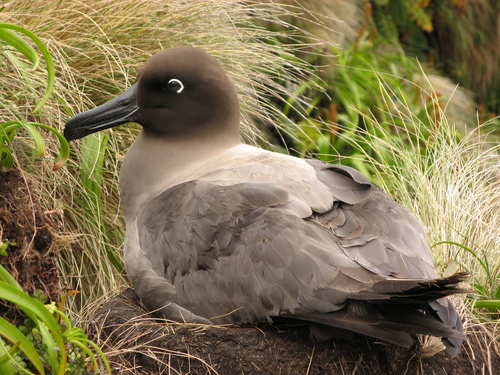
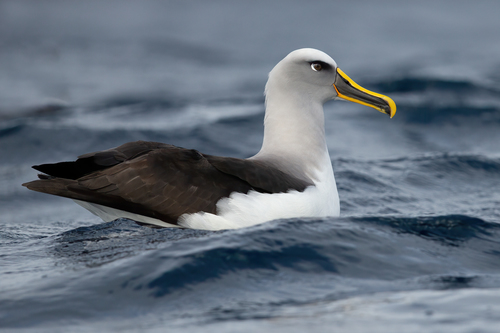
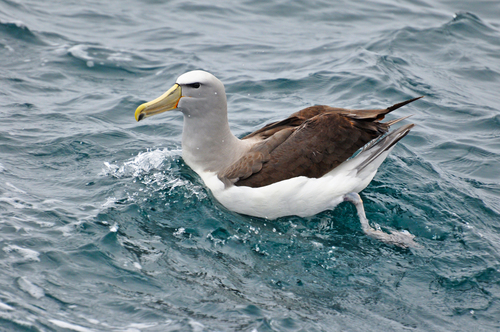
Salvin's albatross, with the scientific name Thalassarche salvini (Rothschild, 1893), measures approximately 90 cm (35 in) in body length and 2.56 m (8.4 ft) across the wings. It weighs between 3.3–4.9 kg (7.3–10.8 lb), and alongside the shy albatross, it is the largest species in the mollymawk, or small albatross, group. Adult Salvin's albatrosses have a silver-grey crown, grey face, upper throat, and upper mantle, and grey-black back, upperwing, and tail. They have a white rump and white underparts, with a black thumb-shaped mark on the underwing, narrow black leading and trailing edges on the wing, and black wing tips. Their bill is pale grey-green, with a pale yellow upper ridge, a bright yellow tip on the upper mandible, and a dark spot on the tip of the lower mandible. Juveniles have more extensive grey colouration across their bodies, and a blue-grey bill with black tips on both mandibles. The species can be told apart from the Chatham albatross by its larger size and grey bill, and from the shy albatross by its greyer head. However, these differences can be hard to identify at sea, which explains why this species is undercounted in at-sea surveys. Salvin's albatross breeds in colonies on three separate groups of islands in the Southern Ocean: Île des Pingouins in the Crozet Islands in the Indian Ocean, the Bounty Islands and The Snares south of New Zealand, plus The Pyramid and Forty-Fours Island of the Chatham Islands. When at sea, its range extends from South Africa across to Australia, and as far east as the coast of South America. In the early 2000s, a fisheries observer sighted an adult Salvin's albatross 700–800 miles north of the Hawaiian islands, and this sighting was confirmed by a photograph. Salvin's albatross breeds mainly on small rocky islands with little vegetation. It builds a pedestal-shaped nest from mud, feathers, and bird bones. A single egg is laid in September, and incubated by both parents until early November. The chicks fledge approximately 4 months after hatching.