About Thalassarche cauta (Gould, 1841)
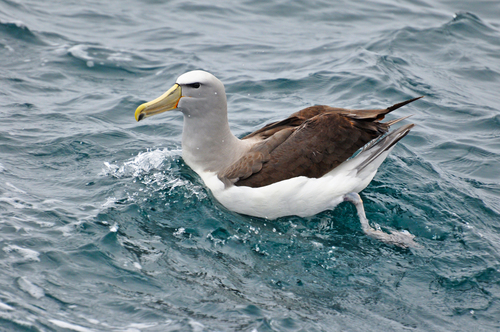
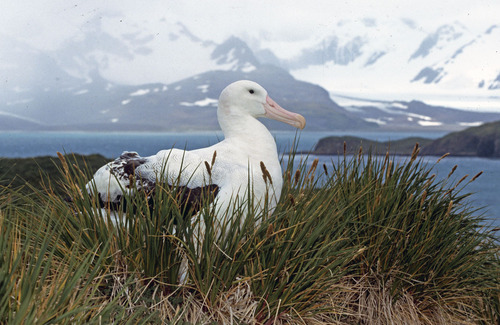
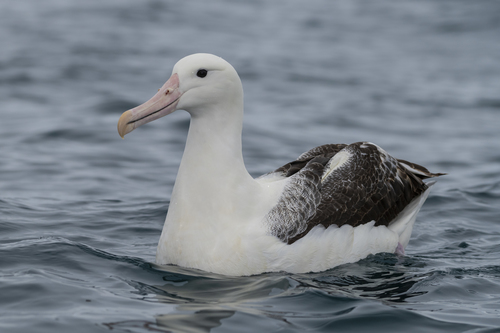
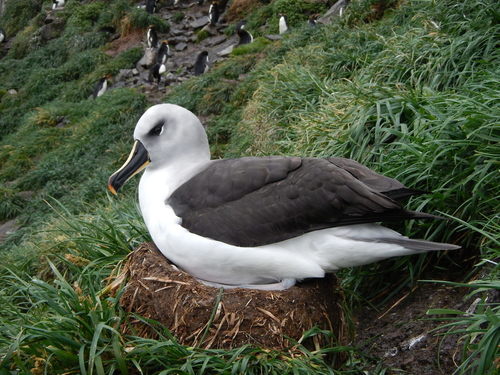
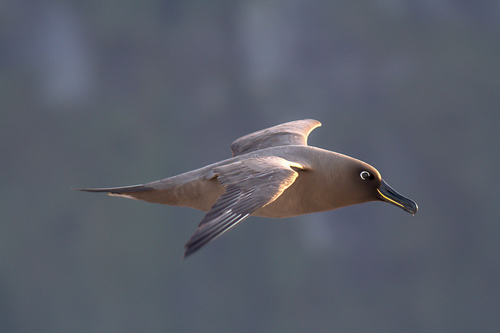
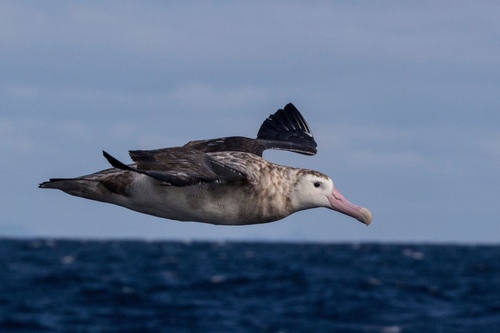
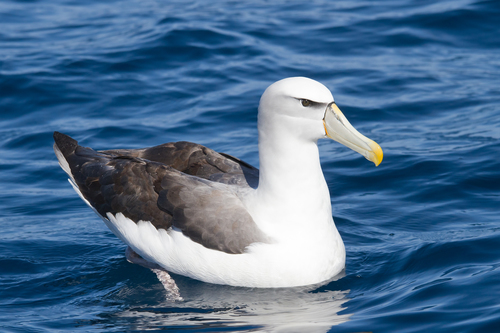
The shy albatross, with the scientific name Thalassarche cauta (Gould, 1841), averages 90 to 99 cm (35–39 in) in length, 220 to 256 cm (87–101 in) in wingspan, and 4.1 kg (9.0 lb) in weight. Alongside the similarly sized Salvin's albatross, its sister species, the shy albatross is considered the largest of the mollymawks, also called small albatrosses. This bird has plumage in black, white and slate-grey, and features the characteristic black thumb mark at the base of the leading edge of the underwing. Adult shy albatrosses have a white forehead and crown, which is bordered along its lower edge by a dark eyebrow and a pale grey face. Their mantle, tail and upperwing are grey-black, and the rest of their body is white. Their bill is grey-yellow, with a prominent yellow culmen and a yellow tip. This species has an average lifespan of about 60 years. As a breeding bird, the shy albatross is endemic to Australia. It breeds on three island colonies off Tasmania in the southern Indian Ocean: Albatross Island, Pedra Branca, and the Mewstone. It is the only albatross species that is endemic to Australia. Juvenile shy albatrosses have been recorded flying as far as South Africa. Outside of the breeding season, non-breeding individuals can be found across the entire southern oceans. It is difficult to determine more specific range details, because the shy albatross closely resembles other related species. It is sometimes observed off the Pacific coast of the United States. Shy albatrosses breed on rocky islands. They build mounded nests from soil, grass, and roots, and lay one egg in the second half of September.