About Teucrium racemosum R.Br.
Teucrium racemosum R.Br. is a perennial herb that reaches a height between 15 and 40 cm (5.9 and 15.7 in). It spreads via root suckering, growing new shoots around the perimeter of its original base. Thanks to this ability, colonies of this species often spread to a diameter of several metres.
Its stems are white or greyish, and are densely covered in curved hairs that lie pressed against the stem; these hairs are usually shed from the stem's ridges. The leaves are narrowly oval, densely hairy (especially on their lower surface), and typically measure 10–20 mm (0.39–0.79 in) long and 2–6 mm (0.079–0.236 in) wide. Leaf edges may be somewhat lobed, rolled under, or wavy.
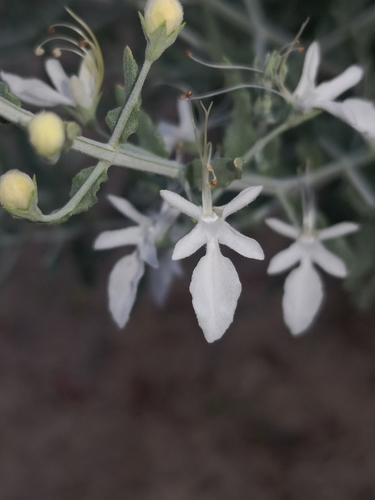
Flowers are usually borne singly in leaf axils near the ends of branches, on a pedicel 5–18 mm (0.20–0.71 in) long. The far end of the pedicel is often held horizontally, while the flower itself stands erect. The sepals are 3–6 mm (0.12–0.24 in) long, densely hairy, and fused at the base for around half their total length. Petals measure 8–14 mm (0.31–0.55 in) long, with the lower middle lobe typically 5–9 mm (0.20–0.35 in) long, and the four stamens are 8–14 mm (0.31–0.55 in) long. Flowering occurs from September to June.
This species is found in every Australian state and territory except Tasmania. It grows on floodplains, dry lake beds, and open woodlands, and is also commonly found around ephemeral lakes or in disturbed areas.
Like many members of the Lamiaceae family, Teucrium racemosum reproduces via gynodioecy, a breeding system where populations contain both male (female-only) and hermaphroditic plants. Gynodioecy arises from a genetic mutation that stops hermaphroditic plants from producing pollen, while leaving their female reproductive structures fully functional. In this species, female plants usually have much smaller anthers (the pollen-producing part of the stamen) and produce little to no pollen, while hermaphroditic flowers have fully functional male and female reproductive parts. Female plants of this species often produce more seeds, as well as healthier, higher quality seeds than hermaphroditic plants, a pattern thought to stem from extra energy available to plants that do not produce pollen. Gynodioecy is an extremely rare reproductive strategy among plants, with only 1% of all plant species exhibiting a gynodioecious mating system, including Teucrium racemosum.