About Teucrium corymbosum R.Br.
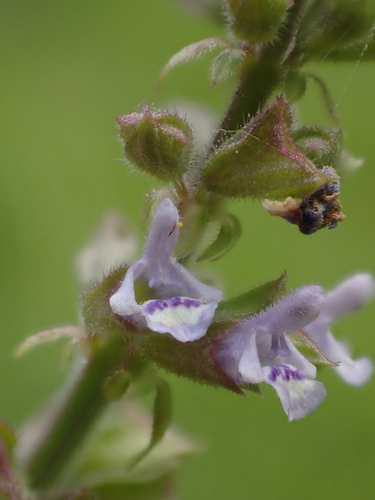
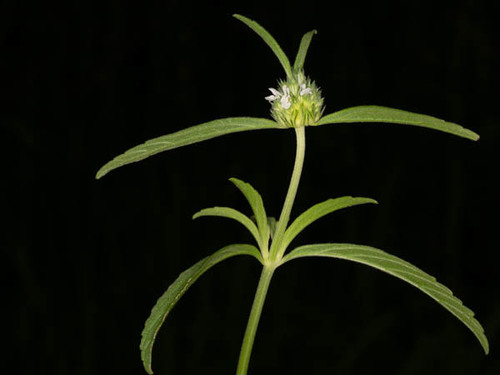
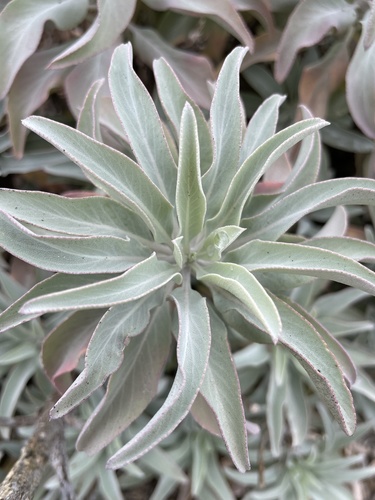
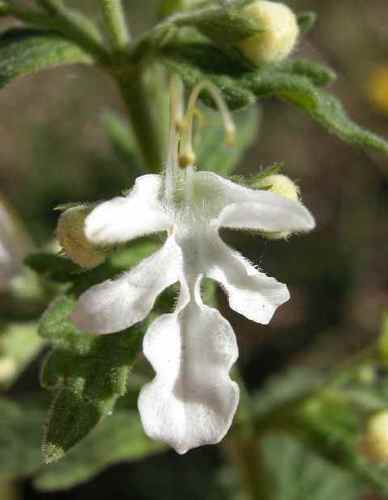
Teucrium corymbosum R.Br., commonly called forest germander, is a perennial herb or subshrub that usually grows up to 1.5 metres (4 feet 11 inches) tall. Its stems are square in cross-section, and are densely covered with greyish hairs and sessile glands. The leaves are between narrow egg-shaped and lance-shaped, 20 to 110 millimetres (0.79 to 4.33 inches) long and 6 to 20 millimetres (0.24 to 0.79 inches) wide, attached to stems by a petiole up to 14 millimetres (0.55 inches) long. Leaf edges are toothed, except for the form found in the Warrumbungles, and the lower leaf surface is hairy. Flowers grow in clusters of 5 to 10 in leaf axils, with each flower sitting on a pedicel 3 to 10 millimetres (0.12 to 0.39 inches) long. The sepals are 3 to 5 millimetres (0.12 to 0.20 inches) long, joined at their lower half, and have sessile glands and hairs on the outer surface. Petals are white, 8 to 12 millimetres (0.31 to 0.47 inches) long, and the lowest lobe measures 8 to 9 millimetres (0.31 to 0.35 inches) long. Flowering takes place from August to April, and the fruit is a schizocarp about 3 millimetres (0.12 inches) long. Forest germander grows in forest, dry creek beds, shaded areas, and partially cleared areas, and is often found on rocky ground. It is distributed in New Guinea, Queensland, eastern New South Wales, Victoria, Tasmania, and south-eastern South Australia.