About Teuchestes fossor (Linnaeus, 1758)
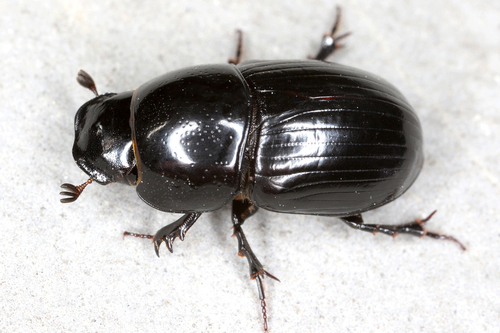
Teuchestes fossor is a species of dung beetle. It is native to the Palaearctic, but became widespread in North America after accidental introduction and naturalisation during European settlement. Both adults and larvae of this species are coprophagous. They differ in resource use: adults feed on the liquid fraction of herbivore dung, while larvae feed on the fibrous fraction. This species can be easily collected from the dung of livestock and other large mammals. It is known to support a number of key ecosystem services in cattle pastures. Teuchestes fossor was formerly classified as a member of the genus Aphodius. Like other species in its current genus, this dung beetle is classified as a 'dwelling' or 'endocoprid' species. Instead of rolling dung balls, beetles of this species feed and reproduce within mammalian dung. Adult beetles preferentially colonise older cattle dung, and adult individuals move between multiple dung pats. Eggs are laid singly beneath the dung crust and in the underlying soil. Adult beetles typically occur at low densities in mated pairs. Pheromones are thought to mediate both mate-finding and anti-aggregation for this species. Despite being found in open environments such as pastures, it is sensitive to desiccation, and larvae experience significant mortality when in highly exposed environments.