About Tettigonia viridissima (Linnaeus, 1758)
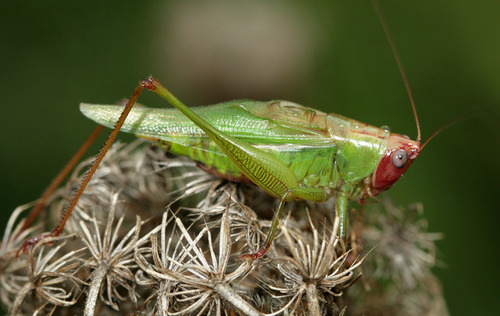
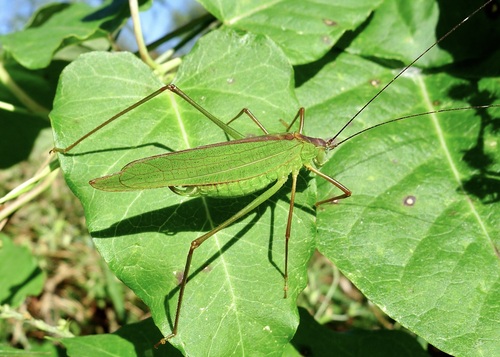
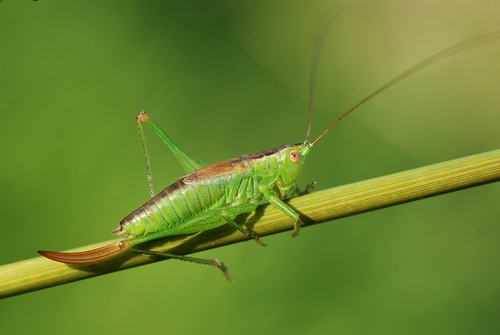
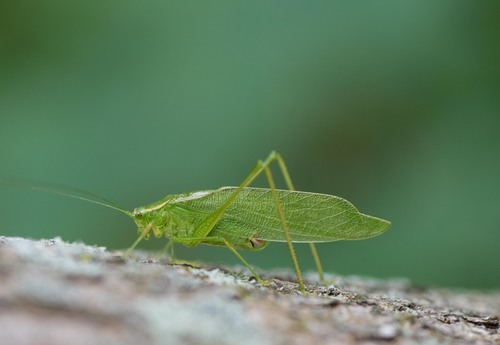
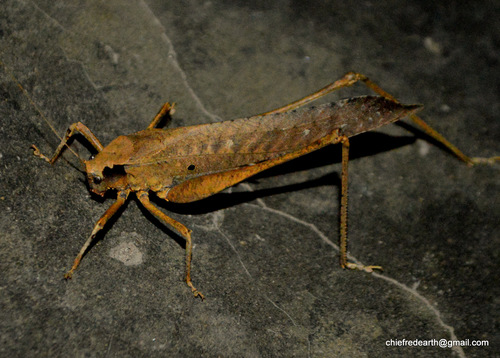
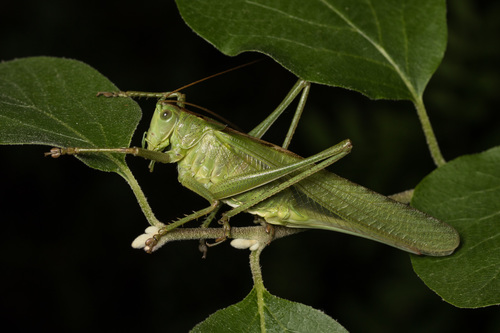
Adult male Tettigonia viridissima reach 28–36 mm (1.1–1.4 in) in length, while adult females reach 32–42 mm (1.3–1.7 in). Most individuals are entirely green, though some specimens are fully yellowish or have yellow legs. A rust-colored band runs along the top of the body, and the male stridulation organ is typically brown. This species is marked by very long, thin antennae that can grow up to three times the length of the body; this feature distinguishes it from grasshoppers, which always have short antennae. It can be confused with two similar species: Tettigonia cantans, whose wings are one centimeter shorter than the ovipositor, and Tettigonia caudata, whose hind femurs have prominent black spines. The general morphology of males and females is very similar, but females have an egg-laying organ called an ovipositor that reaches 23–32 mm (0.91–1.26 in) in length. The ovipositor extends to the end of the elytra and curves slightly downward. Larvae are green, while adult imago have a thin brown longitudinal stripe on their back. The ovipositor becomes visible starting at the fifth larval stage, and wings develop in both sexes starting at the sixth larval stage. This species is found across most of Europe, the eastern Palearctic realm, the Near East, and North Africa. It inhabits meadows, grasslands, and prairies, and is occasionally found in gardens, at elevations up to 1,800 metres (5,900 ft) above sea level.