About Tetronarce nobiliana (Bonaparte, 1835)
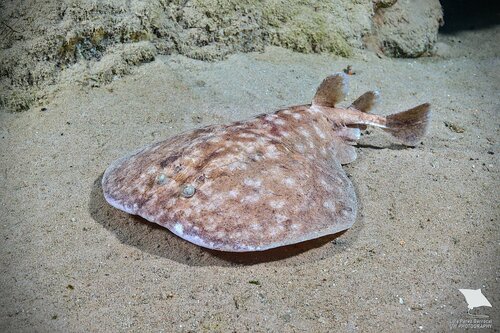
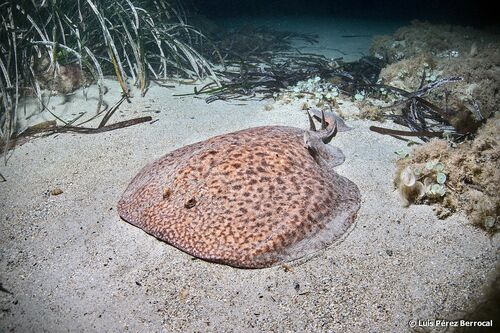
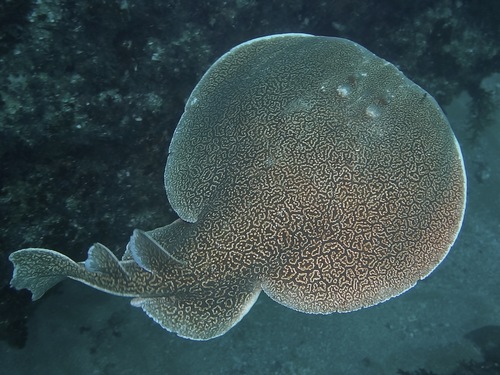
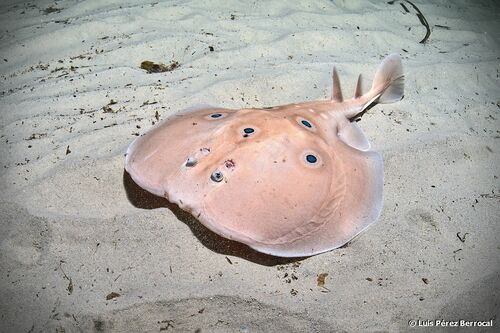
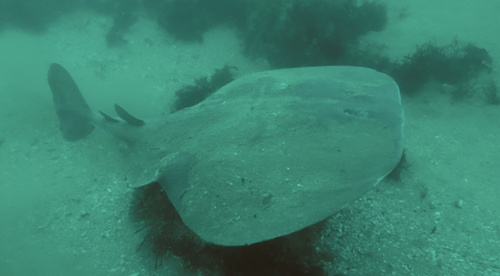
This species is scientifically named Tetronarce nobiliana (Bonaparte, 1835), commonly known as the Atlantic torpedo. Its pectoral fin disc is nearly circular, 1.2 times wider than it is long, with a thick, almost straight front margin. It has small eyes, followed by much larger spiracles that lack papillae on their inner rims. The nostrils lie close to the mouth, with a skin flap between them that is three times as wide as long and has a sinuous rear margin. The mouth is wide and arched, with prominent furrows at the corners. Its teeth are pointed, and tooth row count increases with age, ranging from 38 rows in juveniles to 66 rows in adults, with the first several tooth series being functional. The gill slits are small, and the first and fifth pairs are shorter than the other pairs. The pelvic fins are rounded, and their front portions are slightly overlapped by the pectoral fin disc. The first dorsal fin is triangular with a rounded apex, and it originates in front of the pelvic fin insertions. The second dorsal fin is only one-half to two-thirds the size of the first, and the distance between the two dorsal fins is shorter than the length of the first dorsal fin base. The stout tail makes up about one-third of the ray's total length, ending in a caudal fin shaped like an equilateral triangle with slightly convex margins. The skin is soft and completely lacks dermal denticles, or scales. Dorsal coloration is plain dark brown to gray, sometimes with a few diffuse spots, and darkens at the fin margins; the underside is white, with dark fin margins. The Atlantic torpedo is the largest electric ray. It can reach 1.8 m (6 ft) long and weigh 90 kg (200 lb), but a length of 0.6–1.5 m (2.0–4.9 ft) and weight of 14 kg (30 lb) are more typical. Females grow to a larger size than males.
The Atlantic torpedo is widely distributed in cool waters on both sides of the Atlantic Ocean. In the eastern Atlantic, it occurs from northern Scotland to the Gulf of Guinea, including all of the Mediterranean Sea (but not the Black Sea), the Azores, and Madeira, and also from Namibia to western South Africa. In the western Atlantic, it ranges from southern Nova Scotia to Venezuela and Brazil. It is rare in the North Sea, the Mediterranean, and south of North Carolina. Tetronarce is represented by only this single species in the Mediterranean Sea, where it can be easily identified by its characteristic dark blue pattern. Juvenile Atlantic torpedoes are primarily bottom-dwelling, and are usually found at depths of 10–50 m (33–164 ft) over sandy or muddy flats, or near coral reefs. As they mature, they become more pelagic, and adults are often found swimming in the open ocean. This species has been recorded from the surface down to a depth of 800 m (2,600 ft); in the Mediterranean, it is most common at depths of 200–500 m (660–1,640 ft). It is reported to make long migratory movements.
Like other members of its family, the Atlantic torpedo can produce a powerful electric shock from a pair of kidney-shaped electric organs located in its disc, used for both attack and defense. These organs make up one-sixth of the ray's total weight, and contain around half a million jelly-filled "electric plates" arranged in an average of 1,025–1,083 vertical hexagonal columns, which are visible beneath the skin. These columns act like batteries connected in series, allowing a large, well-fed, rested Atlantic torpedo to produce up to one kilowatt of electricity at 170–220 volts. Electric organ discharges happen in a series, or train, of closely spaced pulses that each last around 0.03 seconds. Trains average 12 pulses, but trains with more than 100 pulses have been recorded. The ray regularly emits these pulses even when no obvious external stimulus is present. The Atlantic torpedo is solitary by nature. It is often seen resting on or half-buried in substrate during the day, and becomes more active at night. It is large and well-defended against attack, so it is rarely preyed on by other animals. Known parasites of the Atlantic torpedo include the tapeworms Calyptrobothrium occidentale, C. minus, Grillotia microthrix, Monorygma sp., and Phyllobothrium gracile; the monogeneans Amphibdella flabolineata and Amphibdelloides maccallumi; and the copepod Eudactylina rachelae. Some accounts note that this ray can survive out of water for up to a day.