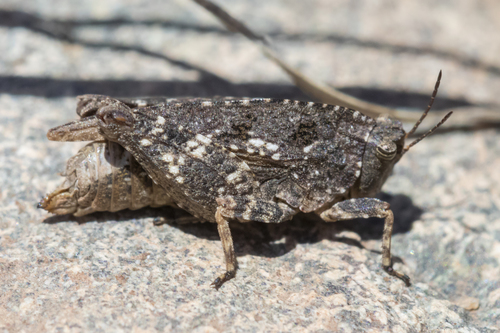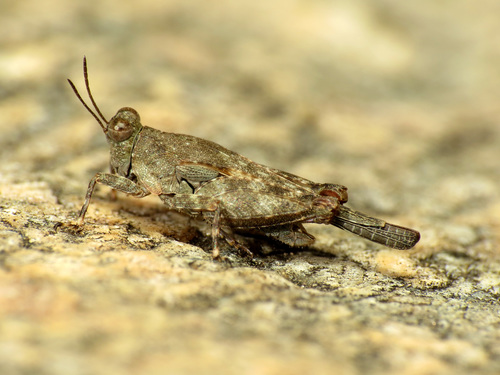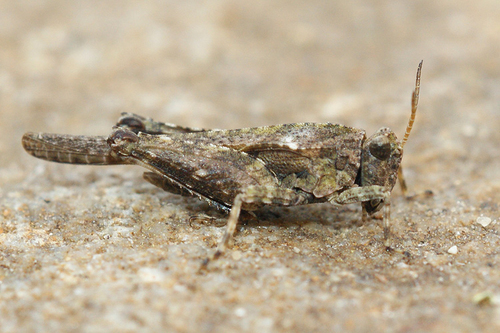
About Tetrix ceperoi (Bolívar, 1887)
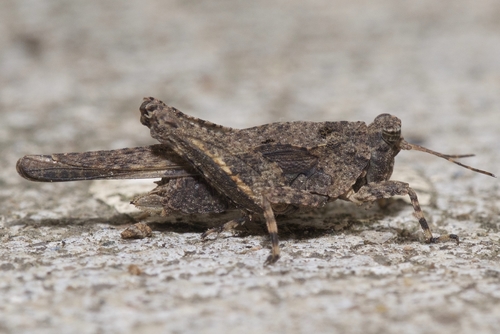
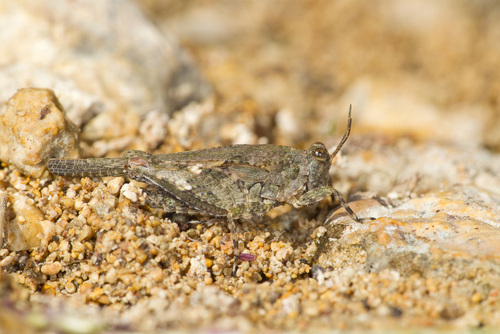
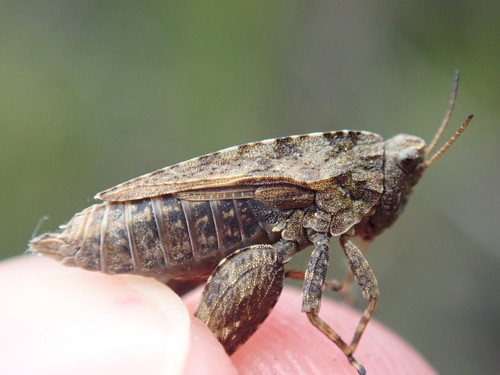
Cepero's groundhopper, with the scientific name Tetrix ceperoi (Bolívar, 1887), is a member of the Tetrigidae family and closely resembles common grasshoppers. Unlike common grasshoppers, the wings of T. ceperoi extend past its pronotum—the upper surface of the first thoracic segment. Its front wings have evolved into stunted structures, while its hind wings are well-developed and capable of flight. T. ceperoi has broad shoulders, and its narrow abdomen is covered beneath the pronotum. Adults reach an average length of around 10 millimetres (0.39 in). This species is a ground-dwelling insect with variable colouration that allows it to blend into its surroundings; this colour variability enables it to evolve colour patterns better adapted to specific habitats, giving protection from predators. T. ceperoi is diurnal, and it can hibernate during late nymphal instar stages and again as an adult. In its natural state, T. ceperoi lives in warm, damp, bare areas of land. As its original natural habitats have become threatened, the species can also now be found in coastal shore dunes, and in areas with low, open vegetation. Over evolutionary time, it has also adapted to survive in floodplains, moist dune slacks, sand pits, drainage ditches, and ponds. Adult T. ceperoi are skilled swimmers, so close proximity to large amounts of water in flooded areas does not impede their survival. The Orthoptera Species File recognizes two subspecies of T. ceperoi with documented distributions: T. ceperoi ceperoi is found along the coasts of the West Mediterranean area, Central Europe, Germany, Southern England, and South Wales; T. ceperoi chinensis has been recorded (likely incompletely) from eastern China and Thailand. The little-understood habitat preferences of T. ceperoi have been the subject of recent research. Hochkirch et al. studied reproductive interference between T. ceperoi and its close relative T. subulata, which shares a geographic range with T. ceperoi. While similar species that share similar habitats can coexist, this often occurs at the cost of eventual displacement of one species by the other, which leaves the displaced species with lower fitness. Intense competition typically occurs between the two species before displacement happens, and competition can occur in two forms: resource competition and reproductive competition. Resource competition involves fighting for food or territorial locations that offer safety from predators and bad weather. Reproductive competition arises when similar species share similar mating and courting systems. Because T. ceperoi and T. subulata share similar habitat requirements, they overlap in broad geographic range, but do not co-occur at the same local sites. Previous experiments conducted in laboratories and in the wild reached conflicting conclusions about the mechanisms that allow this pattern of coexistence, so further experiments were conducted to better understand the interaction between the two species. The study had four core objectives to investigate how reproductive interference shapes the species' interaction. First, researchers observed wild groundhoppers to measure the magnitude and type of interspecific sexual interactions in natural conditions. Second, they analyzed whether the two species use different microhabitats, which could explain micro-scale spatial segregation between the species. Third, they mapped the location and abundance of each species relative to food sources to check for any patterns of segregation or aggregation. Fourth, they experimentally manipulated habitats to test whether the observed spatial distribution reflected actual microhabitat preferences. The theory of temporal segregation was immediately ruled out, because both species are diurnal. If one species were nocturnal and the other diurnal, differing activity periods would explain how they avoid reproductive interference, but this is not the case. The two species also use distinct courtship movements: T. ceperoi performs pronotal bobbing, which involves quick movement of the hind legs and the pronotum, while T. subulata simply swings its body laterally and frontally, which uses less energy than T. ceperoi's courtship behaviour. The field study was carried out in Emsland, Germany, between 10:30 and 17:00, with observations of 116 individuals conducted in 30-minute increments. Results showed that male groundhoppers, which tend to court any moving object that is approximately their size, most often attempted to court females, but these females were not limited to the male's own species, confirming that heterospecific reproductive interactions occur. From the female perspective, T. ceperoi females rejected heterospecific approaches more often than T. subulata; T. subulata females performed defensive behaviors equally against heterospecific and conspecific males. Analysis of microhabitat preferences found that T. subulata prefers areas with taller vegetation and more ground cover than T. ceperoi. Hochkirch et al. note that while both resource and reproductive competition play large roles in interspecific interaction, the costs of this competition can be offset by factors such as segregative mechanisms, dilution effects, and life history effects. Consistent with earlier work by Wertheim et al., the results show that coexistence can be explained by intraspecific aggregation, even when resources are not equally distributed between the species. Finally, the researchers concluded that the disagreement between previous lab and field results is most likely due to the small arenas used in lab experiments, which force higher rates of heterospecific interaction than occur naturally. This conclusion supports the finding from earlier studies that reproductive interference is density dependent. For Orthoptera, mating typically occurs between May and June: males of the order use mating sounds to lure females, then forcibly insert sperm directly into the female's abdomen. However, other sources note that all Tetrigidae lack tympanums and cannot stridulate, though they still perform courtship displays for females. Since T. ceperoi belongs to both Orthoptera and Tetrigidae, this is a discrepancy that requires further research to resolve. In T. ceperoi, the sperm packet deposited into the female makes up approximately 60% of the male's total body weight. This sperm packet acts as a nuptial gift from the male to the female in exchange for mating. Females can choose to accept the sperm packet and mate, or reject it and wait for a different mate. While the nuptial gift may appear to be a purely selfless act by the male to secure mating, the nutrients contained in the sperm packet provide nutrition for the female, which in turn benefits the male's offspring and increases his overall fitness, consistent with the selfish nature of most animal behaviors.